Alarm bells were today raised over the never-ending ‘bed-blocking’ crisis as the crippled NHS heads towards another winter meltdown.
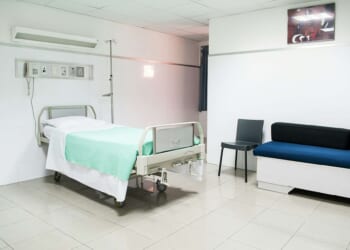
Jam-packed hospitals, battling the worst flu outbreak on record, have lost almost 13,000 beds to the legion of patients fit enough to be sent home.
But rates soar as high as one in four beds at the worst-hit hospitals, a Daily Mail investigation found.
A&E units are consequentially clogged during the busiest time of year, with patients left waiting days for a bed instead being treated in corridors.
Meanwhile, ambulance crews can be delayed from attending life-threatening 999 calls because they can’t hand patients over to casualty teams.
Ongoing strikes by doctors, orchestrated to coincide with staff holidays, have sparked fears that thousands of patients declared fit enough to be sent home but unable to be discharged could be stranded in hospitals over the festive period.
In an attempt to ‘get people home in time for Christmas’, hospital bosses have been told to make a ‘huge effort’ to discharge as many patients as possible.
The majority of bed-blocking patients are elderly, with nowhere to go because of a lack of space in social care.
But the absence of thousands of resident doctors, whose five-day walkout ends Monday, will leave staff stretched thin, potentially stopping them from carrying out the necessary checks to discharge patients who could be passed over.
NHS figures show 12,386 beds were taken up by patients declared fit for discharge, as of December 14th. The crisis is thought to cost the NHS £2.6billion-a-year, according to internal estimates.
A quarter of beds were occupied by patients fit enough to go home at four major NHS trusts – Epsom and St Helier (24.2%), Warrington and Halton (23.3%), Morecambe Bay (23.3%) and East Sussex (23.1%).
Together, these hospitals house up to 2,500 patients at any one time.
In Epsom and St Helier, 144 out of 596 beds were blocked, with 130 out of 557 in Warrington, 137 out of 589 in Morecambe Bay, and 160 out of 692 in East Sussex.
NHS chiefs this summer named delayed discharges as one of their top priorities in its own Urgent and Emergency Care Plan. Yet, the problem remains, with the toll standing at 12,331 this time last winter.
Pre-Covid, the comparable figure hovered around the 5,000 mark.
Dr Ian Higginson, president of the Royal College of Emergency Medicine, told the Mail: ‘When patients are ready to leave hospital, but cannot do so, this causes problems throughout the system.
‘In our A&E departments, we have people waiting, sometimes for days, for a bed to become free.
‘And the scale of the problem is so bad that we have resorted to looking after some of these patients in overflow areas such as hallways, a practice known as ‘corridor care’ which we know exposes them to greater risk of harm.’
He added: ‘For the people experiencing the delay in discharge themselves, we know that extended inpatient bed stays can lead to deconditioning and increase the risk of catching a hospital-born infectious disease.
‘We must end unacceptable, dangerous and sometimes deadly waits in A&Es.
‘But for that to happen, we need to see improvements to bed capacity, social care and other wrap-around services to help people leave hospital faster.
‘The government must listen to the experts, who are desperate for this to be faced head-on.’
Rory Deighton, acute and community care director at the NHS Confederation, told the Mail: ‘Pressure on social care funding, a lack of care home beds and delays to discharge packages are some of the key causes of patients being stuck in hospital beds when medically fit enough to go home.
‘These delayed discharge are a major challenge for the NHS in winter when demand surges due to flu and seasonal viruses, as they can create bottlenecks in the hospital that result in ambulance handover delays and long waits in A&E for beds.’
It comes as the Mail last week revealed that half of hospitals were experiencing their worst ever flu outbreaks for this time of the year, driven by a heavily mutated strain of influenza and damp weather, offering ‘perfect’ spreading conditions.
Nationwide, the number of flu-infected patients in hospitals has snowballed to more than 3,100.
In south-east England, flu hospitalisations were up 33 per cent, in north-east England and Yorkshire they were up 21 per cent, while in London they rose 18 per cent.
Despite signs that the flu crisis might be easing, officials have warned even worse could be to come.
In scenes reminiscent of Covid, some hospitals have reintroduced masking rules for staff, patients and visitors to thwart flu’s spread.
Schools fighting flu outbreaks have shut and pivoted back to pandemic-era ‘learning from home’.
Meanwhile, health leaders have urged anyone with the sniffles to stay home and skip Christmas parties, and MPs have called for an emergency vaccination drive.
Thousands of resident doctors – formerly known as junior doctors – began strike action at 7am Wednesday in pursuit of a 26% pay rise. Walk-outs won’t stop until 7am Monday.
Resident doctors make up half the medical workforce and includes all those below the rank of consultant.
They have already seen their pay balloon by 28.9% over the past three years and each five-day walkout costs the NHS around £300million in lost activity and overtime payments to covering consultants.
Health Secretary Wes Streeting accused the doctors of ‘abandoning patients in their hour of greatest need’ and warned the walkout was occurring at a moment of ‘maximum danger’.
Hospitals have been told they should aim to deliver 95% of usual activity during the strike, though health leaders have conceded this could be ‘more challenging due to the onset of winter pressures and rising flu’.
This latest action will be the 14th round of strikes by resident doctors since March 2023, resulting in 59 days of disruption to NHS services.
Mike Prentice, the NHS national director for emergency planning, had urged leaders in a memo to focus on reducing hospital bed occupancy ‘ahead of, during and after the industrial action, as we go into the peak holiday period’.
‘These strikes will be followed by two full working days before Christmas (and the bank holidays that follow) where huge effort will be needed to safely discharge patients and get people home in time for Christmas,’ he said.
Even before the pandemic, the bed-blocking situation prompted warnings that the knock-on effects, including having to cancel operations due to a lack of space, were killing thousands every year.
Bed-blockers, despite being well enough to leave hospital, still take up staff time and resources, needing to be washed, fed, and kept active to avoid complications like bed sores.
Elderly patients who have ongoing conditions like dementia can also wander off confused into other parts of the hospital, potentially injuring themselves by falling, so need to be monitored by staff.
People who remain in hospital longer than necessary also risk other hazards such as hospital-acquired infections, delirium and muscle wastage from lying in bed all day.
Caroline Abrahams, charity director at Age UK said: ‘The longer an older person is stuck in hospital the lower their chances of making a full recovery and maintaining their independence. Older people can be unable to leave hospital for a number of reasons, but we know that an inability to put together the right social care support for them is a major cause.
‘Sometimes this happens because there isn’t enough home care on offer in their area, or a suitable care home place, but it can also be because there isn’t the money in the system to buy the care that is actually available.
‘High vacancy rates in social care are another bugbear – one set to get worse too because the Government has decided to make it much harder for care staff from abroad to come and work here.
‘At the moment all hospitals are under increased pressures due to the high numbers of patients with severe flu. However, having many thousands of older people stuck in hospital beds when medically fit for discharge is a big problem in our country every day of the year.
‘The Government has made a strategic choice to postpone serious reform of social care until beyond the next General Election and what we’re seeing now is in large part the result of that pigeon coming home to roost.
‘The NHS and social care are two sides of the same coin and trying to improve one while leaving the other largely untouched, and struggling, is a triumph of hope over experience. We hope that when Baroness Casey produces her interim report next year on the future of social care she urges the Government to act sooner rather than later, for the benefit of us all.’
NHS England and the Department of Health have been approached for comment.