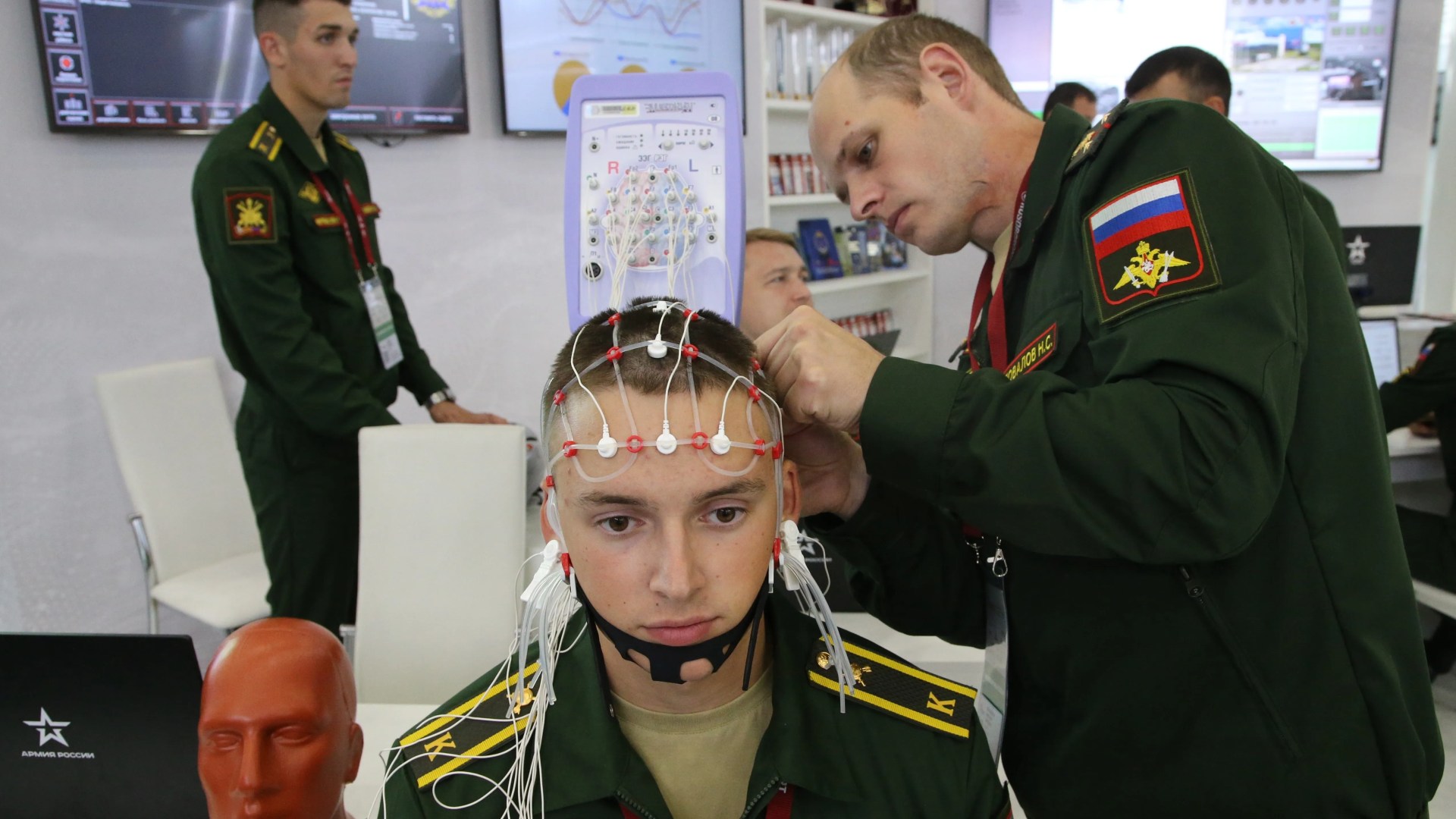
CHILLING “brain weapons” that wipe memories and incapacitate troops could unleashed in a new phase in warfare, a neuroscientist warns.
Professor Malcolm Dando suggests implanting misinformation to bend perception may no longer be confined to science fiction and could soon be a conceivable reality.
Prof Dando, who recently penned a report on the rising threat of neuro weapons, is now begging the UK to take the threat seriously.
The University of Bradford’s Department of Peace Studies professor warns that untraceable drones that spike soldiers with hallucinogens could be just around the corner.
He told The Sun: “You’ve got a history of this kind of thing, and you’ve got a massive change in science and technology.
“And the worry is: put those two things together, and we’ll end up with a new set of agents that do much more specific things than just sedate.”

Prof Dando said one Ukrainian toxicologist suggested a new threat could be the result of a perfect storm: the combined advances in neuroscience, pharmacology, and artificial intelligence.
Discussing the theory, Prof Dando, who attended the Chemical Weapons Convention meeting in The Hague, added: “This is what we used to think about in terms of chemical weapons.
“They were large-scale, very dangerous, and they were used on the battlefield.
“And what he’s saying now is, with the drone abilities, are we moving to drones able to drop very specific amounts of chemicals into particular places?
“His suggestion was that these chemicals might be specifically designed so they left no trace so that you couldn’t actually tell what happened.
“He certainly made this distinction between old-fashioned chemical weapons – large-scale, massive dumping of chemicals on the enemy – through drones, specific chemicals, small amounts, and not traceable.”
Prof Dando, who wrote his paper with colleague Dr Michael Crowley, fears Russian aggression could lead them to this technology, breaking rules along the way.
He points to a siege on a theatre in Moscow, in 2002, as a warning.
Russian forces surrounded the building where nearly 1,000 people were being held hostage.
It became a tragic, notorious incident after “fentanyl was pumped into the theatre”, and soldiers went in “shot the hostage takers, and rescued a large proportion of the hostages.”
According to reports, 130 hostages died because of the effects of the gas.
Prof Dando, who has a PhD in neuroscience, therefore believes rapidly advancing chemical agents could be used by Russia again in this way.
He added: “If you look at the history of efforts to create these kinds of weapons during the last century, in the middle of the last century, we serendipitously discovered that there were certain chemicals that could help people with mental illnesses.
“And this then led to the military trying to find means of using such chemicals for things like interrogation, and for a less lethal way of using chemical weapons on the battlefield.
“But they didn’t know enough about the brain and how it works. So eventually this all came down to efforts to produce chemicals which would produce short-term sedation.”
“But the gap between a lethal dose and a sedation dose is very small, so they killed about 120 people in the process.”
What is gene editing?
GENE editing involves inserting, deleting, modifying or replacing the DNA of a living organism
It could help protect humans against diseases and natural illness
And some believe that gene editing could give us superhuman enhancements
These could include boosted sense of smell or improved night vision
Scientists are divided over the ethics of gene editing
Editing DNA is a new and risky science that could have unknown consequences for babies
And DNA-editing could lead to societal changes, with the prospect of “designer babies” becoming real
This could lead to severe inequality – a future where only the rich can afford to modify their DNA
Perhaps most terrifying of all, Prof Dando fears a world in which memories can be altered, inserted or removed without consent.
He warns this scenario on a battlefield would be devastating.
Such technology would “abolish” the memories of soldiers on the front line to make them question who they are fighting for, and why, he added.
And the process would be a means of “untraining” military personnel, he warned.
Prof Dando said: “Soldiers wouldn’t know what to do. It takes forever to train a good soldier to operate effectively on the battlefield. You could untrain a soldier.”
He added: “So if you have an understanding of how memories work, and you know that the main communication systems within the brain are by chemicals – neurotransmitters, neuromodulators – then it’s at least conceivable that you would be able to very specifically interfere with memory.
“At the moment, our view is we can still stop this. But we have to be aware that, down the line – and you’re not talking many decades – it may be that it’s out, and we can’t stop it.”
The professor explained that Russia could “do exactly what they did in the theatre siege,” but “fentanyl can be in much more severe forms.”
The use of so-called “non-lethal” agents – those that incapacitate rather than kill everyone – is a dangerous temptation.
It immediately throws the laws of war into question regarding the protection of the victims.
Crucially, history shows this path only leads to escalation: one side won’t tolerate such an advantage for long, forcing both parties to develop increasingly dangerous substances, mirroring the deadly chemical race of the First World War, Prof Dando explained.
He continued: “There’s a great deal of material being developed amongst the military, worrying about new forms of cognitive warfare.
“Part of cognitive warfare would be direct attacks on the brain. And there’s a lot of literature, and you can find literature considering what chemicals are available now for direct attacks on the brain.”
He added: “So this is in the military literature – worries about influence operations to change people’s perception of what’s going on in the world, disinformation operations.
“And within that range of cognitive warfare, direct chemical attacks on the brain are certainly under consideration.”
The expert fears that if scientific and technological progress accelerates as expected, the ability to carry out these harmful acts will become a reality.
“AI is an enabling technology which affects everything,” Prof Dando said.
“Applied to chemistry. As I understand it, AI could be used to understand the grammar of chemistry, and could therefore be used to generate a vast range of alternative structures which could have specific effects.”
In a particularly murky scenario, Prof Dando, who will soon release a book on the topic, also questions how soldiers would behave if they come across soldiers who are not dead, but sedated.
“Can you imagine a situation in which troops have just taken over trenches, and there are lots of people lying around – maybe dead, maybe coming round – what would you expect the attacking troops to do?
“In these circumstances, the laws of war would erode as well, because my guess is that some of the people wouldn’t trust people coming out of being drugged, not picking their guns up and starting again.
“So a complete, complete mess.”
The military’s interest in weaponising psychedelics like LSD dates back to the last century, culminating in the creation of the agent BZ.
However, those early attempts failed because the effects were too random and unpredictable, Prof Dando said.
Decades of restrictive anti-drug legislation further halted both military and medical research.
But, modern neuroscience provides a far deeper understanding of how psychedelics affect the higher brain’s neuronal networks.
This advanced knowledge could soon provide the specificity needed to weaponise these agents successfully.
Prof Dando spoke after Russian president Vladimir Putin dramatically rejected a peace plan over Ukraine.
Russia launched a full-scale invasion of Ukraine in 2022, devastating its neighbour and costing millions of lives.
But Putin has blamed Europe for the breakdown in peace talks, accusing Ukraine’s allies of blocking peace by imposing too many terms deemed unacceptable by Russia.
He even warned Nato he was ready for war, saying: “Europe is preventing the US administration from achieving peace on Ukraine.
“Russia does not intend to fight Europe, but if Europe starts, we are ready right now.”
Currently in Ukraine, the prohibition on using riot control agents in warfare – mandated by Article 1 of the Chemical Weapons Convention – is being broken.
Prof Dando explained that military interest in this weapon system is nothing new and traces back to the 1950s.
He said: “The Chemical Weapons Convention is the primary means of preventing this kind of thing happening, and that has a clause in it which allows, as a peaceful purpose, law enforcement, including domestic riot control.
“So domestic riot control agents – we know exactly what they are – and those are usable as law enforcement agents. So there’s a potential gap there.”
It mirrors the First World War’s catastrophic escalation, which began with “non-lethal” agents used to clear trenches and rapidly advanced to truly lethal substances.
“At the moment the Russians are systematically breaking Article 1, using riot control agents and other agents to try to break the stalemate in the trenches,” Prof Dando added.
“And the danger is if you get leakage of that kind in the Convention, you eventually end up saying, well, there might be a better agent, a better agent, a better agent.
“So you’ve got a history, you’ve got current concerns, and added to that, you’ve got the massive advances being made in the understanding of the brain.
“These have been going on steadily over the last 50-odd years, but significantly since the initiation of national and regional state-level brain research projects.
“And these brain research projects have been specifically designed to increase technological capabilities of neuroscientists, so that they can dig into much more detail about exactly how the brain works.”
How China u0026 Russia are leading mission to unlock armies of super soldiers
AN INCREDIBLE hot mic moment among the “Axis of Evil” leaders has cast he spotlight China and Russia’s long-rumbling scheme to develop bio-hacked super-troops.
Genetically modified soldiers “bred like cattle” to kill and unable to feel pain are within the realms of possibility – and experts have revealed how the world’s most dangerous nations could get them.
China‘s Xi Jinping, Russia‘s Vladimir Putin and North Korea‘s Kim Jong Un were more concerned with their own eternal life at yesterday’s monumental Beijing parade.
The three despots discussed how biotechnology could result in humans living up to 150 – with it all picked up on an unprecedented live mic gaff.
Vlad then speculated that repeated organ transplants could let us “perhaps even achieve immortality”.
Putin warned back in 2017 that genetically-modified troops “worse than a nuclear bomb” could soon become a reality.
Since then, experts have warned that China harbours similar ambitions – and it was Xi’s empire which had the first breakthrough.
Prof Louth, of the Royal United Services Institute (RUSI), told The Sun: “The threat is obvious and real.
“Chinese money could be stealing a march on western armed forces and that is deeply concerning.
“In China, it is reasonable to assume that they are enhancing their battlefield soldiers on all these fronts.”