Early in my time as a cadet at school, a slightly sceptical friend posed a series of questions to me. “You’re a toy soldier, right, because you aren’t actually in the Army?” “Yes.” “And you’re a boy soldier, because you’re only 16?” “Yes?” “So does that make you a toy boy soldier?”
The Cadet Forces offer immense value, both to those who join and our broader society
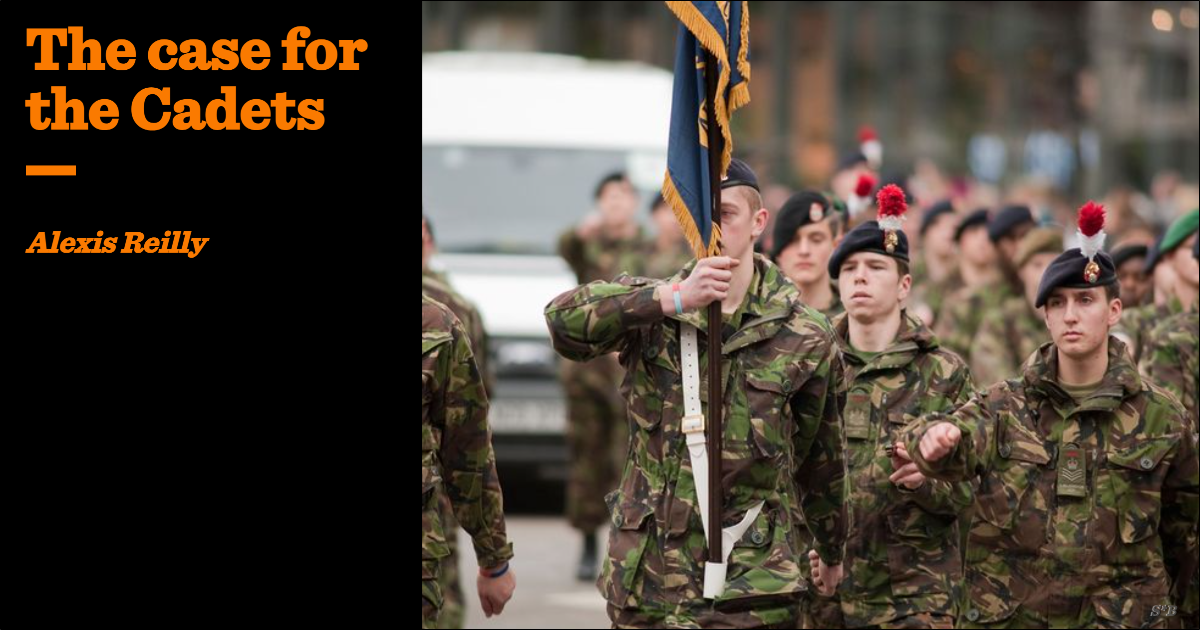
The first cadet units were formed in public schools at the request of the Secretary of State for War, who in 1859 feared home defence troops would be needed if war between France and the Austrian Empire spread to Britain. However, from little platoons grow mighty brigades and today the Cadet Forces are a modern and varied organisation consisting of the Sea Cadet Corps, Volunteer Cadet Corps, Army Cadet Force, and Air Training Corps in the community, as well as the Combined Cadet Force in schools. Indeed, today’s 138,510 cadets outnumber the 126,610 trained regular personnel in all our Armed Forces combined, even without the further 27,700 adult volunteers. The Cadet Forces offer immense value, both to those who join and our broader society. They are not, as some might presume, a strange mix of Eton Rifles boys and St Trinian’s girls.
My three years in the Combined Cadet Force were perhaps my happiest days in uniform. From the lows of the parade when we all forgot which foot to stamp when coming to attention to the highs of flying all over London in an RAF helicopter, I fondly remember learning the basics of soldiering in a safe and enjoyable environment, particularly as it got me out of lessons early on a Monday. I can laugh about surviving only 24 hours of a four-day survival exercise before being hospitalised with a self-inflicted wound, as could one of my instructors, now a Chelsea Pensioner, when I bumped into him recently at the Royal Hospital. Gratifyingly, without me my group apparently fractured and were only sustained by nearby members of the SAS and their “magic sausage roll tree”. Nothing in my regular career has yet outshone winning “best cadet” three years running, and my time came to a glorious conclusion as I led the British troops to victory in a reenactment of the Battle of Waterloo on the playing fields of Eton themselves. While some of my experiences may have been atypical, my enjoyment was not.
In our increasingly atomised society, structure and camaraderie can help pull troubled children back from the brink
While some might dispute the need to teach today’s children military skills, joining the cadets brings great advantages. These include increased social mobility, improved academic performance, enhanced mental and physical wellbeing, and the inculcation values such as courage, confidence, and self-discipline. It is not just the cadets who benefit as instructors, often not from military backgrounds, can both develop intrinsically and receive qualifications from the Cadet Vocational College. The military structure is more a means to an end than an end in of itself, by no means a Field of Mars but rather a proven framework for developing individuals into more than the sum of their parts.
In our increasingly atomised society, structure and camaraderie can help pull troubled children back from the brink. A 2021 University of Northampton study argued that as every child excluded from school costs the taxpayer £392,000 over their lifetime, the £180 million annual budget for 130,310 cadets would be covered if just 460 cadets developed the skills and resilience to stay in school and become successful, productive citizens. If just 0.35 per cent of cadets who otherwise would have been are not excluded, then they have paid for both themselves and all their fellow cadets. Any additional cadets helped back onto the right path thus represent a net lifetime saving to the taxpayer. Poor old Nick, 30 ans may not have been a cadet himself, but he still benefits from their existence.
The Cadets also serve society directly. Their instructors collectively volunteer around 12 million hours annually, while cadets volunteer by fundraising and helping at charity events, particularly at Remembrance. As our Armed Forces have shrunk over recent decades and consolidated into fewer concentrated locations, much of the country is physically and thus psychologically distant from them. This means that at Remembrance Sunday commemorations in cities, towns, and villages away from military camps and garrisons, cadets are often the only uniformed presence.
Although many might expect it, the Cadet Forces are not intended as a recruiting tool for the Armed Forces. Nevertheless, many former cadets (myself included) later join the regular forces and (myself excluded) have long and distinguished careers. Having been already equipped with the basic skills of soldiering, they can focus on developing more advanced skills such as leadership earlier than the “military virgins” still struggling to iron their kit and safely handle a weapon. If nothing else, this comparative advantage buys invaluable extra sleep in basic training.
So, what is to be done? The government has endorsed the recent Strategic Defence Review’s recommendation to expand Cadet Forces by 30 per cent by 2030, with an ultimate ambition to reach 250,000. This requires that almost twice as many children join as cadets and adults as instructors; I strongly encourage both to do so. The great Prussian military theorist Carl von Clausewitz said that in war “it is not merely two armies that are facing each other, but two states, two peoples, two nations.” Britain is not at war — although as in 1859 war does rage on the other side of Europe — but building a stronger society of resilient individuals is key to a nation’s success, even in peacetime.