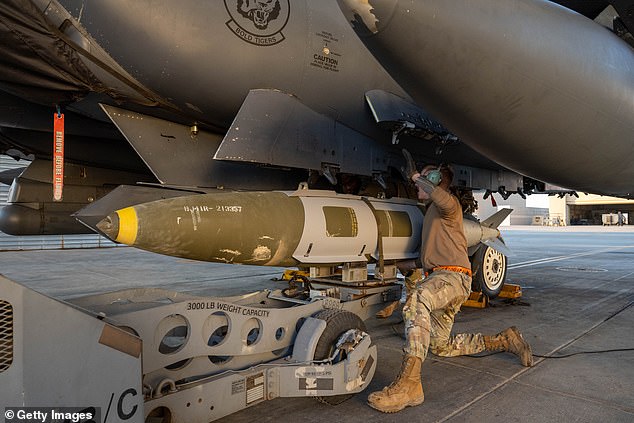
Donald Trump launched a ‘massive’ air strike against 70 Islamic State targets in Syria – and the US vowed to continue attacks on the terror group.
Among the sites hit were IS fighter compounds, weapon dumps and other infrastructure, with Jordanian fighter jets supporting what was dubbed Operation Hawkeye Strike on Friday.
It came after an attack by a suspected IS member killed two US troops and an American civilian interpreter last week.
Speaking at a rally in North Carolina after the operation, Mr Trump told his supporters he’d ‘ordered a massive strike on the terrorists that killed our three great patriots’.
The US President added: ‘We hit the ISIS (Islamic State of Iraq and Syria) thugs. It was very successful. We hit every site flawlessly and we are restoring peace through strength all over the world.’
Defense Secretary Pete Hegseth later posted on social media: ‘This is not the beginning of a war – it is a declaration of vengeance. Today, we hunted and we killed our enemies. Lots of them. And we will continue. As we said directly following the savage attack, if you target Americans – anywhere in the world – you will spend the rest of your brief, anxious life knowing the United States will hunt you, find you, and ruthlessly kill you.’
Two National Guard members and an interpreter were killed in an attack on December 13 on a convoy in the town of Palmyra. Three American soldiers were also wounded.
Syria’s interior ministry said the killer was a member of its own security forces. IS said the convoy attack was a decisive moment that was intended to dispel doubt among its supporters.
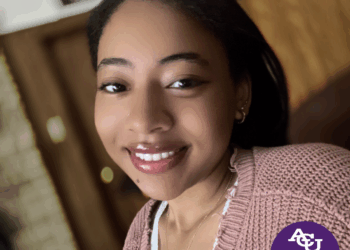
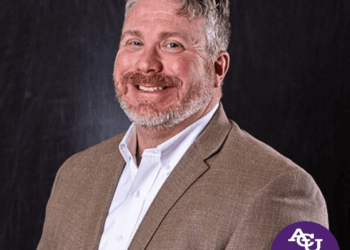
The US launched the air strike after two soldiers were killed in the IS attack. They have been identified as Sgt Edgar Brian Torres Tovar, 25, and Sgt William Nathaniel Howard, 29 (handout image)
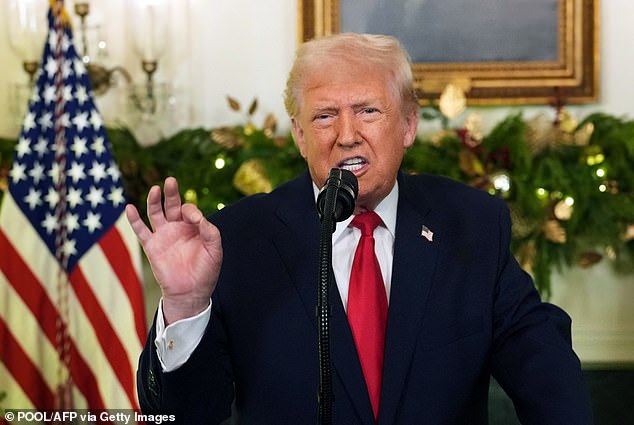
Donald Trump launched a ‘massive’ air strike against 70 Islamic State targets in Syria – and the US vowed to continue attacks on the terror group
Military analysts say the Palmyra killings have forced the Syrian government to increase co-operation with its partners.
That includes, not just the US, but neighbouring Jordan and Kurdish-led Syrian fighters.
Syria’s government is led by rebels who toppled Bashar al-Assad last year after a 13-year civil war. It includes members of Al-Qaeda who oppose IS.
New president Ahmed al Sharaa was designated a ‘terrorist’ as recently as last month. But ahead of talks with Mr Trump at the White House, the US Department of the Treasury deleted him from its Specially Designated Global Terrorist list.
As Operation Hawkeye Strike got underway, Mr Trump wrote on his social media platform Truth Social: ‘Because of ISIS’s vicious killing of brave American Patriots in Syria, whose beautiful souls I welcomed home to American soil earlier this week in a very dignified ceremony, I am hereby announcing that the United States is inflicting very serious retaliation, just as I promised, on the murderous terrorists responsible.’
He added: ‘We are striking very strongly against ISIS strongholds in Syria, a place soaked in blood which has many problems, but one that has a bright future if ISIS can be eradicated.’
Jordan has its own reasons for joining the attack. In 2015, one of its Air Force pilots was executed in public and King Abdullah II pledged that ‘his blood will not be shed in vain’.
Security sources say the US operation was conducted over central and north-eastern areas of Syria’s vast Badia desert while the Jordanians hit southern areas.
The Syrian government was not directly involved, but officials said the attack had its full support.
A statement from the foreign ministry reiterated its ‘steadfast commitment to fighting IS and ensuring that it has no safe havens on Syrian territory’.
About 1,000 US troops are stationed in Syria as part of a long-running operation to remove IS. The group has controlled no territory in the country since 2018 but carries out sporadic attacks.