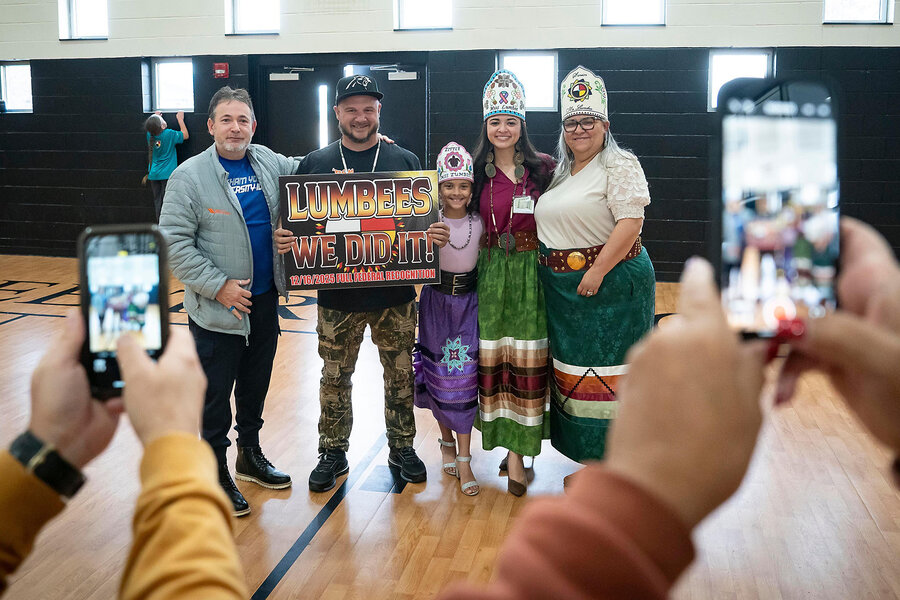
Even through the din of his North Carolina fish market, Joseph Jones’s excitement is palpable. On Dec. 17, Congress recognized his people, the Lumbee Tribe of North Carolina, as a full-fledged American tribe, eligible for government benefits, health-care assistance and, potentially, a casino.
“It’s been a long time, but we finally made it, man,” says Mr. Jones, whose family owns the Lumbee Fish Market in Pembroke, North Carolina, in a phone interview. “People steady working, steady pushing it, steady going to the White House, steady letting Congress know that we are Native regardless of what people say about us, and we are proud to be Native American.”
President Donald Trump, who has long professed his “love” for the Lumbee people, signed the National Defense Authorization Act on Dec. 18. Tucked into that defense funding bill was the Lumbee Fairness Act, making the Lumbee the 575th recognized tribe in the United States. The tribe instantly became one of the nation’s largest. It took the Lumbee more than 30 attempts to earn federal recognition, as its members have fought allegations from other tribes that they have not proved their historical lineage and continuous government.
Why We Wrote This
The Lumbee Tribe of North Carolina, with more than 55,000 members, earned federal recognition from Congress after decades of attempts. The status will open more government benefits for tribal members and fulfills a campaign promise by President Donald Trump.
The recognition is in part a testament to the Lumbee Tribe’s growing political power, with more than 55,000 members. It highlights how the Lumbee have become a influential voting bloc in North Carolina and quietly exerted influence on the national stage. The pushback their recognition has stirred from other Native American tribes also brings into focus how questions of identity linger as the Lumbee Tribe looks to build upon its new federal recognition.
“It’s a really fascinating window into this moment. Here is a kind of racial justice victory” under a presidency that has attacked the social justice movement on many fronts, says Julian Brave NoiseCat, a writer and filmmaker and member of the Canim Lake Band Tsq̓éscen̓, in California. “The tribe has been an interesting political chameleon as its identity has always been Native but also transforming over time.”

Lumbee tribal origins
The Lumbee call themselves the “people of the dark water.” Though there are outposts of Lumbee in Baltimore and Philadelphia, most today live in and around the Lumber River in Robeson County, North Carolina, where tribal connections are cemented and understood by questions like, “Where do you church?”
The Lumbee’s founding story, according to some historians and tribal leaders, intermingles with the European-American one. In one theory, the Lumbee emerged after Europeans possibly left the “the Lost Colony at Roanoke” in modern-day North Carolina in the late 16th century to live with local Native Americans on Croatoan Island. The Lumbee Tribe website says some ancestors of the tribe have always lived on the Lumbee River, while others migrated from parts of the Carolinas and Virginia. Lumbee is the name the tribe chose for itself in the 1950s.
A team that included a Harvard University professor traveled to Robeson County in 1934 to assess the tribe’s eligibility for recognition. They found that, though the tribe was doubtlessly Indigenous, it didn’t meet the federal definition, which at that time considered only race – not culture, ancestors, or relatives.
Often, Lumbee don’t look uniquely Indian, including some who have freckles and red hair. Many share “Tuscarora eyes,” a gray shade traced by many to early colonial settlers. Tribal leaders and members say it is a testament to the inclusiveness of the tribe, which weights familial bonds more than blood line percentages.
The historic struggle for legitimacy makes the Lumbee federal recognition fight partly about who does and doesn’t count as Native, supporters of the Lumbee tribe say.
“The Lumbee are a rich example of how to exercise self-determination against the strongest possible opposition: America’s insistence on their invisibility,” writes Emory University historian and Lumbee Tribe member Malinda Maynor Lowery in “The Lumbee Indians: An American Struggle.”
North Carolina has recognized the tribe since the 1880s, but Congress, which oversees federal recognition, has consistently turned down the Lumbee until now. The Lumbee have watched as 23 other tribes have gained recognition since the 1970s. The latest was the Little Shell Tribe of Chippewa Indians in Montana, which were recognized through the defense authorization bill in 2019.
Influence and money at stake
In some ways, the Lumbee Tribe’s struggle for recognition might have less to do with proving their historical heritage than with pocketbook issues.

Stalwart opposition has come from the 15,000-strong Eastern Band of the Cherokee Nation.
The Lumbee would be the “first to receive recognition without demonstrating any descent from a historical tribe,” Michell Hicks, the chief of the Eastern Band of Cherokee, told Congress in November.
Native American tribes can earn federal recognition through several pathways, including by an act of Congress, through a federal court decision, and by recognition from the Office of Federal Acknowledgment within the Department of the Interior. That office evaluates petitions based on “anthropological, genealogical, and historical research methods.”
In a statement, Mr. Hicks criticized the Lumbee Tribe for seeking recognition through Congress “instead of the merit based federal acknowledgement process. Doing so without a verified history, language, traditions, land base and treaty rights sets a dangerous precedent for regulation moving forward and undermines the standards that protect Tribal Nations and federal Indian Law,” he wrote.
At the same time, the award-winning drum-circle group, War Paint, has Lumbee members and regularly conducts powwows with the Eastern Band. That cultural acceptance, to some, suggests that opposition may also be about gambling markets. The Eastern Band of Cherokee Tribe runs a casino in Cherokee, North Carolina, across the state from Robeson County.
The Eastern Band “have a history of protecting their gaming market, and this is potentially going to be cutting into that,” says Matthew Fletcher, a University of Michigan Law School professor and author of “The Ghost Road: Anishinaabe Responses to Indian Hating.”
“Another aspect of worry is that the amount of money appropriated by Congress in a given year for governmental services is finite, so there’s a little bit of a cut that Eastern Band may be expecting given that the Lumbee will be one of the largest tribes in the country going forward,” he adds.
“Never giving up”
In recent years, members of the Lumbee Tribe have increasingly voted Republican.
President Trump held a rally in Robeson County in October 2020, during which he promised to support federal recognition of the Lumbee Tribe. As candidates in 2024, both Mr. Trump and Vice President Kamala Harris pledged to support recognition of the Lumbee.
Robeson County, whose population is just over 40% Indigenous, voted for President Barack Obama in two elections before swinging to support Mr. Trump in the past three presidential elections.
North Carolina Sen. Thom Tillis, a Republican, first introduced the Lumbee Fairness Act in Congress in 2023. This week, Republicans and Democrats lined up behind the Lumbee Fairness Act’s inclusion in the defense authorization bill.
Wearing a native bolo tie on the Senate floor on Dec. 17, Mr. Tillis later credited the tribe’s “resilience, service and dignity” as they fought for “fair treatment.”
“I thank the Lumbee Tribe for never giving up on our nation, and I’m honored that our nation has finally stopped giving up on them,” Senator Tillis said in a video message. North Carolina’s Democratic governor, Josh Stein, also supported the new recognition.
Most immediately for the Lumbee, the tribe now faces what amounts to a nation-building project as federal subsidies ramp up.
“They’re going to have to build up infrastructure, law enforcement, tribal courts, social services, everything you can imagine,” says Professor Fletcher, who also serves as chief justice of the Grand Traverse Band of Ottawa and Chippewa Indians, the Pokagon Band of Potawatomi Indians, and the Poarch Band of Creek Indians. “It’s a great opportunity for them. But they are starting from scratch.”
Mr. Jones, the fish seller in Pembroke, says his people are up for the challenge, given a long struggle for legitimacy and support in one of the poorest corners of North Carolina.
“We’re not hunting money, we’re hunting for help for our elders,” says Mr. Jones.