Britain has rejoined the Erasmus scheme, triggering outrage in the right wing press and muted praise elsewhere. Coverage has focused on the costs, which will run into the billions over the next decade, and amount to £570 million in the first year. Starmer is undoubtedly hoping to mollify remainers in the most visible and least complex way possible, Erasmus being a quick symbolic win.
No doubt informing his choice is favourable polling on readopting the scheme (even a narrow majority of Reform voters support it), and evidence that a growing number of British adults see Brexit as a mistake. Boris Johnson’s failures are the focus, with the promises of better funded public services, economic dynamism and lower migration all systematically broken by his government.
Yet there is plenty to find fault with in Labour’s adoption of the Erasmus scheme. As often before, Starmer has proven a poor negotiator, with high and rising costs exchanged for a short-term political victory. But the more basic issue is the old problem between Britain and the EU. English is a global language of commerce and mass culture, and native speakers are poorly prepared and incentivised to learn other European languages. As a result, European students — generally already fluent in English — flock to British universities whilst only a trickle go in the other direction. Thus the economic benefits of Erasmus are unlikely to be realised by British students, even as the UK bears the costs.
A more potent case can be made, however, for the cultural and civilisational benefits of Erasmus — one lost on Starmer. Greater engagement with the philosophy, culture and history of a shared Western and European legacy, one still discoverable in the patchwork of modern Europe, is not a quantifiable benefit.
Yet this more seductive argument, and the Erasmus scheme itself, seem to belong to a dying and forgotten vision of Europe.
Yesterday’s world government
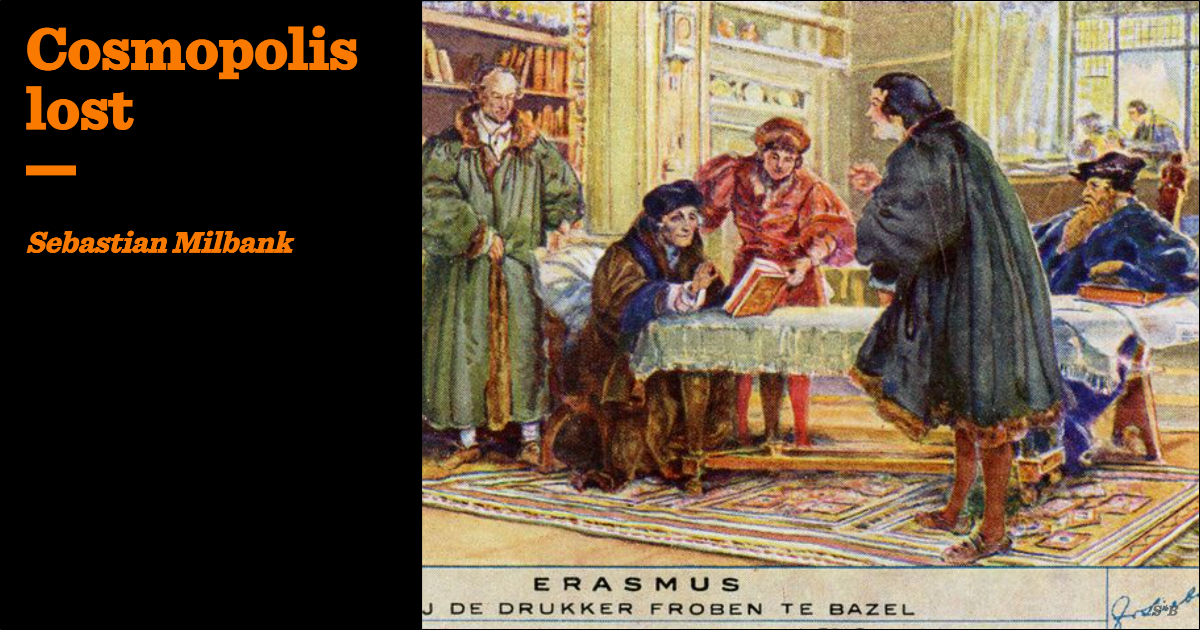
The EU, for both supporters and critics, stands for cosmopolitanism. Erasmus himself gives his name to the scheme, based on his peripatetic attendance of European universities, and his status as a great Renaissance humanist who called himself a “citizen of the world”. Yet this cosmopolitan ideal, rooted in a Stoic and Ciceronian tradition and mediated through Christian humanism, is a distinctly European cosmopolitanism.
In the face of contemporary globalisation, the borderless idealism of the EU increasingly looks naive and parochial. Tech companies and modern logistics have annihilated distance and liquidated local culture with a mercilessness far beyond the powers of the plodding mandarins of Brussels. In this brave new world, Chinese cash builds Latin American infrastructure, automated ports shift millions of tonnes of goods with skeleton workforces, and finished products are produced by supply chains separated by thousands of miles, and yet do so “just in time” so that the gap between sales and manufacturing is narrowed as never before.
This shining realm of automation and commerce is equally a brutal field of competition, conflict and catastrophe. Corruption, fundamentalism and ecological devastation is fuelled by the hunger of new markets for raw materials, and the clashing of great powers over spheres of trade and influence. In this grim global race, millions are displaced by disaster or sucked in by the promise of advancement into the vortex of migration. Hundreds of millions of young Africans, Indians and Arabs have left the countryside for new megacities, yet unlike the Chinese, they are not necessarily building modern infrastructure and a large middle class. 19th century levels of urbanisation without corresponding levels of productivity and public services is a postmodern reality we are unprepared for. The internet, smartphones and AI, coupled with cheap transportation, has made these masses potentially hypermobile and in the market for a better deal.
What is holding Europe back, more than any policy failure or institutional flaw, is an identity crisis
This world of global movement and communications, in which superpowers, corporations and non-state actors vie for influence, is totally alien to the assumptions on which the post-war European order was founded. European countries are caught between demographic decline, mass migration and global economic and military competition. The EU is at once criticised as an instrument of a sinister global order, but also as sheltering a sclerotic social democratic system from the revolutionary forces of digital capitalism, sometimes in the same breath. The real and precious goods of Europe — beautiful walkable cities, economic equality, a more human pace of life and work, clean air and good food, the wonders of our cultural heritage — are in the deepest danger.
Europe’s identity crisis
What is holding Europe back, more than any policy failure or institutional flaw, is an identity crisis. The continent finds itself besieged — whether by mass migration, Islamism, Russian aggression, big tech, American bullying or Chinese influence. It is unable to fight back because it has caught the disease of cultural relativism and civilisational self-hatred. So determined were the framers of post-war Europe to avoid the horrors of war and nationalism, that they smothered European culture in its cradle. The very term “Eurocentrism” is now a universal bugbear denounced in every European university joined together by the Erasmus programme. What new insights are students likely to gain from their exchanges when they hear the same nihilistic lesson from every secular pulpit?
The answers to so many of our current ills and divisions lie, like buried treasure, in the depths of our shared civilisational treasury. Erasmus has been reinvented as a bland borderless bureaucrat yet he was a man suffused with Christian faith, in love with truth, and unafraid to give offence. At a time of profound polarisation, when Christian Europe was divided from within and assailed from without, he preached the unity of faith and reason, of tradition and reform.
The Europe of Erasmus is one that proclaims the universal humanity of all, seeks peace and concord in everything, yet is unflinching in the battle for truth. This fearlessness of critique, both towards the self and other, has been poisoned by a once noble desire for peace that has become a despicable complacency and a love affair with death and decline. Our own history has become opened up to infinite condemnation, yet liberalism itself, ringed about with Popperian steel, is sacrosanct, as is every non-European culture.
A continent of cowards
Scandalously, when Pope Benedict criticised, in the most gentle and indirect terms, the association of violence and religion in Islam, he was met with childish outrage from Muslims, and supine howls of offence from Western critics. If Europe, so bracingly and rightly called a barren old woman by Pope Francis, weeps and rends her garments at the quoting of an insufficiently sensitive medieval Byzantine Emperor, what sort of frank conversation can ever occur on any topic of weight?
Modern Islam has shamefully, and wickedly embraced political violence. This basic truth cannot be written or spoken enough. After Pope Benedict gave his address, and the columnists of Europe had denounced it, Muslims across the world responded to his insulting suggestion that Islam employs violence by firebombing Palestinian churches, issuing a fatwa calling for the death of the Pope, murdering a Somalian nun, and setting fire to crosses in the streets. Yet in the heart of once Christian Europe, this truth is unsayable in polite company, and its utterance socially and legally punished across the continent.
Europe has surrendered its soul, and abandoned the quest for absolute truth
This abject surrender to the violence of religious extremists has done European Muslims no favours, as they become the growing focus of anger and hostility from the nationalist right. Witness the poisonous paradox of modern France, a nation in which Islamic head coverings are widely regulated and banned, and politicians regularly prosecuted for criticising Muslims in too indelicate a manner. In the silence of stifled speech and beneath the veil of secular neutrality, hatred festers unchecked.
When Erasmus wrote 500 years ago, he was unstinting in his criticism of Christian violence, describing the Christians of his day no better than devil worshipers, and worse than the Muslims of his time. He called for both mutual defence in the face of the Ottoman threat, but ultimately for peace and persuasion:
But if there is a fatal propensity in the human heart to war, if the dreadful disease is interwoven with the constitution of man, so that it cannot abstain from war, why is not vent given to the virulence in exertions against the common enemy of christianity, the unbelieving Turk? Yet — even here let me pause — is not the Turk a man — a brother? Then it were far better to allure him by gentle, kind, and friendly treatment, by exhibiting the beauty of our christian religion in the innocence of our lives, than by attacking him with the drawn sword, as if he were a savage brute, without a heart to feel, or a reasoning faculty to be persuaded.
Erasmus, unlike the identitarians of today, understood that difference and disagreement does not necessitate hate, and that we can wage a war of words and ideas without embracing violence. Yet faced with a legacy of terrible bloodshed, Europe has surrendered its soul, and abandoned the quest for absolute truth which is the living spirit of our culture.
This almost ferocious capacity for critique, this violence in thought and gentleness in deed, is a quality essential to the vigour of Western thought and culture. It should be wielded dispassionately against both our own civilisation and those of others. Only with this mental courage and clarity can we begin to define who we are, what ideas we embrace, and which we oppose.
The example of Erasmus should inspire us in this endeavour. In a time of heresy trials and brutal warfare he fearlessly wielded tongue and pen against the princes and potentates of Europe, attacking both the corruption of the Church and the follies of Protestant reformers. He represents an important corrective against the excesses both of populists and progressives — embodying the ideal of a Europe continually engaged in self-critique, but without self-loathing.