

The best thing about Twitter (known to Elon Musk as X) is that it allows everybody to have their voice heard. The worst thing about Twitter is that it allows everybody to have their voice heard. No matter who you are or how little you know, if you can operate a smartphone then you can join the global conversation.
We all remember lifting a rock, as a child, to see the bugs underneath it. To delve into the replies to a popular tweet is to lift the rock on the vast amount of human stupidity. Ignorance and incomprehension exist on a scale that scarcely seems possible in a functioning society. They are the reply guys and they walk among us. The worst of them can be grouped into five tribes.
The single issue obsessive
I have one follower who, bless his heart, only ever replies to my tweets by talking about the medicinal benefits of cannabis. We all have our little hobby horses, but most of us wait for the appropriate context to arise before we give voice to them. Not so the single issue obsessives on Twitter who crowbar their pet project into any conversation. Palestine is a current favourite, but Brexit is the classic example. It was a big story for a few years, then it happened and nothing much changed. Most of us moved on, but a diehard minority kept up the fight. The economy shrank by 0.1 per cent last month? Brexit. The UK did badly in the Eurovision song contest again? Brexit. Fredo bars cost 35p now? Brexit.
There is an element of nostalgia about these one-note bores. There was a moment in time when the whole internet was talking about their favourite issue. Whether they were pro- or anti-lockdown, pro- or anti-EU or pro- or anti-Boris Johnson, there was a sense of solidarity between the reply guys. They were good times for anonymous accounts who held strong opinions and some of them cannot let them go. There are still people who tweet “Was he vaxxed?” when a celebrity dies unexpectedly. There are still people wearing face masks in their Twitter profile. There are still people making jokes about Barnard Castle. Perhaps they always will.
The party loyalist
For most of us, the government is made up of interchangeable politicians who raise our taxes and relieve us of our liberties. We vote with a heavy heart for the ones we hate the least. If the cross-party consensus on most of the big issues makes you feel that you are governed by a Uniparty, “the government” is just another term for “the state”. To criticise the government is to criticise the political class. A plague on all their houses. But for the party loyalist, criticism of the government implies support for the opposition. These are people who do not have to hold their nose when they enter the polling booth. They have picked a team and if you have a pop at their team, they assume you support the opposing team with equal fervour.
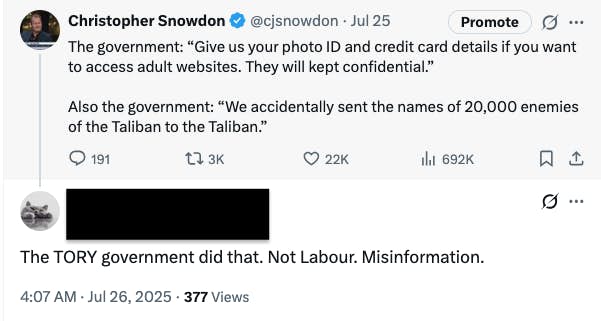
This is a tendency most often found among Labour voters because Tory voters do not feel protective about the Conservative Party and no one feels strongly about the Lib Dems. If you voice support for a left-wing policy, right-wingers might accuse you of being a woke communist snowflake or even a “leftard” but they will probably not assume that you are a Labour supporter. Criticising the government of, say, Rishi Sunak would not even be left-coded. But if you criticise the current government, even without mentioning words like “Labour” or “Starmer”, the party loyalist will assume that you are fanatically devoted to the Conservative and Unionist Party of Great Britain and Northern Ireland.
This is mere projection. They cannot view politics as anything other than a team sport and they assume that you can’t either. The party loyalist is very keen to inform you that the policy you detest originated from the outgroup and not the in-group although, now you mention it, they quite like the policy themselves. Things might be bad under the party they support, but things would be even worse if the party you are presumed to support were in charge. As if you had ever said otherwise.
The credentialist
Twitter/X would be a very quiet place if people were only allowed to discuss issues that they have a post-graduate degree in, but that is how it would be if we took the credentialists seriously. Express a view on a matter outside your immediate professional expertise and they are straight down your throat demanding to know what gives you the right. So, you think Lucy Letby is guilty, do you? How long have you worked in a neonatal unit? Got an opinion on this ridiculous food fad? Where’s your PhD in nutrition? You reckon three months in prison is too lenient for this depraved criminal? What law school did you go to?
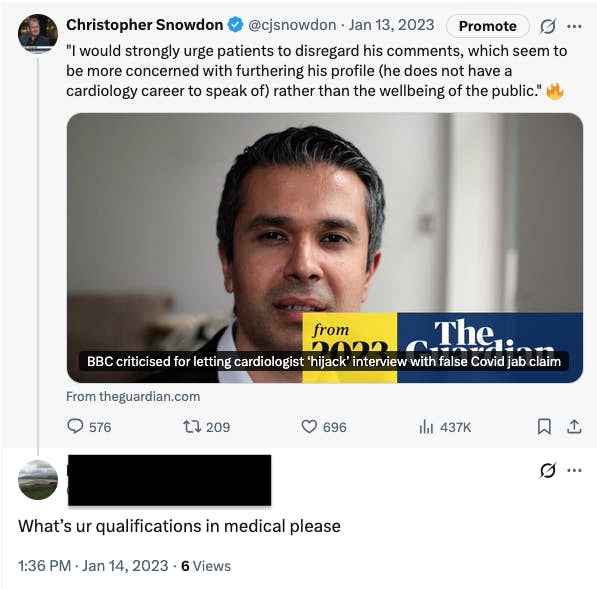
The demand for credentials is conspicuously one-sided. It never applies to the credentialist himself, who has spent the last five years tweeting with great confidence about everything from PCR tests and myocarditis to Modern Monetary Theory and the influence of the far-right in Ukrainian politics. Nor does it usually apply to the alleged experts from whom the credentialist gets his information, whose qualifications are often only vaguely related to the matter at hand. And it never applies to the majority of genuinely qualified experts in the field if their opinion differs from that of the credentialist, an anomaly that the latter explains by reference to group-think and conflicts of interest.
The Grok appreciator
There is often a gap of a few minutes between replies on social media as each interlocutor frantically searches Wikipedia to find something to back up their opinions. Thanks to AI, this has now been reduced to a matter of seconds.
The “Hey @Grok, is this true?” guy is a recent arrival on the scene, made possible this year by one of Elon Musk’s debatable improvements to the platform. Are these people being needlessly argumentative or are they Just Asking Questions? If it’s an argument they want, they are taking a gamble because there is a good chance that Grok will confirm that “this” is indeed true. Then again, it might not. All Grok can do is summarise what people have been writing on the internet. If the question is “How old is Keir Starmer”, it is likely to provide the correct answer. If the question is “Will Russia invade the UK?” or “How much alcohol is it safe to drink?”, it will be out of its depth.
The “is this true?” guys are annoying, but the guys who ask Grok leading questions to sidetrack the conversation are the worst. If you’re going to call for back up, at least find a human to do it.
I have nothing against AI. It has generally improved search engine results and is getting better all the time. There are times when using Grok on Twitter is tolerable, such as if you want to know the context of a video. But if you just want to check if a statement is true or get additional information, do it in your time. If you discover something interesting then report back, but don’t clog up my timeline with inane questions. And if you think that Grok is the ultimate arbiter of the truth, don’t get in my timeline at all.
The imbecile
No matter how clear the statement, there will always be someone who doesn’t understand it. No matter how obvious the joke, there will be someone who doesn’t get it. No matter how thickly you lay on the sarcasm, someone will always think you are being serious. This is Twitter/X and all human life is here, including the most obtuse folk who ever logged on to the internet.
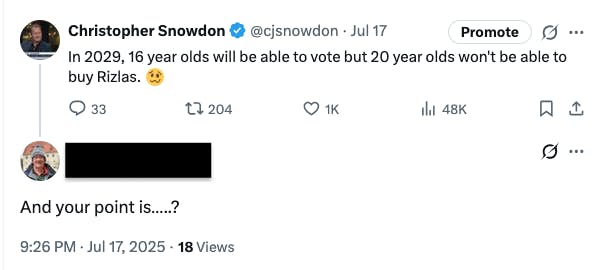
This is obviously a broad category. The imbecile takes many forms. They will sometimes settle for replying with “And your point is?” to a tweet that is making a perfectly obvious point. How is one to respond to such an enquiry except by repeating oneself? If you are confused by a tweet that thousands of people have clearly understood and appreciated, does it not strike you that the fault might lie in yourself?
At other times, they will furiously argue with you, not realising that they actually agree with you. Post a quote from an annoying person saying something ridiculous and you will receive a stream of invective from the imbecile berating you for being a terrible human being. It can be a bit of a shock when you are casually scrolling through your mentions in the morning and have someone calling for you to be executed/deported/sterilised, only for you to realise that they think you are Narinder Kaur or Terry Christian. I suppose this is the kind of thing Narinder Kaur and Terry Christian have to put up with all the time, although they do bring it on themselves.