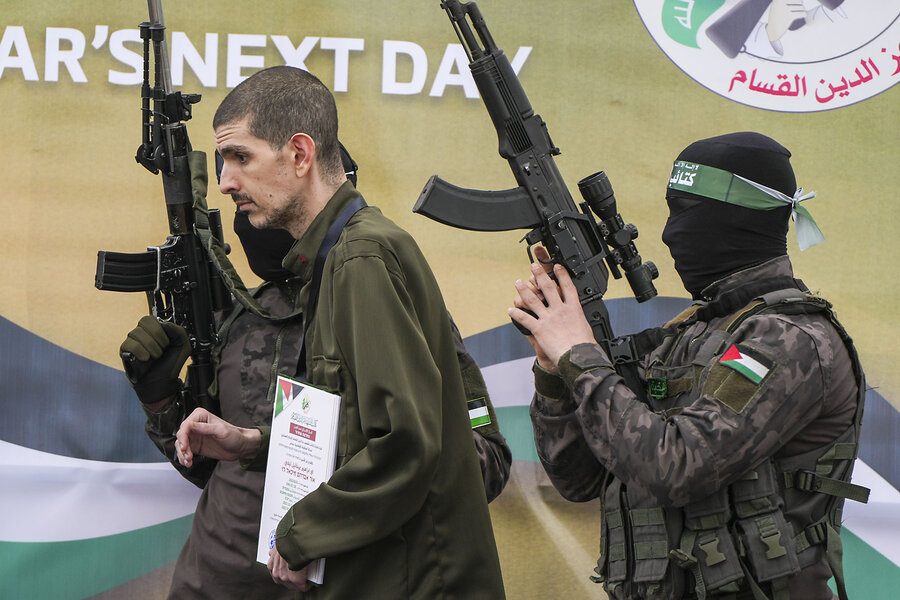
Or Levy was an Israeli hostage deep underground in a Gaza tunnel looking at a crack in the ceiling, when it suddenly occurred to him it might not just be a crack, but something divine, and he started talking to God.
“Before Oct. 7, I was not a big believer,” he said, but that changed when he was plunged into what he describes in a testimonial as a “living hell.”
“Whenever it became too hard, I’d ask Him [God] to save us.” He interpreted extra provisions of pita or a hot cup of tea, moments that helped blunt the suffering, as signs his prayers were heard.
Why We Wrote This
The long, emotionally exhausting ordeal of hostages held in Hamas tunnels, and the general trauma of Oct. 7, has led to a visible rise in religious belief among Jewish Israelis. As one hostage notes: “God will always listen. He does not get tired.”
At the same time, also in Gaza, another hostage, Liri Albag, a soldier who was captured during the Oct. 7, 2023, Hamas-led attack on Israel, was also shifting into a believer. Sixteen of her fellow female lookout soldiers were slaughtered near her the day of the attack. They were among the 1,200 killed people, mostly civilians, along Israel’s southern border with Gaza.
“Before then, I was an innocent 18-year-old who did not think about religion too much,” she says in an interview.
But after surviving what she witnessed that day, “I thought, there is no chance I could come out alive from Oct. 7 without someone looking over me.” She spent hours speaking to God, telling herself, “God will always listen. He does not get tired.”
In captivity, she and fellow hostages began marking Shabbat, reciting the ritual blessing for wine over a cup of water. When her captors passed on a siddur, a Jewish prayer book they found in Gaza that had been left behind by soldiers, they took turns reading and praying from it.

Trend extends beyond hostages
The experiences of Mr. Levy and Ms. Albag turning to religion amid extreme crisis were echoed by several returning hostages. But their experiences also speak to a broader trend of Jewish Israelis feeling more connected to Judaism and spirituality in the wake of Oct. 7 and the multifront war that followed.
There are the outer manifestations observable in daily Israeli life:
- the prevalence of religious sayings sprinkled in everyday conversation
- more religiously inflected songs getting airtime on the radio
- the wearing of Stars of David
- otherwise secular-looking young men wearing ritual tzitzit fringes worn by the devout
- teens with no prior connection to religious observance attending lessons on Torah teachings – some made popular by rabbis promoting such gatherings on TikTok.
And then there are the more interior ones, of feeling a deep personal connection to faith.
The shift speaks to how profoundly Hamas’ attack and the war it instigated – and, some argue, Israel’s growing international isolation and the spike in antisemitic attacks abroad – have profoundly impacted all Israelis, no matter how closely events touched them directly.
In such a small country, where lives and futures feel intertwined, a sense of national trauma and a desire to rebuild from it loom large.
“The trauma of Oct. 7 was, of course, frightening and scarring. But it’s also a very Jewish kind of trauma, because what we saw on Oct. 7 is something familiar, something we have learned about it, seen at museums – a pogrom, a Holocaust, a hunting down of Jews, hiding in houses,” says Tomer Persico, a senior fellow at Shalom Hartman, a Jerusalem-based research and educational center.
“The murdering, raping, all of this is familiar for Israelis and Jews – a sort of return to Jewish history, although something we thought [until recently] was part of Jewish history of a long time ago.”
The turn to religion is also interpreted as a response to a crisis in Zionism, as the Oct. 7 massacre was precisely the kind of mass violence that the movement for Jewish self-determination was supposed to prevent.
“Israel was supposed to be a safe shelter, a solution for the ‘Jewish problem’ of persecution,” says Rabbi David Stav, chairman of Tzohar, a Modern Orthodox organization that works to make Judaism more accessible to the secular public. “Here we realize all of a sudden, after 75 years of statehood, that we are still not accepted, and the enemy does not distinguish between left- and right-wing Israelis.
“One of the responses to this crisis is to say that we are Jewish, and that Jewishness has to have a meaning.”

No longer is it enough to be Hebrew speakers living in the biblical homeland of the Jews as part of a sovereign nation, says Mr. Persico. “It has to be something else, because that [model] is broken.”
The fracture, he says, has sparked “a reconnection and strengthening of this pre-modern, pre-Zionist Jewish identity, which many people are translating as a return to tradition, or being closer to tradition.”
Poll data shows an uptick
Several recent studies in Israel back up anecdotal evidence of an uptick in religious connection in response to Oct. 7 and the war that followed.
In a poll by Hiddush, an organization that advocates for the separation of religion and state, 25% of respondents said those seminal events strengthened their faith in God. Fifty-five percent said they had not impacted their faith, and 7% said they had weakened it.
Researchers at The Hebrew University found in a survey of students that one-third experienced an increase in spirituality, while 9% said it decreased.
Yaakov Greenwald, a doctoral student in psychology and co-author of a paper recently published in The International Journal for the Psychology of Religion, says the research speaks to the comfort that can be found in religion and being part of a community during times of war.
“Religion offers specific benefits, specifically that God is there for you in your time of need and for the community,” he says, adding that it also appears to boost resilience.
A main function of an embrace of religion or spirituality, concepts that overlap, he says, is that they “may serve as a powerful meaning-making framework for understanding and coping with much of life and death.”
Rabbi Stav says his organization has seen a surge in requests to officiate bar mitzvahs, as well as religious wedding ceremonies, including for couples who were previously married in civil ceremonies, but now want their union to be bound by religious law.
“We are seeing a huge resurgence of Judaism in Israel. It does not mean that we are seeing more people necessarily observing religious obligations: You are seeing people with tattoos, wearing tzitzit, and driving cars on Shabbat. But it does mean that more and more Israelis are proud to say, ‘We are Jewish,’” says Rabbi Stav. Driving on the Sabbath is forbidden according to Jewish law, as are tattoos.
Ms. Albag, who was released from Hamas captivity last January after almost 500 days as a hostage, reflects on her own approach. “Today I consider myself to be more of a believer, but I do it in my own way,” she says. “I don’t think God is mad at me if I eat pork. What’s more important is that I am a good person.”