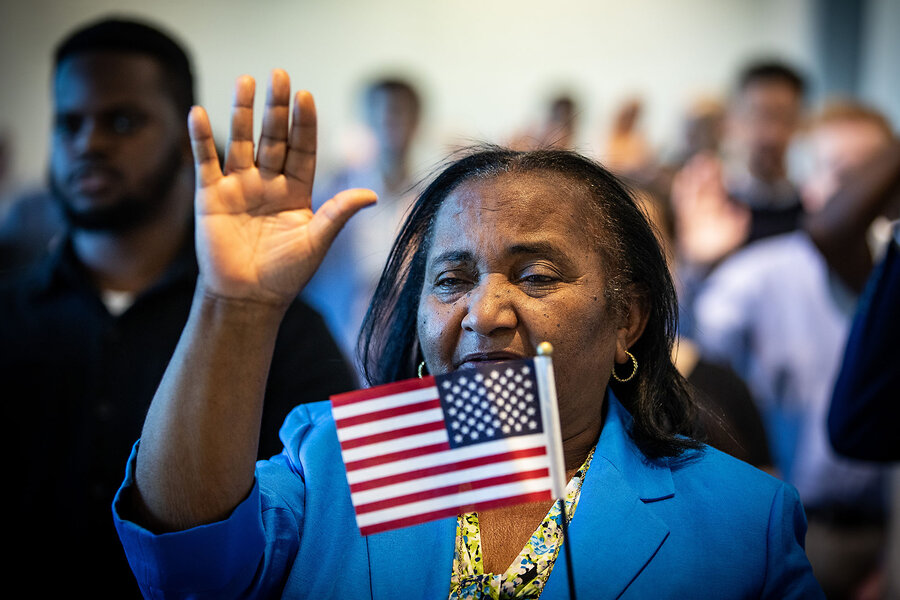
For immigrants, naturalization ceremonies represent the culmination of their yearslong effort to earn citizenship. In front of a federal judge, permanent residents raise their right hands, repeat the Oath of Allegiance to their new country, and usually wave a small American flag with pride once the judge confirms their citizenship.
On Dec. 4, inside Boston’s Faneuil Hall – a historic site where revolutionaries like Samuel Adams fostered the idea of American freedom – one such event took a turn. U.S. Citizenship and Immigration Services officers denied entry to several people who showed up for their naturalization ceremony, according to Project Citizenship, a nonprofit providing legal support for those seeking citizenship. Each of these individuals was from one of 19 countries the Trump administration identified as high-security risks under a Dec. 2 Department of Homeland Security memo, which mandated the immediate pausing and review of immigration applications from those countries, including Haiti, Afghanistan, and Venezuela.
What happened at the Boston ceremony is part of a tightening of the naturalization process throughout the country. In late November, New York state Attorney General Letitia James wrote a letter to USCIS questioning its decision to cancel ceremonies in several counties in her state; USCIS said the counties “did not meet the statutory requirements.” On Dec. 9 in Indianapolis, 38 out of 100 prospective citizens were turned away at their ceremony, according to local news reports. Local outlets in Atlanta reported that, on Dec. 12, three immigrants had their oath ceremonies canceled.
Why We Wrote This
In Boston and other cities, some lawful permanent residents are having their naturalization ceremonies canceled, amid a Trump administration review of applicants from 19 countries identified as posing high security risks.
The efforts to clamp down on legal immigration pathways follows the shooting of two National Guard members in Washington, one fatally, just before Thanksgiving. An Afghan national, who entered the country legally in 2021 through a program for allies who served alongside the U.S. military, has been charged with first-degree murder. Following that attack, President Donald Trump quickly announced significant immigration restrictions, including a pause on all asylum decisions. This week, the Trump administration added 20 countries to a list of nations whose citizens face full or partial bans on entering the U.S.
Those who apply for naturalization are some of the most thoroughly vetted immigrants in the country. To be eligible, an immigrant must generally have been a lawful permanent resident for at least five years, be a “person of good moral character,” and pass tests in civics and English. The process can take decades, and the oath ceremony is largely seen as a formality.
Gail Breslow, the executive director of Project Citizenship in Boston, said that 21 clients of the organization had their naturalization ceremonies canceled this month. Clients were either pulled out of line at the Dec. 4 ceremony or notified via email that their ceremonies, scheduled for Dec. 4 or Dec. 10, had been canceled.
One client who was turned away in person has lived in the U.S. for more than 20 years, Ms. Breslow says. “She’s been background checked, she’s been fingerprinted, she’s had her photo taken, she’s been tested on her knowledge of US civics. … This is someone who has already been told that they’ve been approved for citizenship.”
In Minnesota, naturalization ceremonies have also been canceled in recent weeks, says Jane Graupman, executive director of the International Institute of Minnesota, which provides legal services for immigrants. Only four of the organization’s clients have been granted citizenship this month, compared with the typical 40 to 70. In addition, the institute has documented more than 60 cases since November of immigrants who received fee waivers for their citizenship applications having officials from the USCIS’ fraud division show up at their homes to review documents such as tax records and mortgages, according to Ms. Graupman.
In a statement to the Monitor, a USCIS spokesperson said the agency has “paused all adjudications for aliens from high-risk countries” while it “works to ensure that all aliens from these countries are vetted and screened to the maximum degree possible.”
“The pause will allow for a comprehensive examination of all pending benefit requests for aliens from the designated high-risk countries,” the statement said. “The safety of the American people always comes first.”
Immigration lawyers and advocates have condemned the cancellations as unnecessary and cruel.
“By the time you actually get to the ceremony, you’ve gone through so many steps and so many processes; you already feel like you’re an American,” says Jeffrey Thielman, president and CEO of the International Institute of New England, which supports immigrants and refugees. “It’s discouraging to people, and it also creates more anxiety among the immigrant population.”
The actions from the Trump administration come at a time when national support for the president’s handling of immigration is dwindling. A recent poll by the Associated Press-NORC Center found that approval of Mr. Trump’s immigration policies has dropped from 49% in March to 38% in early December.

Melanie Stetson Freeman/Staff/File
“Tip of the iceberg”
Over the last year, the White House has made illegal immigration a focal point in its agenda – from large scale Immigrations and Customs Enforcement operations to the mobilization of National Guard troops, the Border Patrol, and other federal agencies to assist immigration enforcement officers. Now, USCIS’s recent policies are restricting legal immigration pathways, posing roadblocks for those seeking citizenship.
Jeannie Kain, a lawyer at Kain Immigration, suggests that the cancellation of naturalization ceremonies is the “tip of the iceberg” on the possible outcomes from the USCIS memorandum.
Under Section 1447(b) of Title 8 of the U.S. Code, those pulled from the naturalization ceremonies need to be certified as a citizen within 120 days of their citizenship interview. Ms. Kain suggests that legal action is likely to be taken on behalf of those whose ceremonies have been canceled. Her greater concern is for those from the 19 high-risk countries who have pending asylum cases or are seeking green cards.
“I have [a client] who has been waiting since 2014 for a decision on their asylum case. … And now he’s not going to get a decision.”
Ms. Kain also worries that the number of high-risk countries will increase. It’s not clear yet whether nationals who are already in the U.S. – but from the latest countries added to the Trump administration’s travel ban – will also face additional vetting for their asylum, green card, or citizenship applications.
The Trump administration might also be intensifying efforts to revoke citizenship from some who have already been naturalized. USCIS field offices have been asked to identify 100 to 200 denaturalization cases per month in the 2026 fiscal year, according to recent reporting in The New York Times.
On Dec. 10, another ceremony was held at John Joseph Moakley U.S. Courthouse in Boston, days after the Faneuil Hall ceremony where immigrants were turned away. Jane Ellis, one of many volunteers that help new citizens register to vote, said that extra volunteers were called in the event of a similar disruption.
“I just cannot imagine people going through all the steps that they have to do to get to this point. And to be turned away is just horrific,” says Ms. Ellis, who began volunteering during the first Trump administration. “I can’t even get my head around it.”
Supporters of the administration’s immigration policies see tighter restrictions as a boon. Lora Ries, director of the Border Security and Immigration Center at the Heritage Foundation, published a report this month calling for a new immigration system that “prioritizes Americans first, lawful immigrants second, and illegal aliens not at all.”
“In short, lawful applicants who are eligible for an immigration benefit should have it granted in a timely manner, and those who are not eligible should be denied expeditiously and then promptly depart the U.S.,” Ms. Ries writes.
Immigration advocates such as Ms. Breslow criticize the recent Trump administration policies for targeting people based on nationality, which she calls “xenophobic and racist.” Of the 19 high-risk countries, most are in Africa or the Middle East.
“These are people who’ve made their lives here. They’re our neighbors, they’re our co-workers, they’re people we sit next to on the bus and the subway,” she says.
Naturalization ceremonies have long been a beacon of hope to immigrants seeking the American dream.
Mounifa Prosnitz, who is originally from Brazil, has lived in the U.S. for nine years. She walked into Moakley Courthouse last week as a permanent resident, and left as a U.S. citizen. After receiving her citizenship certificate, Ms. Prosnitz said she felt “free.”
“I don’t know how to explain it, it [feels] so good. Now I can vote, I can serve the country. I can do something to be better here.”