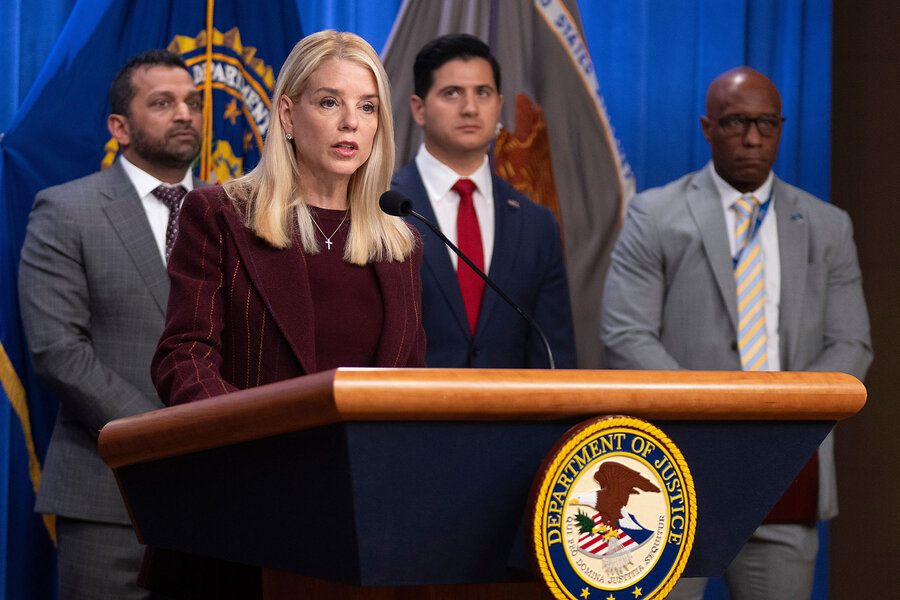
The FBI said Monday that it had stopped a series of attacks planned for New Year’s Eve in Southern California. The alleged plotters, say law enforcement officials, are members of a far-left, anti-capitalist, anti-government organization that had targeted companies “engaged in activities affecting interstate and foreign commerce.”
“This country protects the right to hold extreme views about its past, present, and future, but violence is an unmistakable and enforceable line,” said Assistant Attorney General for National Security John Eisenberg in a news release.
Federal and local law enforcement worked together on the case, and experts say the foiled plot underscores the success of interagency collaboration. It is also a reminder, they say, that extremism is not bound to a particular side of the political spectrum – it can arise from any social or political ideology.
Why We Wrote This
Politically-motivated violence, like the thwarted plan in the Los Angeles area, can often arise from specific beliefs instead of “pure ideology.” Experts say there are ways society can defuse potential acts and reduce the risk of terrorism.
What is this group and what was its alleged plot?
Federal authorities charged four people from the greater Los Angeles area with conspiracy and “possession of unregistered destructive device[s]” for allegedly planning to use pipe bombs on two U.S. businesses, as well as to target Immigration and Customs Enforcement agents.
The defendants, officials say, are members of the Turtle Island Liberation Front, which describes itself on social media as seeking “Liberation through decolonization and tribal sovereignty.” Turtle Island is a term for North America used by some Indigenous people. Instagram posts by the organization, which aligns itself with pro-Palestinian activists, call for decolonization, and one post reads “Peaceful protest will never be enough.” Law enforcement says the account is run by Audrey Carroll, one of the defendants.
Threat experts who spoke with the Monitor said their knowledge of the group is limited to the information made public by federal authorities. “It’s hard to know how significant it was and what in the end were the aims,” says Randolph Hall, director of the Center for Risk and Economic Analysis of Threats and Emergencies at the University of Southern California.
Court documents describe a manifesto the group circulated titled “Operation Midnight Sun,” which lays out plans to use improvised explosive devices at five potential targets. A task force arrested the group during the planning phase, in the Mojave Desert, where the defendants were assembling bombs, according to the affidavit, which also says Ms. Carroll told a confidential informant that the plot “will be considered a terrorist act.”
What does this plot say about extremism in the U.S.?
The arrests point to a recent increase in leftist extremism, says Lorenzo Vidino, director of the Program on Extremism at The George Washington University.
While some people may remember the Weather Underground bombings of the early 1970s, leftist violence since then had not been “terrorist in nature,” says Dr. Vidino. But “in the last couple of years that dynamic has changed and we see more and more of this.”
A study from the Center for Strategic and International Studies shows spikes in left-wing attacks over the last decade, and a sharp decline in right-wing incidents in the past year.
While political violence happens all over the world, the United States, Dr. Vidino says, is experiencing more than other Western countries. “It is more polarized,” he says.
America is distinct in ways that overlap with the increased polarization: First, law enforcement is aggressive in its pursuit of violent extremists, which “allows for a pretty intense level of scrutiny of some of these dynamics,” he says. Second, access to weapons is relatively easy. Third, America’s First Amendment “allows for protection of speech that is very extreme and can therefore allow people to recruit other people to extend their message to a broader audience.” But having an outlet to express extreme ideas can also be an alternative to violence, he adds.
While some conflict may lead to violence, most does not, says Dr. Hall. “You can look at specific incidents where there’s a connection, but it hasn’t become, say, pervasive in society that people are battling with each other with guns or fists over political issues,” he says.
What does the alleged plot say about a need for vigilance?
Extremism is springing from an increasingly complex “mishmash” of beliefs, says Mike Downing, chief security officer at private security firm Prevent Advisors.
“It’s not a pure ideology on one side or pure ideology on the other side, but it’s a mixed bag of things that are used to justify certain actions, how they got radicalized, how they mobilized to violence,” says Mr. Downing, who ran counterterrorism operations in Los Angeles as a former deputy police chief for the city.
The FBI calls it “nihilistic violent extremism”: mostly people who are young and online 24/7, who pick and choose from extremist beliefs. “An extremist probably 50 years ago was reading long manuals, philosophical treatises. Today, it’s TikTok,” says Dr. Vidino. “They simplify things a lot, and they also have a fascination with ultraviolence.”
A narrow focus on whether violence comes from one end of the political spectrum over another can lead law enforcement to overlook threats, says Mr. Downing. “We just have to be careful that we don’t get lured into this false sense of security by saying, ‘Oh yeah, the evolution of these threats are only coming from one side.’”
It is possible to change a culture of violence, says Dr. Hall. “The ability to resolve disputes peacefully with the kind of institutions that favor dialogue and rule of law, trust in the legal system – these things are all important.”
Elected and civic leaders can set the tone. “It’s important for all those in the political sphere who have the ability to influence, … to defuse the conflict that exists,” he says. “I think that’s very valuable.”
The Southern California arrests show how law enforcement agencies can successfully work together when their authority is not politicized, says Mr. Downing. Engagement like community policing and teaching people about the terrorism landscape diminishes the motivation for extremists. “And if you diminish both the motivational part of it and the capability part of that,” he says, “you reduce the risk of terrorism.”