With US warships menacing Venezuela amidst rumours of regime change in Caracas, it seems that the neoconservatives, champions of regime change, are back. While they reached the peak of their influence under the administrations of US president George W. Bush from 2001-2009, they have long haunted the swampland of Beltway think tanks and research institutes, with columns and sinecures aplenty. Even when they have not been in office, they have often been in power, as their views on US foreign policy formed part of the bipartisan consensus across the thirty years prior to Donald Trump’s first term in office from 2016-2020. This consensus was that the US was, in the words of Bill Clinton’s Secretary of State Madeline Albright, the “indispensable nation.”
Despite their ideological affinity with globalist liberalism, not to mention the disastrous record of adventurist wars in the Middle East, some neoconservatives have now — remarkably — joined forces with the populist insurgency that was fuelled in part by the failure of the very policies they championed. All this despite the fact that Trump himself said his greatest regret over his first term in office was how much leeway he gave the neocons. How is it that we find ourselves here again?
The ultimate aim was the same — forever wars to defend global liberalism and nation-building
Historically, neoconservatism was an unabashedly globalist vision, committed to spreading liberalism and democracy through military might, trampling over the rights of independent states in the process. The major point of difference with their Democratic opponents was how much multilateral support was needed for the forever war. While leftist liberals fretted over the need to secure the benedictions of the UN and preferred deploying Blue Helmets, the neocons were happy to shrug off international law and deploy squads of Marines. But these were disagreements about means rather than ends. The ultimate aim was the same — forever wars to defend global liberalism and nation-building.
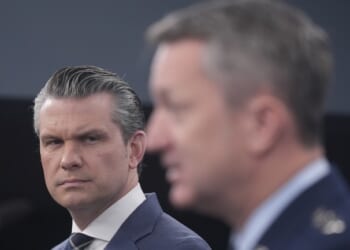
It is the Florida neoconservatives that have been the most prominent converts to national populism. Congressman Michael Waltz and Senator Marco Rubio, the latter appointed Secretary of State by Trump, have undergone the most dramatic conversions from the worship of American power abroad to personal loyalty to Trump. John Bolton, a Bush-era neocon who briefly served as national security adviser during Trump’s first time, has since been the target of Trumpian lawfare, currently facing federal charges for having allegedly mishandled classified materials.
Even stranger, however, than the Floridian converts are the British neoconservatives joining the populist bandwagon. Douglas Murray, author of the 2005 book Neoconservatism: why we need it, was spotted slinking around the celebrations at Mar-a-Lago that followed Trump’s electoral victory last year. More recently, Alan Mendoza, leader of the London-based Henry Jackson Society — named for one of the original neoconservative cold warriors, the American Senator Henry “Scoop” Jackson — was appointed chief adviser on global affairs to Nigel Farage’s Reform party in November.
The neocons have form when it comes to failing upwards. Their ideological origins famously lie in Trotskyism, named for the Ukrainian communist revolutionary Leon Trotsky who notoriously lost to Joseph Stalin in the battle to decide who would lead the early Soviet Union after Lenin’s death in 1924. Stalin’s vision of “socialism in one country” triumphed over Trotsky’s internationalist vision, which nonetheless enamoured a coterie of New York intellectuals in the middle of the last century. Defeat did not hold them back. While the neocons’ forebears abandoned communism in the aftermath of the Second World War, they retained and transmitted some of the ideological moulds formed in the heat of internecine Bolshevik feuding of the 1920s — notably the hostility to the national interest. Although Trotsky’s vision was rooted in the prospect of a chain of coordinated proletarian revolts more than spreading communism by invasion, his wayward ideological off-spring were happy to swap in the armed might of the US state for the revolutionary working class. Unsurprisingly however, the effort to spread liberal democracy by force has been no less successful than the effort to spread global communism.
For all the litany of failure, there is some logic to Floridian neoconservatives joining Trump. The US is still the most powerful country in the world, even if its margin of supremacy is significantly eroded since the disastrous invasion of Iraq in 2003, the peak of neoconservative influence in foreign affairs. With Trump’s sabre-rattling against Venezuela, Rubio may yet get the opportunity to practice neoconservatism in the Americas. Neoconservatism in one hemisphere may not be quite as alluring as global neoconservatism, but neocons have rarely seen a war they did not want to send others to fight in, especially if it involves regime-change.
The effort to graft British neoconservatism to populism is significantly stranger than Floridian conservatives seeking regime change in Caracas. While Farage has had to distance himself from the pro-Russian leanings of his Reform base following the conviction of Reform leader in Wales, Nathan Gill, for accepting Russian bribes, Britain is not especially alluring from the neoconservative viewpoint — unlike the American war machine, Britain’s enfeebled military can hardly swap in for the might of the revolutionary proletariat to spread freedom.
For all its drawbacks, at least Britain’s geopolitical weakness means there is no chance of British power being embroiled in more foolish wars. This offers at least one check on neoconservative globalism. Second, and more importantly, Britain voted for Brexit — and neocons are deeply hostile to national sovereignty, seeing it as an offence to liberal globalism, only fit to be pulverised by sanctions and bombing campaigns. Third, and most decisively, Trump is breaking up the Western alliance. The most recent leaks coming from the White House even suggest that Trump aims to set up a new global power directorate dubbed the C5 (“Core 5”) encompassing the US, China, India, Russia and Japan — a vision for global leadership in which the larger Western world no longer figures. The supposed “Free World” that was the centrepiece of neocon crusading for decades no longer exists. Neoconservatives remain trapped in the twentieth century, fixated on transnational ideological crusades and vast strategic alliances in which the national interest is suppressed and forgotten. A fluid, multipolar world with no permanent friends or allies is alien to this way of thinking.
As with Trotskyism’s hostility to socialism-in-one-country, so too neoconservatism could never be satisfied with liberal freedom-in-one-country. Neoconservatism is especially ill-suited to a middling power such as Britain whose voters support national sovereignty and that does not have the power to spread freedom by force, especially when it cannot rely on the US. Despite the fact that the neoconservative-populist alliance will find itself largely impotent without US power, neoconservative efforts to latch themselves onto populism tells us that the Anglo-populists themselves have few independent ideas of their own, reliant as they are on neocons for any ideological charge. Until that new foreign policy vision emerges, the countries of the former West like Britain, will remain trapped in the politics of the last century.