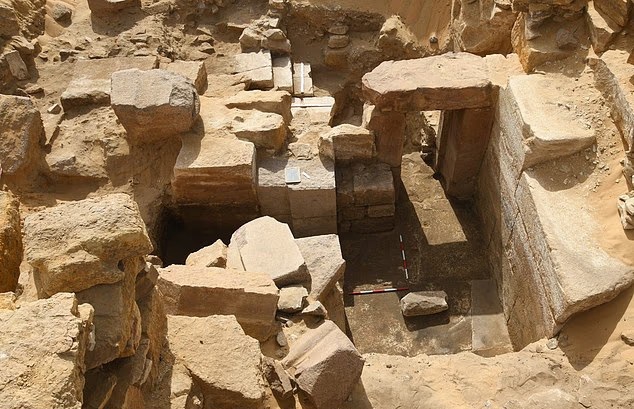
ARCHAEOLOGISTS have uncovered the remains of an ancient Egyptian temple, dedicated to the sun god Ra.
The temple is thought to be 4,500-year-old and is located about nine miles south of Cairo and five miles west of the River Nile.
The discovery includes the remnants of a “huge” building covering more than 10,000 square feet.
Researchers believe the temple was dedicated to the sun god Ra – the father of all creation.
The structure was built on the orders of Pharaoh Nyuserre Ini, who reigned from approximately 2420 BC to 2389 BC during Egypt’s Fifth Dynasty.
According to Egypt’s Ministry of Tourism and Antiquities, the temple contained a public calendar of religious events carved into stone blocks, as well as a roof used for astronomical observation.
Read more about ancient egypt
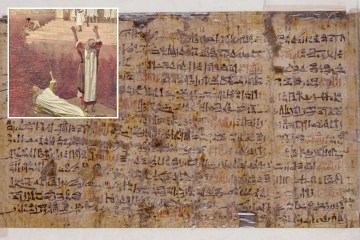
The religious events recorded include feasts honouring Sokar, a falcon-headed god linked to the Egyptian city of Memphis, a festival dedicated to Min, the god of fertility, and a procession celebrating Ra.
Images from the site show several well-preserved artefacts, including wall fragments depicting hieroglyphics and shards of pottery.
“With a unique architectural plan, it makes it one of the largest and most prominent temples of the valley,” the Ministry said.
“Carved stone fragments of fancy white limestone are also found, alongside large quantities of pottery.”
The site was first identified in 1901 by German archaeologist Ludwig Borchardt, but high water levels at the time made excavation impossible.
Recent archaeological work, which began in 2024, has now uncovered more than half of the temple that was previously buried under sediment.
Excavations have revealed the temple’s entrance, including the original entrance floor, as well as the remains of a circular granite column believed to have been part of the entrance porch.
Sections of the original stone cladding from the corridor walls have also been unearthed, along with architectural elements such as granite shingles and doors.
The dig has additionally uncovered the remains of an internal staircase leading to the roof in the northwestern part of the temple, as well as a slope thought to have connected the temple to the Nile or one of its branches.
“The roof the valley temple was probably used for astronomical observations but not for the celebration of the festivals,” said Massimiliano Nuzzolo, the excavation co-director.
Meanwhile, the lower level was “used as a landing stage for the boats approaching it from the Nile or, more likely, from one of its side channels”.
Among the most intriguing finds is a distinctive collection of artefacts, including two wooden pieces from the ancient game of Senet, which resembles modern chess.
“The sanctuary thus became a dwelling and one of the favourite local [games] was probably playing senet,” said Nuzzolo.
Initial analysis suggests that the temple was later transformed into a small residential area after it ceased to function as a place of worship.
Researchers say further excavation could reveal even more about the site’s long and complex history.
“The mission is preparing to continue its work in the coming seasons to explore more elements of this important archaeological site,” the ministry added.
This comes after discoveries of similar magnitude were made back in 2022.
Archaeologists unearthed an ancient Egyptian shrine and hidden treasures while researching the lost “City of the Sun” – Heliopolis.
Experts discovered a limestone wall, fragments of a shrine of pharaoh Takelot I (887-874 BC), and the remains of a sandstone building at their excavation site near Cairo.