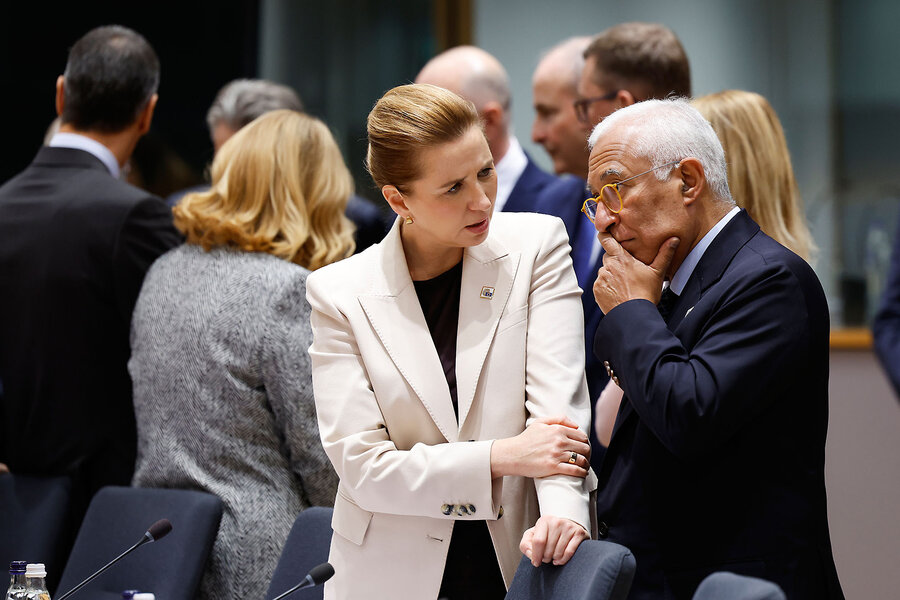
The meeting drew scant attention in Europe, and almost none in the United States. It was a ministerial discussion, not a summit. It was held in a provincial hub, not a national capital.
Yet last week’s talks in the northeastern French city of Strasbourg addressed a question whose stakes could hardly be higher.
Can Europe survive?
Why We Wrote This
In the teeth of U.S. opposition, Europe is fighting to preserve its identity, based on regional cooperation, human rights and international law. Washington is promoting a looser assortment of nationalist, Christian nations focused on keeping migrants out.
It is a question being posed – through very different political lenses, and with very different aims – by rival leaders on both sides of an increasingly strained transatlantic alliance.
U.S. President Donald Trump, whose recent National Security Strategy warned longtime European allies that they risked “civilizational erasure,” regards the centuries-old legacy of Christian Europeans as imperiled by a series of threats. These include sputtering growth within their economic union, “politically correct” social and legal policies, and, above all, a failure to stem migration from non-Christian countries in Africa and the Muslim world.
For Europeans, however, the picture could hardly be more different.
Their existential worry centers on preserving the reimagined and reconstructed Europe that was built eight decades ago to repair a fatal weakness in the “civilizational” legacy being championed by Mr. Trump and by far-right European political parties.
Old Europe was indeed a source of beautiful art and music, vibrant religious life, and groundbreaking intellectual advances. Yet its kings and emperors also battled ceaselessly – a legacy culminating in two 20th-century world wars, at the cost of tens of millions of lives.
After the second of those world wars, Europe created a series of agreements and institutions rooted in a belief that a shared interest in European cooperation, development and peace would outweigh destructive national disputes. Critically, the new order was grounded in an explicit commitment to international law and fundamental human rights.
Mr. Trump and the far-right parties surging in the polls in a number of European countries argue that this model has failed. Rallying around the issue of migration, they say Europe needs again to become a looser assortment of proudly nationalistic, Christian countries focused on securing their own interests and their own borders.
Europe’s leaders, on the other hand, are determined to demonstrate that the model has never been more urgently required – and that it can deliver a secure and prosperous Europe better than any single nation.

They point to one obvious example of the value of collective action: Europe’s support for Ukraine. But they are under pressure to resolve other challenges raised by Washington and Europe’s far right: poor economic growth, security, and, especially, migration.
That’s where last week’s Strasbourg meeting comes in.
It was held at the headquarters of the Council of Europe, set up after the Second World War as the steward of its 46 member states’ commitment to the European Convention on Human Rights (ECHR).
With far-right parties eager to ditch the convention, shut down migration and expel migrants, more than half of the member states, including Britain, presented the Strasbourg meeting with a proposal to narrow some ECHR protections against potentially unsafe deportations.
A number of countries, among them France and Germany, balked at a possible weakening of the convention’s definitions of torture or dangerous prison conditions. Their concerns were strongly echoed by human rights groups.
Still, there was unanimous agreement that Europe needs to agree on a new “political declaration,” reaffirming the 1950 convention while recognizing governments’ “fundamental responsibility” for their citizens’ security.
That statement, due by next May, is intended to set out how to “make Europe work” – how to retain the human-rights bedrock of post-World War II Europe, yet also allow national governments to curb migration.
Similar challenges loom in other areas.
Regarding Ukraine, especially as Mr. Trump intermittently presses for a Russia-friendly peace deal, the 27-member European Union is intensifying efforts to agree on how to deliver urgently required funding and military support to Kyiv.
The EU has also been struggling to find a consensus, and the political will, to step up the defense spending and manufacturing, and military preparedness, that most member states recognize is necessary to cope with Russian aggression and a likely reduction in Washington’s military support for Europe.
The good news for European leaders is that recent polls suggest a broad, grassroots understanding of these challenges, and strong support for the EU’s role in dealing with them.
And the city of Strasbourg, itself, might provide a clue to the enduring appeal of the “new” Europe, despite its many political challenges.
The city is a classic example of the “civilizational Europe” animating the political agenda that Mr. Trump and hard-line European nationalists have adopted.
The Rhine-side city, on France’s border with Germany, is home to the Notre Dame de Strasbourg cathedral, completed nearly 600 years ago and one of the continent’s most stunning examples of Gothic architecture.
But vestiges of medieval city walls are a reminder of repeated battles Strasbourg faced over several centuries. The city periodically fell under the rule of France’s rivals: Prussia and the German empire, then, in 1940, Adolf Hitler’s army.
The peace that Strasbourg has known since 1945 owes nothing to its city walls. But will modern Europe’s democratic values prove to be firmer foundations?