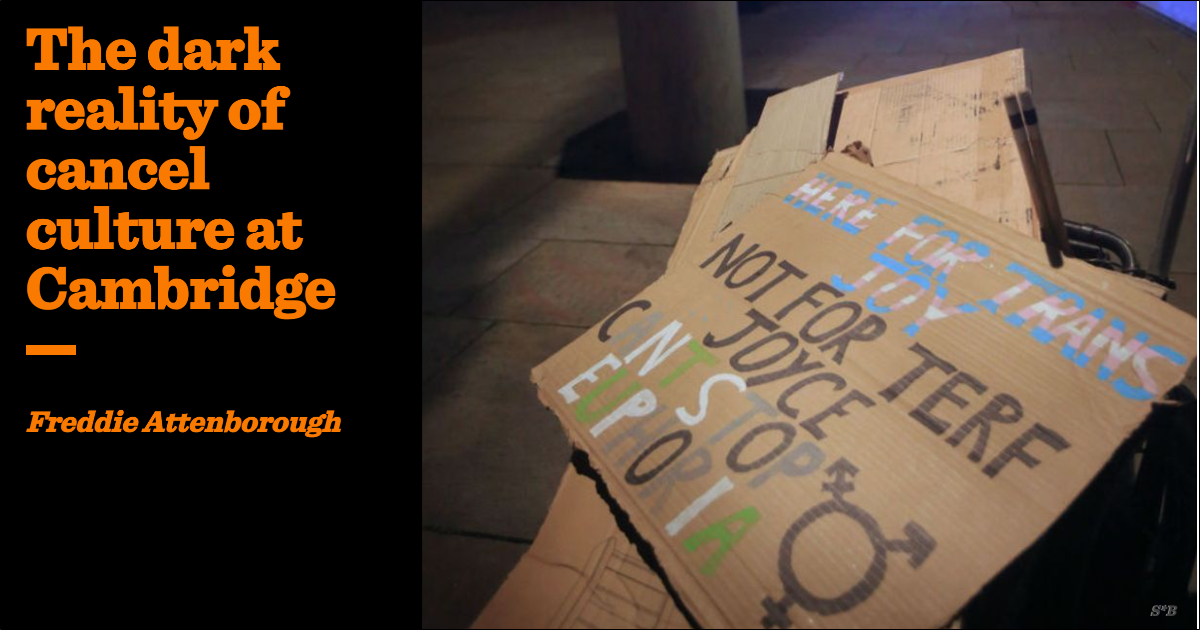
Is it possible to be out and proud as a gender-critical student at Cambridge? On paper, you might think so.
A string of recent legal rulings has confirmed that belief in the immutable reality of biological sex is protected under the Equality Act. Earlier this year, the Supreme Court likewise held that, under the same legislation, the terms “man” and “woman” refer to biology, not gender identity. That left universities little choice but to review policies that had, much to the delight of trans activists, blurred the two. Most significantly, the Higher Education (Freedom of Speech) Act strengthens universities’ obligations, requiring them to secure freedom of speech within the law for staff and students.
Then, of course, there’s the university’s own leadership. Since taking office, Professor Deborah Prentice has placed conspicuous emphasis on the free interplay of speech and ideas, warning that campuses are particularly vulnerable to self-censorship and “spirals of silence”. Hence her “Vice-Chancellor’s Dialogues”, a series of events designed, as she puts it, to “create environments in which free speech can flourish”, bringing people with “seriously conflicting opinions” into conversation and encouraging the art of “disagreeing well” on “difficult issues”.
It all sounds impeccably reasonable. Yet the problem with the modern managerial university is that such sentiments too often exist at the level of high-visibility set-piece events and op-eds, while the reality of campus life takes place elsewhere, held together by a tangled web of half-spoken norms and institutional reflexes — things one senses without ever quite being able to name, and which, for that very reason, remain difficult to contest.
There is, for instance, a distinct stratum of administrators, in thrall to gender ideology, that continues to overinterpret equality duties in ways that infringe lawful expression. Beneath this salaried layer lies the student world, home to the biggest enculturation device of all: the accommodation system. It is here — in the halls and the common rooms — that students encounter the Progress Pride flags, the rainbow lanyards, the exhortations to share one’s preferred pronouns, and do what many people in search of belonging do: acquiesce, join the crowd, and chant along to the permitted slogans with sufficiently evangelical zeal to pass as “one of us/we”.
Her “crime” was to be seen reading Helen Joyce’s bestseller Trans
Do statutory duties, legal rulings and stirring words from above penetrate to this level — particularly for young women who, for daring to insist that biological sex matters in policy and law, have for years been under fire on the front line of the culture wars?
The appalling ordeal endured by Thea Sewell, a second-year undergraduate philosophy student at Christ’s College, suggests not.
Her “crime” was to be seen reading Helen Joyce’s bestseller Trans: When Ideology Meets Reality — and, worse, to treat it as one treats books at university: as something to talk about. She mentioned it to a friend who professed an interest in politics. It’s fascinating. You should read it. Let me know what you think.
Within days, everything fell apart.
A fellow student heard about this thoughtcrime, discussed it with others, and confronted her in a shared kitchen with the McCarthyite question: “Are you a TERF?” Thea owned “some gender-critical books”, she said. Thea had been to a Helen Joyce talk, she added. Thea owning books by bigots was “the same as being a bigot”, this representative of one of the world’s oldest and most prestigious universities concluded.
When Thea rang the original friend to ask what was going on, she was put on speakerphone, with others listening in. The denunciation, when it came, was delivered in a tone completely different to anything she’d heard from her friend before. Thea was a “bigot” (a go-to word for some at Christ’s, it would seem — and one that invites an obvious question about projection) and everyone deserved to know her “hateful views on trans people”.
Most of her friends ceased contact. Apparently, they couldn’t be seen with her for “social optics”. Allegedly, Thea was also “divorced” by her “college wife” — a fellow student with whom she was due to help settle in some of next year’s undergraduates — who harangued her down the phone. Messages even arrived from members of her philosophy cohort telling her that her views were “completely reprehensible”.
Around the same time, the Junior Common Room circulated an open letter “in support of trans students” — which, though it didn’t name her, many students took to imply was about her, and that whatever she’d done must have been so heinous, so discriminatory, that it couldn’t “just” be about her choice of reading matter.
The ostracism became so severe that Thea returned home for a few weeks. During her absence, fellow students speculated with ghoulish relish about whether she’d taken her own life. None checked on her welfare.
On her return, she felt unable to use the shared facilities in her accommodation without encountering hostility. So she was moved to another room in a different building, and had to transport her belongings during the night so as not to be seen. When she went back one final time — again under cover of darkness — to collect what remained, she discovered the derogatory slur “TERF” had been scratched into her door.
This is a long way from Professor Prentice’s talk of “disagreeing well”
Thea continues her studies. But it is no surprise that she now attends fewer lectures and tutorials, fearing how fellow undergraduates will treat her. Meanwhile, a low-level pressure builds, perfectly calibrated to remain beneath the threshold of harassment: stares held a fraction too long, comments whispered in voices too soft to decipher but too loud not to hear, stifled giggles, surreptitious photographs taken on campus, no doubt later to be circulated and mocked in private messaging groups.
This is a long way from Professor Prentice’s talk of “disagreeing well”. And therein lies the problem with a form of managerialism where leadership operates in a rarefied space above the fray. To lead is to deliver “exciting” visions and values, while the concerns of staff and students appear — if they appear at all — as depoliticised percentages buried in audit trails, or in those fleeting moments of unscripted honesty that occasionally erupts into otherwise choreographed, media-friendly events.
The “Vice-Chancellor’s Dialogues” is symptomatic of this tendency. Since launching in 2023, Prentice’s much-trumpeted initiative has resulted in just three events. This is culture in the Matthew Arnold mould: an enlightened elite periodically demonstrating a more refined sensibility and hoping the masses will dutifully fall into step.
What Thea’s ordeal reminds us, however, is that outside a few curated pockets of performative “best practice”, campus life continues to evolve within the warp and weft of collegiate existence, shaped by informal norms and unspoken pressures. As Raymond Williams once famously remarked, culture is not the plaything of the powerful, but something “ordinary” — something lived; and precisely because it is rooted in particular groups at particular times, something stubbornly resistant to change.
This is how we end up with rousing free-speech soundbites, photogenic set-piece dialogues … and an accommodation block in which a student has to creep back to her room at night to avoid harassment, only to find the slur “TERF” carved into her door.
If Professor Prentice wants to know how bad the problem is becoming, she should announce that the fourth topic in her series will be a debate on “the importance of women’s sex-based rights” — a “difficult issue” that, curiously, she has so far avoided – and take the show on the road, visiting each of her thirty-one colleges.
Each night, hurried by a security detail past masked protesters hoping to shut the event down, she could read the room: the aggressive body language, hostile gestures, sullen stares, staged walkouts, hyperventilated denunciations, the repeated calls for Cambridge’s “bigoted” Vice-Chancellor to resign for “debating trans lives”. At Christ’s, she could even read the slur carved into Thea’s door.
If we want women with heterodox views to feel welcome at Cambridge — to be able, in Prentice’s own phrase, to disagree well — this is the “ordinary” level at which leadership now needs to be felt.