The dome built over the remains of the Chernobyl disaster has been damaged, raising fears it may no longer be able to contain radioactive material.
Officially known as the New Safe Confinement (NSC), the at least $2 billion protective shield was constructed over Reactor 4, which caused the world’s worst nuclear disaster in 1986.
The United Nations‘ International Atomic Energy Agency (IAEA), a nuclear watchdog, revealed this month that the NSC was severely damaged in a Russian drone strike in February.
The IAEA team conducted a safety assessment earlier this month, finding the dome had lost its primary safety functions, including confinement capability.
IAEA director general Rafael Mariano Grossi said: ‘Limited temporary repairs have been carried out on the roof, but timely and comprehensive restoration remains essential to prevent further degradation and ensure long-term nuclear safety.’
The inspection brought some relief, confirming that the dome’s main structure and monitoring systems remain intact.
But beneath the damaged shelter lies massive quantities of radioactive material from the 1986 disaster, making the site a ticking time bomb.
The IAEA has urged urgent repairs and upgrades to Chernobyl’s protective shelter, calling for better humidity control, advanced corrosion monitoring, and a high-tech automatic system to keep the radioactive reactor remains under control.

Nuclear watchdogs discovered this month that the dome built over the remains of the Chernobyldisaster has been damaged
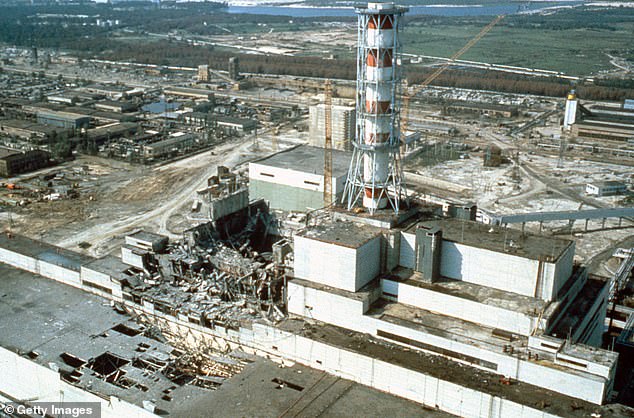
It began on April 26, 1986, with the explosion of Reactor 4 that led to the largest release of radioactive material into the environment in human history
The damaged dome is the latest of several such expert missions since September last year, when the substations became increasingly affected by the military conflict.
‘These substations are essential for nuclear safety and security. They are absolutely indispensable for providing the electricity all nuclear power plants need for reactor cooling and other safety systems,’ Grossi said.
‘They are also needed to distribute the electricity that they produce to households and industry.’
In 2026, with support from the European Bank for Reconstruction and Development (EBRD), the Chornobyl site will undertake additional temporary repairs to support the re-establishment of the NSC’s confinement function, paving the way for full restoration once the conflict ends.
‘The IAEA – which has a team permanently at the site – will continue to do everything it can to support efforts to fully restore nuclear safety and security at the Chornobyl site,’ Grossi said in a statement.
It began on April 26, 1986, with the explosion of Reactor 4 that led to the largest release of radioactive material into the environment in human history.
Around 30 to 50 people died from immediate blast trauma or acute radiation sickness in the first few months after the disaster
Following the tragic event, humans were evacuated from Chernobyl and the surrounding areas to avoid the extreme levels of radiation.
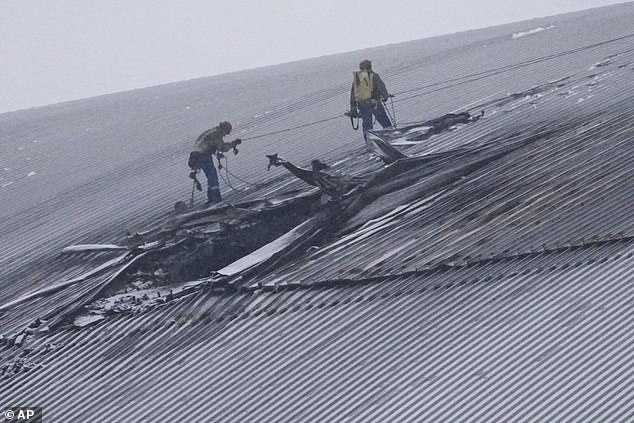
The IAEA team conducted a safety assessment earlier this month, finding the dome had lost its primary safety functions, including confinement capability
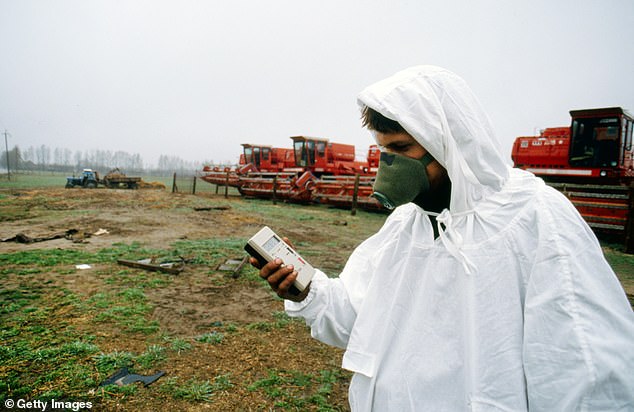
Pictured is someone measuring levels of radioactivity in the area surrounding the Chernobyl nuclear power in 1990
While long-term deaths from radiation-induced cancers are harder to quantify, the UN Chernobyl Forum estimated up to 4,000 eventual fatalities among highly exposed populations, though figures vary widely, with Greenpeace suggesting tens of thousands, highlighting the difficulty in assessing the full toll.
From then on, the site was known as the Chernobyl Exclusion Zone (CEZ).
The absence of humans has allowed wildlife to flourish and thrive in the CEZ, which contains 11.28 millirem of radiation, six times the allowed exposure amount for human workers.
A study in 2024 found that the dogs had mutated to develop a new superpower – they are immune to radiation, heavy metals and pollution.
Scientists collected blood samples from 116 stray dogs living in the CEZ, finding two different populations that were both genetically distinct from other dogs in the surrounding area.
This suggests the animals have adapted to withstand long-term exposure to this toxic environment and would explain why they have continued to thrive in the wasteland.
Norman J Kleiman, an environmental health scientist at Columbia University, led a team of researchers to investigate how living in this harsh environment impacted the dogs’ genetics, as disasters that contaminate or destroy habitat can force wildlife to adapt to adverse environmental changes.
He and his colleagues collected blood samples from 116 ‘semi-feral’ dogs, which were humanely captured around the Chernobyl Nuclear Power Plant and 10 miles away in Chernobyl City.
These samples were taken during sterilization and vaccination procedures conducted by the Clean Futures Fund Dogs of Chernobyl program in 2018 and 2019.

Officially known as the New Safe Confinement (NSC), the at least $2 billion protective shield was constructed over Reactor 4, which caused the world’s worst nuclear disaster on April 26, 1986
The blood samples were then transported to the US for DNA extraction and analysis, which revealed the dogs’ unique genetic makeup.
‘Somehow, two small populations of dogs managed to survive in that highly toxic environment,’ Kleiman said in a statement.
‘In addition to classifying the population dynamics within these dogs . . . we took the first steps towards understanding how chronic exposure to multiple environmental hazards may have impacted these populations.’
He and his colleagues published their findings in the journal Canine Medicine and Genetics in March 2023.
Specifically, the researchers found nearly 400 ‘outlier loci,’ or genomic locations that show behavior or patterns of variation that are extremely divergent from the rest of the genome.
Then, they identified 52 genes associated with these outlier loci that ‘could be associated with exposure to the contamination of the environment at the Nuclear Power Plant,’ the study states.
In other words, the dogs’ contaminated environment caused them to develop genetic mutations that were passed down from generation to generation, ultimately driving their adaptation to the harsh conditions.