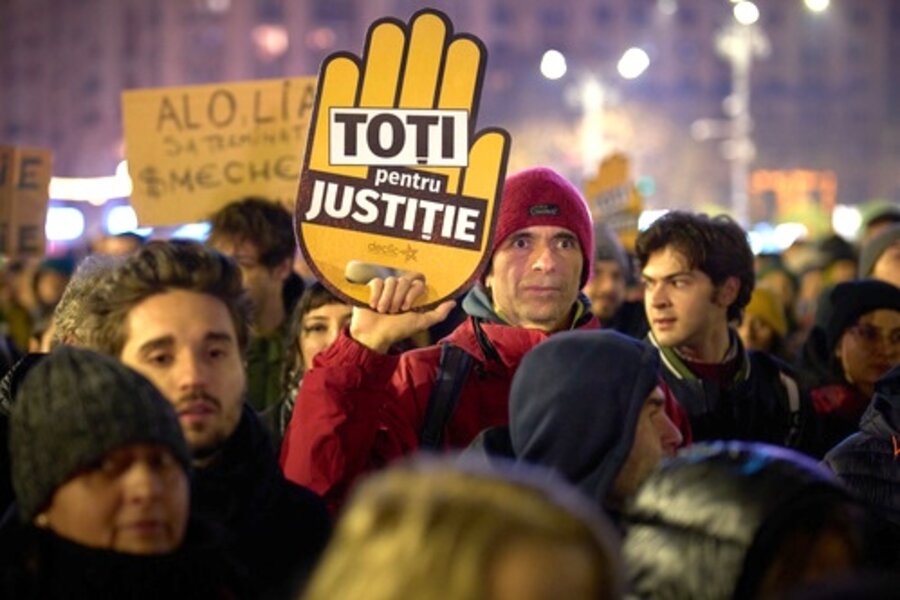
Over the past week, Romania has been rocked by protests against corruption. Like many of its neighbors, the Eastern European nation has seen similar uprisings for more than a decade. This time, however, many protesters have appealed to people’s better angels. They lean toward affirming principles of governance rather than merely opposing evil acts.
One chant favored during the protests, for example, is “Justice, no corruption.” Another is “Integrity, not complicity.” One protest sign reads: “Respect for honest magistrates.”
In the midst of the demonstrations – which focus on a media report that some judges helped officials avoid trials on corruption charges – hundreds of judges and prosecutors signed an open letter. It supports whistleblowers inside the judicial system who, despite threats of punishment, bravely expose wrongdoing.
“Truth and integrity must not be penalised but protected,” the letter stated.
This shift toward an emphasis on higher qualities of thought was made clear in Romania earlier this year. A former anti-corruption activist, Nicuşor Dan, became president in May after winning an election with the slogan “Honest Romania.” Now, in response to the letter, he invited prosecutors and judges to an “open-ended discussion” on judicial reform Dec. 22. (The date is remembered as the anniversary of the end of a dictatorship in 1989.)
Like many countries still mired in corruption despite reforms in laws and institutions, Romania struggles with defining corruption in many situations or effectively measuring it. In early December, the United Nations held its second global conference on corruption measurement. The effort is more than a technical exercise. “It’s a foundation for building integrity systems that rely on evidence,” said Marcos Neto, U.N. Assistant Secretary-General.
In fact, one of the newer ways of tallying corruption in countries is the Index of Public Integrity. It has been effective in focusing attention on three pillars that help embed trust in government: an independent judiciary, a free press, and digitally empowered citizens. For Romanians protesting on the streets, their selfless appeals to people’s integrity – and similar immeasurable traits – are not simply the inverse of corruption. They are an invitation to participate in a corruption-free life.