Travel executive Sanjay Arora recalls a work trip to the historic Amer Fort in India’s northwestern Rajasthan state, where he saw tourists riding an elephant. “It was swaying under their weight,” he says. “Its eyes were tired.”
Although Mr. Arora left Rajasthan feeling sad for the gentle giant, he was not fully cognizant, at the time, of the issues surrounding the welfare of captive elephants. A few years later, in 2023, Mr. Arora co-founded QXP India Travel, a luxury tour business. He acknowledges that in the beginning, the company occasionally included elephant rides at Amer Fort in their guest itineraries. Some Indian travel firms promote such rides as a quintessential tourist experience.
Then he learned about the Refuse to Ride campaign launched by Wildlife SOS, an animal welfare and conservation organization headquartered in New Delhi.
Why We Wrote This
Riding elephants has been promoted as a quintessential tourist experience in India. A New Delhi-headquartered nonprofit encourages compassionate alternatives.
The campaign’s website describes the abuse that elephants endure during training, and later, in their lives as riding elephants. “The more we understood the hidden suffering,” Mr. Arora says, “the clearer it became that we could not continue to support” elephant riding.
QXP, whose clients are predominantly from the United States, the United Kingdom, and Australia, has since removed elephant rides from all itineraries it offers. “For us, it was not just about removing an unethical tourist attraction,” Mr. Arora says, speaking to the Monitor via Zoom. “It was about replacing it with something more powerful: compassion.”
“Their spirit is broken”
The International Union for Conservation of Nature lists the Indian elephant subspecies (Elephas maximus indicus) as endangered in the wild. Yet the country has an estimated 2,700 to 3,000 captive elephants. “[Practically] every captive elephant we see was once a wild one,” says Kartick Satyanarayan, the CEO and co-founder of Wildlife SOS. “They can never be put back in the wild.”

Snatched from their herd at a young age, elephant calves are starved and beaten into submission. “Their spirit is broken so people can ride them,” he says. “No wild elephant will let a human get on its back.”
The animals are then used for begging or for providing rides to tourists. A mahout, or handler, controls elephants’ movements using a sharp, pointed tool known as an ankush, resulting in tattered ears and other injuries. The animals also are often restrained by spiked metal chains that cause immense trauma to their legs. Captive elephants can experience a range of health issues caused by abuse and neglect.
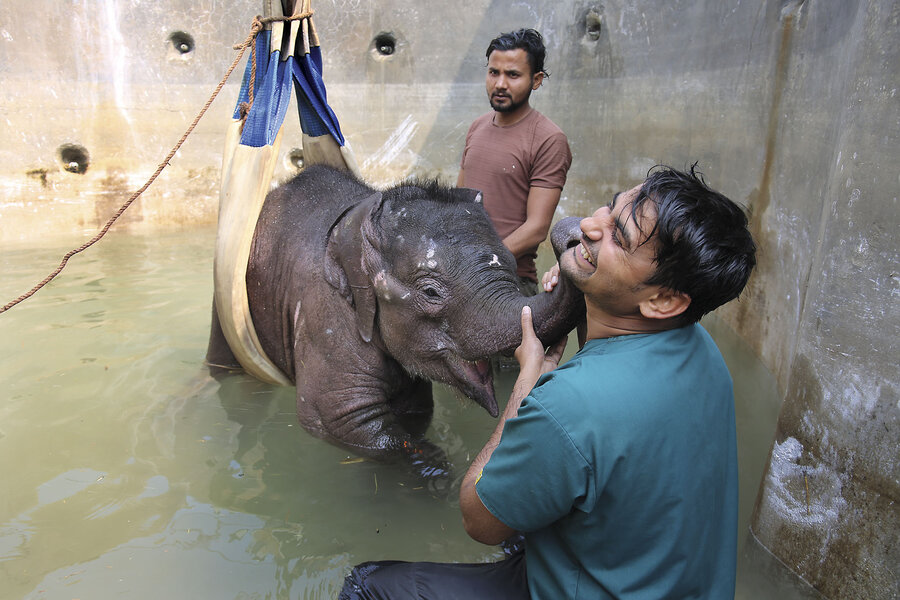
Since its first elephant rescue in 2009, Wildlife SOS has provided care for more than 300 captive elephants, either at its facilities or the animals’ location. Currently, Wildlife SOS is rehabilitating and housing 37 rescued elephants. Most of the animals are at the Elephant Conservation and Care Centre (ECCC) and the state-of-the-art Elephant Hospital, both in the town of Farah in northern Uttar Pradesh state, while four elephants are at a facility in northwestern Haryana state. The hospital is the first of its kind in India.
This year, Wildlife SOS launched a mobile veterinary unit called Haathi Sewa in Hindi, which translates to “in service of elephants.” The vehicle, staffed by experienced veterinarians, has diagnostic tools, including X-ray and ultrasound machines. The nonprofit also has a hotline for reporting an elephant in distress.
Ethical options
In addition to creating awareness through its Refuse to Ride campaign, Wildlife SOS works to educate tour operators like QXP. Mr. Arora acknowledges the nonprofit’s critical role in shaping his company’s understanding of the problematic issues around elephant rides. “They offered us research-backed guidance; powerful rescue stories; and practical, ethical alternatives,” he says. “When travelers ask about elephant rides, we use it as an opportunity to share the reality behind the experience.”

Wildlife SOS has also partnered with the Responsible Tourism Society of India, which has thousands of local tour operators under its umbrella. “Once people understand the abuse, they change their mind very quickly,” Mr. Satyanarayan says. “The same revenue, or more, can be generated without subjecting elephants to abuse.”
While some tourists coming to India forgo elephant rides in favor of jeep rides and walking tours, Mr. Satyanarayan urges travelers who nonetheless seek an interactive experience with elephants to do their due diligence and investigate. “Does [the facility] ensure the welfare of the animals in its care, or is it just exploiting them?” he asks. “Any place where there is riding, painting of the elephant, touching, and bathing of elephants by tourists is a big no-no.”
As part of Wildlife SOS’ volunteer program, tourists can help care for rescued elephants in a meaningful yet hands-off manner. The ECCC is open to receiving both short-term volunteers for a few hours as well as longer-term ones, in exchange for a donation to support the organization’s work.
Volunteers get to join elephants on their daily walk, help clean the enclosures while elephants are out walking, and assist with meal preparation.
Leena Walia-Thomas, a Mumbai-based finance professional, has volunteered with Wildlife SOS for more than a decade. She appreciates how detail-oriented her volunteer tasks have been, especially those related to preparing the elephants’ snacks. She washes the fruits thoroughly, chops them down to the right size, and weighs them to meet dietary requirements.
“Everyone should visit to see the care and compassion with which Wildlife SOS looks after these elephants,” Ms. Walia-Thomas says. “And to understand how not to aid animal cruelty.”
Wildlife SOS also retrains the mahouts of the rescued elephants and employs them as caretakers at its centers. “We provide decent wages, medical insurance, on-site meals, and other benefits,” Mr. Satyanarayan says. “We help them unlearn their bad training habits and relearn kind techniques that use positive reinforcement.”
The nonprofit’s latest campaign focuses on eliminating the centuries-old practice of using elephants for begging. These
elephants are forced to walk in the hot sun on scorching tar roads, often while in poor health. Mr. Satyanarayan estimates the country has 270 begging elephants.
“Our goal is to provide every begging elephant a life of safety, dignity, and good health,” he says.