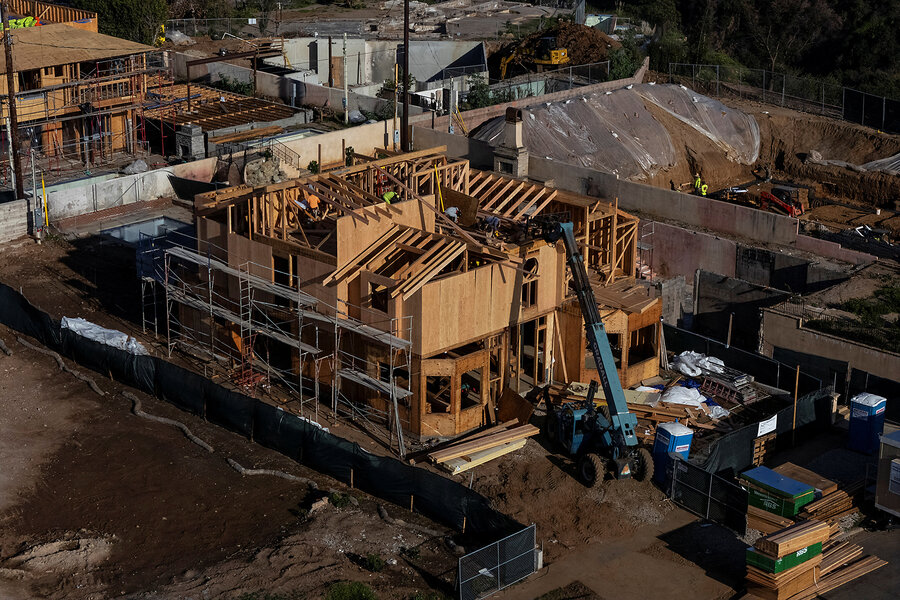
In the aftermath of the Los Angeles wildfires, California is trying a new approach to crafting the recovery: A first-of-its-kind attempt for the state, leaders say, to involve the public in policymaking.
Emerging from a disaster as large as the wildfires generally falls to agencies and elected officials. California is offering a vehicle for the public to help shape whatever comes next, with a pilot program called Engaged California.
The state harnessed online discussions to give policymakers a data-driven picture of the public’s opinions, suggestions, and priorities. The result, says an administrator, is something residents can use to hold their government leaders accountable.
Why We Wrote This
Backers of a process called deliberative democracy say inviting the public to collaborate in community problem-solving is a way to rebuild trust in government and neutralize political polarization. California is using the model as part of its fire-recovery planning.
Engaged California released an action plan in November, based on input from 3,000 Angelenos over a six-month period. The process used a form of deliberative democracy, which invites communities to participate in decision-making by sharing opinions, and then talking – and listening – to each other.
“The conversation was incredibly civil, incredibly productive,” says Jeffery Marino, director of California’s Office of Data and Innovation, which runs the effort with a coalition including the Carnegie Endowment for International Peace.
The effort may be a model for cutting through political polarization and the public’s waning trust in government, which is at historic lows: In a recent Pew Research Center poll, 17% of respondents said they trust federal leaders to do what is right. Deliberative democracy, which can be traced back to Aristotle, has succeeded in other countries and in the U.S. In Ireland, for example, citizens’ assemblies work closely with Parliament. Fort Collins, Colorado, used it to develop a strategic housing plan.
In an era of ideological intransigence, purposeful discussion can move people toward greater tolerance for others’ beliefs, says James Fishkin, director of the Deliberative Democracy Lab at Stanford University, which advised Engaged California. The lab’s work includes introducing the process to Mongolia, which now requires it as part of the country’s constitutional amendment process.
“It increases trust generally. It increases respect for the people you disagree with most strongly. And it increases the tendency to vote,” Professor Fishkin says.
Solving shared problems
Deliberative democracy is intended to build consensus and strengthen connections between lawmakers and the people they govern. If done well, say advocates, the public creates a problem-solving agenda and then finds solutions, rather than leaders trying to convince the public of their vision. Institutes like the Center for Public Deliberation at Colorado State University administer these deliberations for local governments or nonprofits.
Generally, the process involves two parts: a survey of participants to determine what needs consideration, and then a deeper, guided discussion. Administrators randomly select the players, who are often paid for their time. Ideally, the makeup of the group matches community demographics.
Engaged California adhered to the two-part process of survey and discussion, but in order to hear from as many people as possible, it lowered barriers to participation: demographic information was requested but not required, people were able to skip survey questions, and the online discussion forum was not held in real time.

When a community comes together to find solutions for collective issues, “partisan identities tend to melt away,” says Sabrina Slagowski-Tipton, the Colorado State center’s managing director. “We very rarely hear at an event, ‘I am a Republican, and here’s why I feel this way.’ Or ‘I’m a Democrat and I want to talk about this.’”
But the process is labor-intensive and takes time, like the two-year-long project she worked on for Fort Collins that resulted in a housing plan, including adoption of new land-use codes.
Transparency about how the input is used has a big impact, she says. And citizens are more willing to have good-faith discussions with local agencies that go through the deliberations, even when they have complaints.
“More and more people are also just realizing how important it is and how fulfilling it is to feel like you are part of your community,” she says.
Pivoting to fire recovery
The Los Angeles wildfires struck in January as Engaged California was preparing to launch on a different subject. Administrators saw an opportunity to support the fire recovery, says Mr. Marino. City leaders pushed back, he says, suggesting it could backfire: Instead of thoughtful discussion, there would be anger.
The opposite happened: Less than 5% of the online conversation had to be suppressed, and much of that was due to people posting business links, not spewing vitriol.
Another surprise was the agreement among participants – despite broad differences in the two communities most impacted by the fires, they expressed the same priorities. “They wanted support in terms of fast-tracking, permitting, getting more financial support, while at the same time building for resilience,” Mr. Marino says.
The November report delivered a plan with five focus areas: burying power lines and equipment underground, improving water systems for fighting fire, improving emergency communications, helping survivors connect with financial support programs, and helping residents get permits so they can rebuild.
Some participants were critical of what they say is a government program out of touch with the people it’s trying to help. Joy Chen, a former deputy mayor of Los Angeles who heads the nonprofit Eaton Fire Survivors Network, called the platform disappointing.
“There was not a place that it seemed like they were collecting our actual priorities,” she says. “They’re asking, ‘Well, what do you think about our priorities, being state government,’ as opposed to, ‘I’m concerned about your priorities.’”
Each of the report’s focus areas, for instance, links to steps that are already underway to address those issues, like executive orders issued by Gov. Gavin Newsom and LA Mayor Karen Bass to ease permitting, and a state order that was signed in March to fast-track burying power lines in the burn areas.
Mr. Marino acknowledges some challenges. Participants weren’t paid, which meant the process was open to whoever had the time and inclination as opposed to administrators being able to control for demographics. And then there’s skepticism – “the idea that your government is saying, ‘No, trust us this time, we really mean it this time,’” he says.
But, he says, the online engagement allowed all types of voices to be heard, not just the loudest ones. And the Office of Data and Innovation, which runs Engaged California, turned that engagement into information that policymakers used as they were coming up with plans to rebuild.
Along with the report, the state has published more than 1,500 public comments, including these (edited for brevity):
- “If folks can’t afford to rent somewhere, they should get an easy to access, free permit to stay on their property in a tiny house or ADU [accessory dwelling unit] while their house gets rebuilt.”
- “What warning systems? Palisades had evacuation routes, only there weren’t nearly enough of them.”
- “Knowing a full week in advance that winds were coming, there was no excuse for LA Fire to wait UNTIL fires had begun before deploying.”
- “This is an opportunity to apply lessons learned from here and other cities around the world and to modernize infrastructure.”
The final report establishes a record of what people say are their top priorities for recovery.
The program’s next topic is already underway: enlisting state employees to help make California’s government more effective and efficient.
The deliberative democracy process “not only tells you what the people think, but why they think it,” says Professor Fishkin, “and that in itself can have an effect when people think about the issue.
“If we see that as a way to sort of cure the extreme partisan divisions and to get people to think about the issues, we could actually greatly improve our democracy.”