Announcement of the latest Turner Prize winner last Tuesday was immediately hailed as a triumph for progress. Commentators celebrated the fact that Nnena Kalu was the first learning-disabled winner of this famous annual contemporary art award. In a statement, Chair of the jury and director of Tate Britain, Alex Farquharson, called it a watershed moment, before quickly dispelling any suspicion that Kalu was selected as the winner because of her autism.
Winners of the Turner Prize enter a hall of infamy
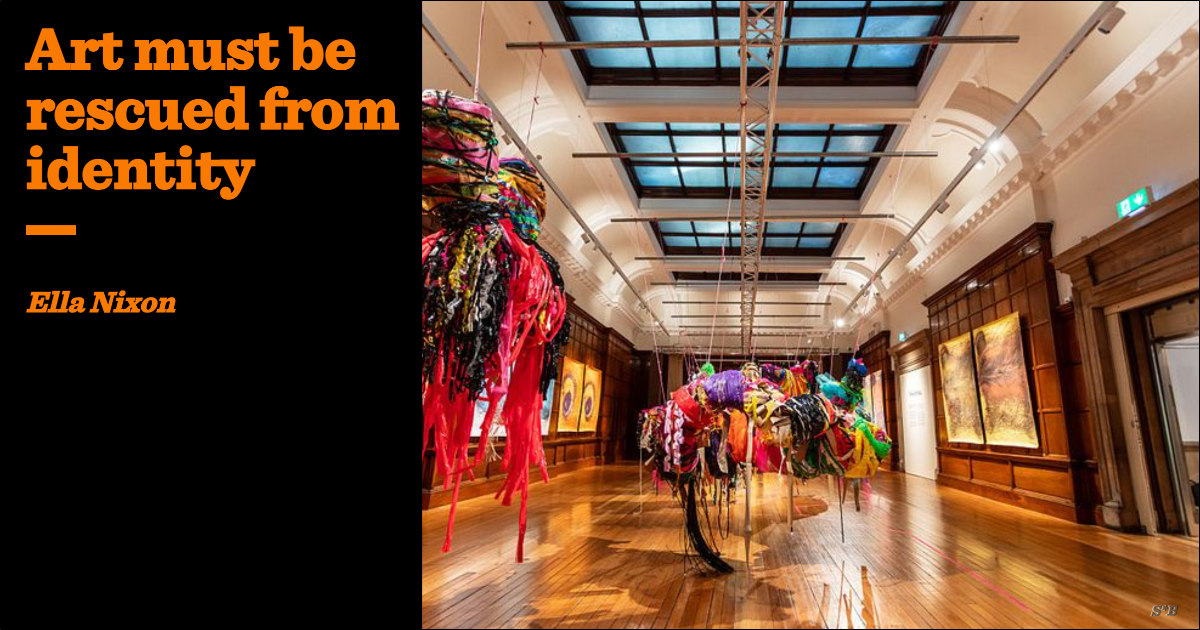
Discussion of Kalu’s disability is as closely intertwined with the discourse about the award as the brightly coloured pieces of fabric she painstakingly wraps around each cocoon-like hanging sculpture. The aesthetic qualities of these works are an afterthought in commentary on the prize, which is not surprising given its emphasis on identity politics. For this reason, Kalu’s victory should not be seen as marking a new era for a more inclusive art world, but quite the opposite.
Winners of the Turner Prize enter a hall of infamy. From its very inception, controversy arose when the prize — established to honour British art — was awarded to London-born Malcolm Morley, who had lived in New York for the prior twenty years. Controversy shifted to the artworks themselves in the following years — notably, in response to Damien Hirst’s dissected cow and calf preserved in formaldehyde in 1995, and later the elephant dung used by Chris Ofili for his winning exhibit in 1998.
For conservative critics and the befuddled public, the Turner Prize represents everything that is wrong with contemporary art. In recent years, its symbolic potential has expanded from aesthetic critique alone to broader public dissatisfaction with social justice. Winner of last year’s prize, the self-identifying transmasculine Jesse Darling, used the opportunity to unsettle “notions of labour, class, Britishness and power”. Nominees for the award this year included a non-binary mixed-heritage artist, Rene Matić, whose work criticised British identity and political hypocrisy; Zadie Xa’s ecological exploration of diasporic identities and otherness; and Baghdad-born artist Mohammed Sami’s canvases of imperial conflict and violence.
An excessive focus on social justice has fostered a general apathy towards the prize — a far cry from fulfilling its original aim of showcasing the “most exciting developments in British art”. The demand for novelty is superficially and blandly fulfilled through a checklist of current political terms. From this understanding of “developments”, and despite claims of relevance, momentum failed to grow between the exhibition’s opening in Bradford in April and the announcement of the winner in December. Every year, news of the winner dawns as an unpleasant reminder of the nature of institutionally-selected contemporary art — a discomforting realisation, akin to the moment when one notices that the bath water has turned cold.
The Tate recognises its own identity problem, even having an FAQ page on its website about the prize titled “How is it relevant?”. This defensive tone echoes Farquharson’s statement, but the public is intelligent enough to see through this patronising language. For those who lack confidence discussing art or are uncertain about their own judgement, framing the prize as a victory for social justice makes honest conversation difficult. At least, with Tracey Emin’s unmade bed, people could laugh without it being an insult to a marginalised community.
Due to the centrality of identity politics, criticism of Turner Prize nominees is often seen as a personal or political insult. It’s difficult to imagine King Charles making a statement now like the one he made in 2002, when he said that the prize had “contaminated the art establishment”. Public commentators make such statements today at peril. However, unintentionally, this does an innjustice to Kalu as a practising artist. Jonathan Jones criticised her work on formal grounds, quite rightly unafraid to express his scathing judgments. In doing so, her work was treated as part of the art establishment, rather than, as Alastair Sooke suggested in The Telegraph, “a collective act of goodwill” for the disabled community made by the jury.
The unsubtle, clumsy heralding of identity both ghettoises marginalised artists and further disconnects the Turner Prize from the public and wider art community. Engagement with Kalu’s work is framed within the superficial concept of “relevance” — an overused term in the prescriptive prerequisites of public funding bodies, such as the Arts Council, which has even published a ten-page document to define this single word. Checking off identities is an easy way to indicate progress — an articulation of concrete value in a contentious field that constantly seeks to prove its public worth — without needing to translate or justify its intangible aesthetic impact.
George Orwell’s first rule of writing is never to use a figure of speech which you are used to seeing in print. Sadly, this would stifle any commentary about Kalu and her exhibition, which may or may not be deserving based on aesthetic grounds alone. Inclusivity in the famously elite and exclusive art world is undoubtedly a fact to be celebrated, but not under the guise of a Turner Prize-winning effigy.