In China, they call it “Crazy Animal Town.”
Chinese filmgoers have indeed gone a little bonkers over the Hollywood animated buddy-cop comedy “Zootopia 2” – starring a police officer rabbit named Judy and her partner, a fox named Nick.
“After watching it, I was extremely excited,” says teenager Li Jialing, as he leaves a Beijing theater with his mother and younger brother. That theater is currently screening “Zootopia 2” 27 times a day.
Why We Wrote This
Disney has struck gold with the “Zootopia” franchise, breaking box-office records in one of the most profitable but challenging movie markets in the world: China. How did they do it?
“All my friends are going to see it,” he says.
The “Zootopia 2” craze has produced impressive box office numbers. Since opening on Nov. 26, the film has raked in more than $444 million, making it the highest-grossing imported animated film ever released in China. The film also broke the record for the biggest single-day gross for a foreign film in China – a whopping $104 million, according to data from the Chinese ticketing platform Maoyan, cited by China’s state-run media.

Ann Scott Tyson/The Christian Science Monitor
The popularity of “Zootopia 2” bucks a broad trend. Over the past decade, domestic-made films have captured an increasing share of the market, edging out Hollywood offerings. That reflects Beijing’s tight control over which foreign films are released in China and the government’s promotion of patriotic blockbusters, such as the “Wolf Warrior” action series and “The Battle at Lake Changjin,” which depicts heroic Chinese soldiers fighting Americans in the Korean War.
“Hollywood has not done well recently” in China, says Stanley Rosen, professor of political science at the University of Southern California and an expert in Chinese film.
Many Hollywood films are barred by Chinese film regulators, or censored – leading some in the U.S. film industry to rethink the Chinese market altogether. Makers of the U.S. films “Top Gun: Maverick” (2022) and “Spider-Man: No Way Home” (2021), for example, rejected Chinese censorship and still made $1.4 billion and $1.9 billion, respectively, in box-office sales globally outside China.
“Once it was clear these films were not going to be accepted for China, they had a completely different marketing strategy … and did extremely well,” Dr. Rosen says. “That helped to convince Hollywood they don’t really need China so much.”
Beijing, for its part, remains eager to remind Hollywood of its status as the second-biggest film market in the world. The country currently accounts for about 45% of “Zootopia 2”’s worldwide box-office sales.

Still, other Hollywood films will have a hard time matching the enthusiasm surrounding “Zootopia 2.” Chinese moviegoers are even bringing their dogs and other pets to special showings in several cities – spurring social media posts featuring furry friends and their owners bouncing to the theme song “Zoo” by Shakira.
So why the frenzy over “Crazy Animal Town”?
One reason is the popularity of the first “Zootopia,” released in 2016.
Mr. Li saw that film when he was about 7 years old and has never forgotten it. “The last time I was so excited, so happy,” he raves, adding that “this one is a significant improvement in quality.”
Moreover, a generation of young people captivated by “Zootopia” nearly a decade ago now have children of their own and want to bring them to see the sequel.
“I really liked the first one, so when the second one came out, I wanted to bring my child,” says Zhang Rui, a telecommunications company worker who saw the movie with her 6-year-old daughter.
Capitalizing on that success, Disney opened the world’s only “Zootopia land” at the Shanghai Disney Resort in late 2023, attracting flocks of fans. “Everyone watched the first movie, then went to Disneyland to play at [Zootopia], and is now watching the sequel,” says Ms. Zhang.
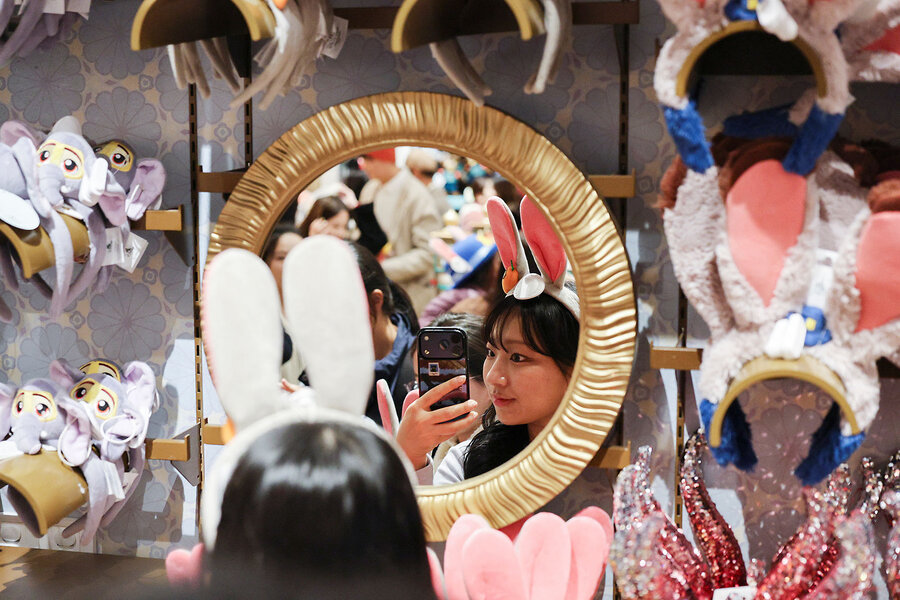
Disney is also marketing “Zootopia 2” in China with special short preview films and a “Zootopia”-themed aircraft – the Disney-Zootopia Express – unveiled as part of the China Eastern Airlines fleet. Theaters are selling all sorts of merchandise, from “Zootopia” key chains and phone cases, to dolls and snacks.
The overall popularity of animated films in China is another factor in the success of “Zootopia 2.” It follows this year’s Chinese animation sensation “Ne Zha 2,” the world’s highest grossing movie in 2025, with $1.8 billion in Chinese earnings.

Ann Scott Tyson/The Christian Science Monitor
As for the film’s message, Ms. Zhang appreciates how “Zootopia 2” touches on deeper themes, such as overcoming social ostracism and personality conflicts – although they might be over the head for children her daughter’s age. “Children might not grasp … the layers of meaning,” she says.
Yet that depth is also part of what gives “Zootopia 2” its broad audience appeal in China, moviegoers say.
“The protagonists are very brave, intelligent, and witty,” says Ms. Liu, a university-educated Chinese teacher in her 20s who declined to give her first name to protect her privacy. She was a fan of the first “Zootopia.”
“Their personal charm is what makes [the film] so appealing and charismatic,” she says. “It’s the spirit they embody.”