IN one of my encounters with Pink Floyd’s Nick Mason, he cast his mind back to his first dealings with the “crazy diamond”.
This would have been late 1964, early ’65, when the band still called themselves The Tea Set because they rehearsed in a basement tearoom at Regent Street Polytechnic in London.
The drummer recalled with great affection the addition to their ranks of Syd Barrett with his mop of dark curls and pop star good looks.
Mason, Roger Waters and Richard Wright had found themselves not just a singer and a guitarist but a charismatic frontman, all set to “shine on”.
“Syd was the most delightful man, absolutely charming,” Mason told me. “He wrote wonderful, whimsical, pastoral English music.”
Barrett, a childhood friend of Waters in Cambridge, came up with Floyd’s first single, the eyebrow-raising Arnold Layne, about a pervert whose hobby was stealing women’s underwear from washing lines.

He composed the top ten follow-up, See Emily Play, a classic slice of Sixties psychedelia, and most of the debut album The Piper At The Gates Of Dawn.
But then, fuelled by psychoactive drugs, most notably LSD, Barrett’s world fell apart.
Before the second album, A Saucerful Of Secrets, was even completed, the troubled star had no choice but to leave and guitarist David Gilmour was already in place.
“It’s still not entirely clear what happened with Syd,” Mason continued. “There is a belief that maybe he didn’t want to be a pop star. You have to know that, in 1967, the rest of us DID want to be on Top Of The Pops.
“Maybe Syd realised it wasn’t what he wanted, but didn’t know how to get out of it.”
As students of Pink Floyd know, the band crossed paths with Barrett several years later in haunting, uncomfortable circumstances.
On June 5, 1975, a shambling figure — shaven-headed, overweight, largely incoherent and clutching a plastic shopping bag — pitched up at EMI Studios (Abbey Road), stomping ground not just of The Beatles but also Floyd.
Years later, keyboard player Wright described the scene: “I remember going in and Roger was already in the studio working.
“I came in and sat next to Roger. After ten minutes, Roger said to me, ‘Do you know who that guy is?’
“I said: ‘I have no idea. I assumed it was a friend of yours.’ Suddenly I realised it was Syd!”
Art director Storm Thorgerson, responsible with Aubrey “Po” Powell for the band’s iconic album covers, also witnessed the scene.
“Two or three people cried,” he said. “Syd sat around and talked for a bit, but he wasn’t really there.”
On that very day, the band were mixing their nine-part, 26-minute homage to Barrett, Shine On You Crazy Diamond.
To many, it ranks as the band’s greatest single composition, matching Gilmour’s elegant, fluid guitar, Wright’s serene keyboards and Mason’s perfectly weighted drumming to some of Waters’ most touching lyrics.
“You were caught in the crossfire of childhood and stardom. Blown on the steel breeze.”
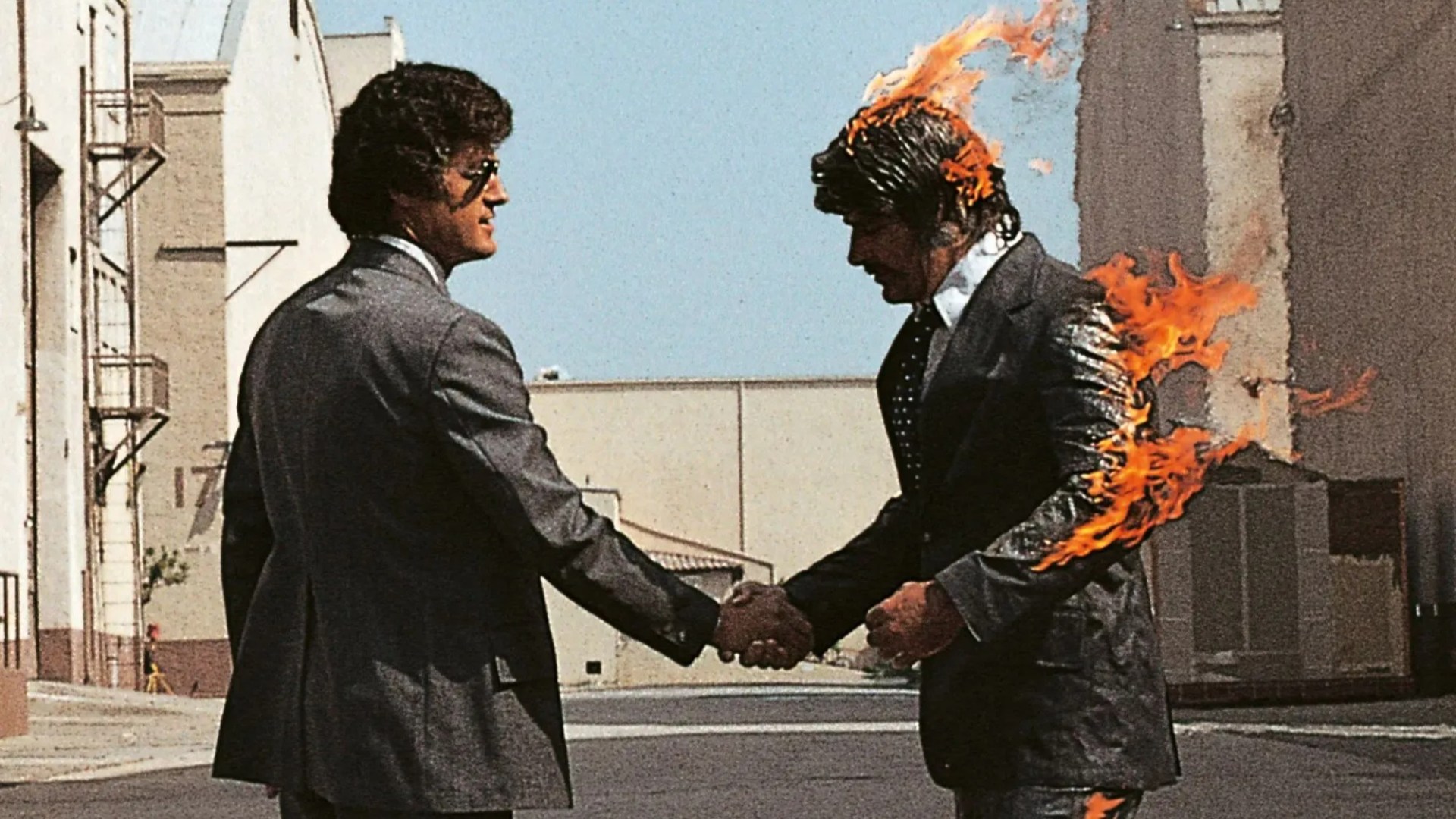
The song would be split into two sections, Parts 1-5 and Parts 6-9, to bookend Wish You Were Here, the follow-up to a cultural phenomenon, The Dark Side Of The Moon.
Now, to mark its 50th anniversary, the album is appearing in expanded formats, adding alternate takes to the original release.
Poet Laureate and Floyd superfan Simon Armitage has written a stream-of-consciousness love letter to the band and, in particular, Wish You Were Here.
I’m very sad about Syd. I wasn’t for years. For years, I suppose he was a threat because of all that was written about him and us
Roger Waters
It has no capital letters or punctuation, but these lines give you the drift: “it’s the forty four minute five second guide to eternity — it’s infinity measured in five songs.”
And for the first time, Shine On You Crazy Diamond is also presented as one continuous piece thanks to a new remix by James Guthrie.
It stands as an emotional remembrance of Barrett, who died a recluse in 2006, aged 60, at his home in Cambridge.
Poignantly, as the track fades to nothing, you hear strains of the See Emily Play keyboard melody.
Waters once reflected: “I’m very sad about Syd. I wasn’t for years. For years, I suppose he was a threat because of all that was written about him and us.
“Of course, he was very important and the band would never have started without him but, on the other hand, it couldn’t go on with him.”
As for Shine On, he added: “It is not really about Syd. He’s just a symbol for the extremes of absence some people have to indulge in because the only way they can cope with how sad it is — modern life — is to withdraw completely.”
On the song’s scale in musical terms, Mason likened it to another lengthy set piece, Echoes, from 1971’s Meddle album. “Echoes,” he said, “was Shine On’s grandfather.”
Now let’s rewind to 1974 when Pink Floyd set about devising an album in the wake of the juggernaut that The Dark Side Of The Moon had already become.
Their initial attempt, using everyday objects as instruments, was not very encouraging, to say the least.
When I reminded Mason of it, he replied: “Some things I’ve been trying to obliterate from my brain — and I’m afraid you just brought that one up!
“The problem was that we ended up spending an awful lot of time grinding away, developing the sounds.
“We hadn’t even got any real music. Things like plucking rubber bands slowed down to quarter-speed.”
He added: “It was a fantastically fruitless exercise, really a way of putting off the ghastly business of what the hell were we going to do next.”
So, did the whole band buy into the daft idea? I ventured.
“We did,” Mason sighed. “If only two people at least had had the gumption to go, ‘F*** this! Let’s work on a record’.”
One of the extra Wish You Were Here tracks, Wine Glasses, offers listeners a taste of the project that became known as Household Objects.
And, as Mason reported, “The wine glasses did make it on to the beginning of Shine On.” (Listen carefully and you’ll hear the tinkling sound.)
So what about the three tracks, further exploring themes of absence and alienation, which were sandwiched between Shine On’s lengthy sections?
Synthesiser-heavy Welcome To The Machine was a product of Floyd’s infatuation with latest technology, and the others came with fascinating back stories.
If Barrett had been a surprise visitor to the Abbey Road sessions, so were two virtuoso violinists just as Floyd were recording the album’s title track, Wish You Were Here.
Mason picked up the story: “If someone was down the hall recording at Abbey Road, it was OK to pop in and say, ‘Hello’.
“Suddenly the door opened and Yehudi Menuhin and Stephane Grappelli were standing there, going, ‘Hello boys’.”
Menuhin, an American-born Brit, was widely regarded as one of the greatest 20th Century classical violinists. Grappelli, a French jazz violinist, was noted for an intuitive, more improvisational approach.
Mason added with English understatement: “By ’75, we were reasonably well known and Grappelli being French would have heard about us because we always had a standing in France.
“I think we invited them both to play with us. Menuhin wanted to but wasn’t comfortable improvising, whereas Grappelli could do it like stepping off a log.”
So the Frenchman went up to one of Pink Floyd’s mics and added gorgeous violin flourishes to a take of the acoustic guitar-led Wish You Were Here.
Ultimately, his contribution didn’t make the finished album, but it can be heard on the expanded editions.
Mason said: “I’m really astonished by it. We thought it had been recorded over, that we’d lost it for ever. I don’t know why we didn’t use it — it would have enhanced the record, but maybe it sounded too folky.
“Or maybe, in a pre-Euro world, we thought, ‘It’s a bloody Frenchman and he shouldn’t have anything to do with it!’”
Grappelli was paid £300 (a princely sum in those days), but went to his death in 1997 oblivious to this unlikely footnote to the Wish You Were Here story.
People did say to us: ‘Which one’s Pink?’ They thought Pink Floyd was the lead singer!
David Gilmour
Another outsider at the sessions — Floyd’s friend, folk-rock troubadour Roy Harper — felt “hard done by” when it came to payment for his lead vocals on Have A Cigar.
After numerous failed attempts by Waters to nail his withering put-down of music industry executives “on the gravy train”, he turned to a singer who loaded his delivery with the perfect sneering tone.
“Roy was recording in the studio anyway,” remembered Waters, “and was in and out all the time. I can’t remember who suggested it, maybe I did, probably hoping everybody would go, ‘Oh no Rog, you do it’, but they didn’t!
“They all went, ‘Oh yeah that’s a good idea’. And he did it and everybody went, ‘Oh, terrific!’ So that was that.”
We know how single-minded Waters can be and he still gave it one final go — but to no avail.
Tape engineer John Leckie recalled Waters saying to Harper that they should reward him for his efforts.
“And Roy said: ‘Just get me a season ticket for life at Lord’s.’ He kept prompting Roger, but it never came.”
Many years later in 2013, when Harper released his comeback album Man & Myth, I met him for coffee near Lord’s, just before the avid cricket fan watched England play Australia for The Ashes.
Best known for When An Old Cricketer Leaves The Crease, he bemoaned his lack of payment for Have A Cigar but talked about his close ties to three of Britain’s biggest rock bands.
“I was an interloper really,” he said. “I was the one who didn’t have a band. I drifted between Led Zeppelin, Pink Floyd and The Who basically.
“At the time, they were big and here was this strange interloper moving between all three.
“One thing I never did, for which I deserve credit, was to transfer what one said about the other. Keep it discreet!”
On the recording Have A Cigar, he said: “I listened to the song at home for a night. I came back the following day and didn’t quite nail it. But then, on the day after that, I did — and they had a song.”
The track’s most memorable line is, “Oh by the way, which one’s Pink?”
Gilmour once admitted: “People did say to us: ‘Which one’s Pink?’ They thought Pink Floyd was the lead singer!”
As you may have gathered, Wish You Were Here comes with a rich history and timeless, captivating music.
Emerging as it did from the mighty shadow cast by The Dark Side Of The Moon, it still shines on 50 years later.