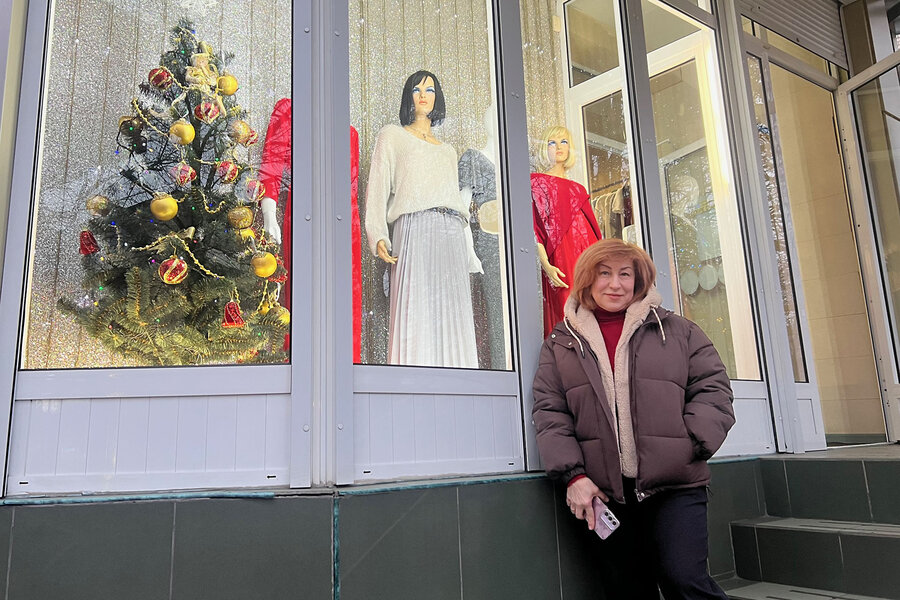
After a particularly harrowing night of Russian drone and missile strikes this month, Viktoria Horban knew exactly what she would do to lift the spirits of her beleaguered city near the front lines of Russia’s war on Ukraine.
“I thought, today is the right day to put up the Christmas decorations in the shop,” says the ebullient store clerk at Ramazan, a women’s fashion shop on Sloviansk’s main square, where she has “helped women feel beautiful” for 23 years.
“I knew the tree and the twinkling lights would cheer people up,” she says. “With all the sadness and uncertainty we are experiencing, I thought we needed something happy and bright.”
Why We Wrote This
Russia’s Vladimir Putin has vowed to take all of the mostly occupied Donetsk region either through negotiation or militarily. Even as Ukraine resists ceding territory, how is the city of Sloviansk maintaining morale in the face of a forbidding future?
Despite valiant efforts like Ms. Horban’s, these are far from the happiest of times in Sloviansk, a city in Ukraine’s eastern Donetsk region known for its ceramics industry – and which is less than 20 miles from the front.
A turbulent decade saw the city briefly seized by Russia-backed separatists in April 2014, then liberated months later at high cost by Ukrainian forces, only to face the accelerating violence of the full-scale invasion which began in February 2022. Now, a depopulated and largely economically inactive Sloviansk is again under threat.
Russia’s onslaught of strikes against civilian infrastructure here has recently intensified, while Russian forces on the eastern front line, stalled and perishing at devastating rates over the summer, have again made small – but for Ukrainians, demoralizing – territorial advances.

Howard LaFranchi/The Christian Science Monitor
But perhaps most harrowing for the people of Sloviansk are Russian President Vladimir Putin’s repeated vows to take all of Ukraine’s Donetsk region – 70% of which his forces already occupy – either through a diplomatic agreement or militarily.
Even as Ukraine and its European allies mount resistance to U.S. pressure for territorial concessions, that menacing vow puts Sloviansk and the neighboring industrial city of Kramatorsk in Mr. Putin’s crosshairs. And it leaves Sloviansk’s residents, now thought to number less than 50,000, down from 111,000 in January 2022, contemplating a forbidding future for themselves and the city they call home.
For one thing, they are well aware of the scorched-earth tactics Russia has resorted to in the territory it has seized. The nearby city of Pokrovsk, which a fatigues-clad Mr. Putin claimed last week had fallen to his forces, offers the latest testimony. Drone footage accessible online shows a lifeless, bomb-blasted urban expanse of collapsed buildings and charred vehicles. Posts from Russian military media depict soldiers raising the Russian flag over destroyed municipal buildings.
On Wednesday, Oleksandr Syrskyi, commander in chief of Ukraine’s armed forces, said five square miles in Pokrovsk’s north remain in Ukrainian control.
“We don’t want to leave”
“We all know what Putin is saying. Of course, it is very scary, and it makes us think what we might have to do for our family’s safety,” says Nataliia Grigorova, who recently brought husband Andrii and son Mykyta on a tour of the Christmas decorations in Sloviansk’s Mulberry Park, where she is employed.

Howard LaFranchi/The Christian Science Monitor
“But we don’t want to leave, we have made our lives here,” she adds as she smiles tenderly at Mykyta, who watches ducks floating on a park pond. “Sloviansk is our home.”
The lament and worry that grips people here over the geopolitical vise their region is held in is augmented by knowledge that U.S. President Donald Trump appears to be siding with Mr. Putin on his demand for all of Donetsk. The United States once vowed to support Ukraine against Russia “as long as it takes.”
White House officials as well as European officials briefed on Mr. Trump’s latest stab at a Ukraine peace plan say territorial concessions, and specifically the ceding to Russia of all of the larger Donbas region, which includes Donetsk, are indeed a key feature of the proposal.
On Sunday, President Trump expressed frustration over Ukrainian President Volodymyr Zelenskyy’s resistance to the plan. Then, a day later in London, European leaders advised Mr. Zelenskyy to stand firm on his refusal to cede to Russia any territory under Ukrainian control – including 30 percent of Donetsk, where an estimated 100,000 Ukrainians live.
Mr. Zelenskyy has said that giving up all of Donetsk – including the cities of Sloviansk and Kramatorsk – would not only gift Mr. Putin territory it might otherwise take him years to conquer, but it would also open the gates to a Russian invasion of regions south and west of Donetsk.
Mr. Zelenskyy said on Wednesday he’d be sending an amended peace plan to the U.S. “soon.”
“How would you feel?”
At the dress shop, Ms. Horban says that, though Mr. Putin’s pledge directly threatens the people of Sloviansk, it should also be of concern to the wider world.
“I would ask anyone, how would you feel if someone came to your house and said to you, ‘One way or another I will take your home, so you might as well just give it to me?’” she says.
But the Russian leader’s threat also has implications for international security, she adds. “If Putin gets his way, to me, it says we have returned to the days when it’s the guy with the biggest stone who wins.”

Howard LaFranchi/The Christian Science Monitor
At Sloviansk’s Fire Station 37, senior firefighter and rescue coordinator Dmytro Udalov confirms that Mr. Putin’s words are the talk of the town – no doubt part of the Russian president’s objective.
“Everyone is aware of what he said, they know what Russia does in the places it occupies, and it makes them scared,” says the Sloviansk native. To explain “what Russia does,” he turns to firetruck driver Pavlo Chernyi, who transferred to Sloviansk from Pokrovsk in January.
“The fear that what I lived through in Pokrovsk might be repeated here – who doesn’t have that feeling in his stomach?” Mr. Chernyi says.
Mr. Udalov says the last three years of firefighting and rescue operations in Sloviansk have demonstrated just how much more dangerous and challenging emergency service work has become.
“We now have to deal with the glide bombs and the drones,” he says, indicating the anti-drone netting that now cloaks the firetrucks like a fishnet. “We have to worry about the double-taps,” he says, referring to the Russian practice of hitting a site, waiting for emergency services to arrive, and then striking the same spot to maximize casualties.

Howard LaFranchi/The Christian Science Monitor
Just hours after Mr. Udalov spoke, a Russian glide bomb struck a Sloviansk apartment tower, killing one woman and destroying or damaging dozens of apartments.
As repair work got underway the next morning, emergency workers in lime-green vests tossed chunks of plaster, insulation, and mangled appliances from exposed upper floors. Volunteers with the Angels of Salvation humanitarian organization cut plywood to cover blasted windows against the cold.
Outside one building’s door, a group of Jehovah’s Witnesses waits to help a “sister in faith” move out belongings while her unit is repaired.
“These are very stressful times in Sloviansk, all we can do is help each other and pray to God to support our sister Liudmyla who lost her home, and all of us living here,” says Nataliia Borzenkova, a nurse who plans to stay in Sloviansk “for now” because her job is secure.
Her fellow church member Hennadiy Kumpan says he has only swear words he’s not supposed to use to describe Mr. Putin, so he vows to keep quiet. But he then offers: “How am I supposed to feel when someone comes to my place and says, ‘You can’t live here, I’m taking it’?”

Howard LaFranchi/The Christian Science Monitor
For many in Sloviansk, the sign that Mr. Putin’s vow has taken a critical step closer to fruition will be the day local administrators declare a mandatory evacuation of children. That, they say, would be a dark day in Sloviansk’s fight to remain a place where families can live and flourish in safety.
At Fire Station 37, Mr. Udalov says it’s always the elderly who most resist leaving and relocating to safer areas. He understands their “sentimental feelings” for their homes, but says holding out until the last minute also puts others in danger.
And while he has no desire to leave his hometown, Mr. Udalov says he tells himself his life would not be over just because it was no longer in Sloviansk.
“I’m not so attached to this place as the elderly are. If I lose my apartment, I can rent one somewhere else. I have even thought,” he adds, “that if it happened soon, I would be able to see how they celebrate the New Year in another city of Ukraine.”
Oleksandr Naselenko supported reporting for this story.