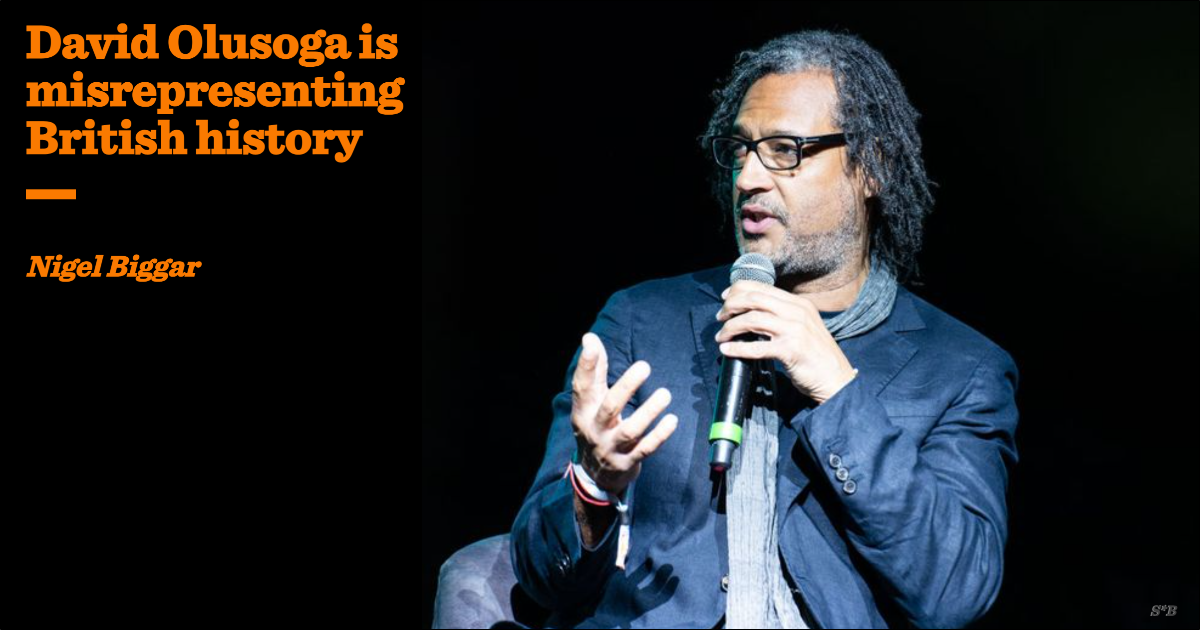
His news series brushes over facts which might confuse its black-and-white narrative
Let us do what David Olusoga doesn’t do. Let’s be fair.
Viewers of Olusoga’s three-part BBC Two series, Empire, do learn many things that are true about the British Empire. They learn that, as empire-builders, the European British weren’t the only or the first, coming after the North American Powhatan and the Indian Mughals. They discover how Britain’s imperial expansion began with adventurers heading west across the Atlantic to North America and merchants sailing east to India in the 16th and 17th centuries. They find out how at the end of the 18th century the American Revolution robbed the British government of a destination for convicts and inspired the settlement of Australia. They’re told of the migration of up to two million Indians as indentured labourers around the Indian Ocean and as far as the Caribbean in the 19th and early 20th centuries. And they hear how the Empire reached its height in the early 1920s, only to have vanished less than fifty years later.
Moreover, not everything viewers are told is bad. They’re told that native Americans sometimes welcomed English colonists because they wanted the things they traded and coveted their alliance against native enemies. They learn of “the British commander” in New York City who, in 1783, defying the terms of the Treaty of Paris ending the American War of Independence, evacuated African American loyalists rather than return them to their “patriot” slaveowners. And they hear the story of an Indian migrant whose indentured servitude enabled him to buy land in what is now Guyana and make a better life for himself.
So, positive truths are voiced. But they’re all incidental to the central story, which is overwhelmingly negative, as the sinister music growling in the background signals. Each episode opens with the same voiceover by Olusoga, which includes the observation that “scattered across the world are the ruins of the British Empire … slave fortresses, schools, railways, and prisons”. Observe: yes, schools and railways, but bracketed by — contained within — slavery and repression. During the series, the only imperial Britons graced with names and faces are villains such as Robert Clive, John Batman, and John Gladstone. William Wilberforce’s surname appears only momentarily on a street sign with no explanation given. And whereas the evils of slavery take up a large part of the first episode and some of the second, Britain’s unprecedented abolition of the slave trade and slavery, and its century-and-a-half’s worth of worldwide suppression of them, are allotted an offhand twenty-five seconds.
Viewers who know nothing about the history of slavery learn that the British practiced it, but not that the practice was universal, conducted by people of every skin colour on every continent. They are given the impression that enslavement was something imposed by whites on blacks, not being told that black Africans had been enslaving other Africans for centuries before the Europeans arrived, and that, twenty years after British abolition, the Fulani people of what is now northern Nigeria were running vast plantations, where they exploited as many slaves (four million) as in the whole of the then United States. Viewers are also told, several times over, that Britain’s wealth today derives from historic British slavery, but not that this is a highly controversial thesis rejected by the most eminent living historian of transatlantic slavery, David Eltis, and by the 2025 Nobel Prize winner for economics, Joel Mokyr. Furthermore, they hear it asserted that the legacy of slavery continues to misshape the lives of the descendants of slaves, without being given any explanation of why those descendants in Barbados are significantly better off than their peers in Jamaica and far better off than those in Nigeria, some of whom are the descendants of slave-raiders, traders, and owners.
Among many things, what’s missing from this sorry tale is context
About the settlement of Australia we learn that some convicts (somehow) managed to better themselves, but not that this was the fruit of the deliberate policy of rehabilitation promoted by the remarkably humane colonial Governor of New South Wales, Lachlan Macquarie. Thereafter the story of Australia is made to focus on Tasmania, where settlers displaced aboriginal peoples, using violence against them “from the beginning” and intent upon extermination, and culminating in their forced removal to Flinders Island. There, “an ancient people, hunter gatherers, with their own complicated culture and spirituality, [were transformed] into sedentary, Christianised, obedient peasants…. people promised sanctuary were instead subjected to the systematic destruction of their culture”.
Among many things, what’s missing from this sorry tale is context. The truth is that modernity was coming to aboriginal Australia sooner or later, one way or another, and that the impact on stone-age peoples was bound to be shocking. If it hadn’t been the British, it would have been the French or the Americans. It could even have been the Māori, who, if not exactly modern, were far more technologically, politically, and militarily advanced than native Australians or Tasmanians. They were also more warlike: when they invaded Chatham Island in 1835, they slaughtered ten per cent of the Moriori people and enslaved the rest. In contrast, when the enlightened British admiral, Arthur Phillip, landed the First Fleet at Sydney Cove in 1788, he ordered his men to share their catches of fish with the aboriginals, allowed them to wander into his house and sit down and eat with him, provided medical aid when they were struck down by smallpox, and refused to retaliate when speared in the thigh. So, no, the original encounters between the British and aboriginals in Australia were actually not violent.
And when, in 1830, it seemed to Lieutenant-Governor George Arthur that the only way to save Tasmanian aboriginals from settler violence was to separate them onto a “reserve” where they would have time to adapt to the new world that had suddenly come upon them, he set about the Flinders Island scheme. Even the left-of-centre historian, Henry Reynolds, acknowledges that Arthur had no wish “more sincerely at heart than that every care should be afforded these unfortunate people” and that he “begged and entreated” George Augustus Robinson, the commandant of the aboriginal settlement on Flinders Island, to “use every endeavour to prevent the race from becoming extinct”. Reynolds also argues that Arthur matched his words with deeds, ensuring that the aboriginals were better provided for–not least in medical care–than other welfare recipients in Tasmania such as orphans, paupers and convicts. This well-intentioned endeavour was not sufficient, however, to prevent most of the aboriginal people on Flinders Island from dying, mainly from respiratory diseases inadvertently imported from Europe. None of this complicating detail, however, is allowed to muddy the stark, simple colours of Olusoga’s story of wanton white oppression of black victims.
He applies the same white-versus-black straitjacket to the Mau Mau rebellion in Kenya from 1952-60. The cause, we’re told, was the theft of land by white settlers from the Kikuyu. Although the vast majority of those killed were African, it was only the killing of white settlers that shocked the colonial authorities into action. This action consisted of hanging 1,090 convicted rebels, presiding over the castration with pliers of some detainees, and permitting the beating to death of eleven of them at the Hola detention camp.
But what are we not being told? That the reason why the British government encouraged white agricultural settlement in Kenya in the first place was to help fund the ‘Uganda’ railway, and one of the reasons for building that railway was to help suppress the African-Arab slave-trade. That when the first white settlers arrived in 1902, much of the land they settled on was unoccupied and local Kikuyu often assisted in building their houses and barns and proceeded to work as labourers. That one of the causes of intensifying competition for land in the 1940s was the rapid population growth brought about by modern medical triumphs over disease. That another cause of social unrest was the attempt by colonial government to ameliorate that competition by improving agricultural productivity through improved soil conservation and land husbandry — a policy that the moderate nationalist Jomo Kenyatta praised, but which offended local custom by obliging women to build terraces. That support for the rebellion was confined only to the Kikuyu people, and that as many Kikuyu fought with the colonial government against the rebels, as vice-versa. That native opposition to the rebels was inspired by terroristic atrocities perpetrated against African loyalists, including the attack at Kandara in October 1952, where “three of the Tribal Police wives and four of their children were hacked to pieces. The heads of the four children were laid out in a row beside their disembowelled mothers”. That, according to the (black) Kenyan historian Bethwell A. Ogot, African loyalists played “the crucial role” in defeating the uprising and the 1,090 executed men were not martyrs to the rebel cause, but criminals hired to carry out assassinations. And that despite some serious failures, according to the counter-insurgency historian David French, “[t]he British did conduct their counter-insurgency operations according to the [albeit permissive] rule of law … they did establish limits beyond which they did not go. They ensured that … they did not follow Nazi policies”.
The story that David Olusoga’s Empire tells has its centre of gravity firmly in white oppression, enslavement, pillaging, and slaughter of black people. It’s a story of relentless white racism, which in its overwhelming neglect of complicating contexts and facts, is itself a racist story. So, why does he choose to tell it? Because most British people, apparently, airbrush evils such as slavery and racism out of their understanding of Britain’s colonial past, and the history that they overlook “runs too deep and matters too much to be brushed aside or wished away”. Exactly what it is that runs too deep and matters too much, he does not state. But, given the tale he tells, we may safely infer white racism. Although he pooh-poohs the view “that the uncovering of this history is intended to make people feel guilty about events that took place before their birth”, that is surely what he intends: that white people should confess and repent of the prevalent racial prejudice that their persistent colonial nostalgia perpetuates.
But these are straw men. Unalloyed admiration of the British Empire expired in the early 1960s. Even the 2003 account given by the right-of-centre historian Niall Ferguson in his book and Channel 4 TV series, Empire: how Britain made the modern world, was perfectly frank about the evils of slavery and other colonial injustices. And if contemporary Britons still knew nothing about them before the killing of George Floyd in 2020 and the consequent upsurge of Black Lives Matter in the US and its translation across the Atlantic, they now know little else.
As for the racist problem that Olusoga’s truth-telling is supposed to solve, social scientific evidence tells us that Britain is already one of the least racist countries on earth. The 2019 report of the European Union Agency for Fundamental Rights, Being Black in the EU, found that the prevalence of racist harassment as perceived by people of African descent was lower in the UK than in any of the twelve EU countries surveyed, except Malta. And the prevalence of overall racial discrimination — in terms of such things as employment, health, or housing — was the lowest in the UK bar none. It also found that race relations were worst in Austria, Finland, and Ireland — countries with no history of overseas colonisation.
Then there is the 2021 “Sewell” report of the UK Government’s Commission on Race and Ethnic Disparities (CRED) — eight out of whose nine commissioners were members of ethnic minorities and whose chairman, Dr Tony Sewell, was a Jamaican Briton and descendant of African slaves. This argued that while racism certainly persists in Britain, different socio-economic outcomes for different ethnic groups in Britain have a variety of causes, of which racism is only one. Outcomes vary considerably between different ethnic groups. For example, in secondary education Chinese and Indian pupils outperform their White British peers “by wide margins” in terms of strong GCSE passes in English and maths. Indeed, when socio-economic status is controlled for, “all major ethnic groups perform better than White British pupils except for Black Caribbean pupils …”. And, compared to the US, the attainment gap between “black” and “white” pupils is approximately eight times smaller. Because of this variety in outcomes, the CRED report concludes that the divisive conceptual division of British society into “White” on the one hand, and “Black and Minority Ethnic” (BAME) on the other, should be abandoned.
The third set of social scientific data that disturbs the claim that British society today is systemically racist is provided by the World Values Survey 2023. This shows Britain to be one of the least racist countries in the world: only 5 per cent of British respondents objected to having immigrants as neighbours and only 2 per cent to neighbours of a different race — roughly the same as Norway, Sweden, and Germany and far better than Iran, Russia, and China. It is notable that Australia and Canada, both creations of British colonial endeavour, also returned some of the lowest scores.
It’s perfectly possible that David Olusoga didn’t quite know what he was doing
Olusoga’s narrative about the British Empire is not only a solution to a problem whose actual dimensions are much, much smaller than he assumes. It’s a solution that exacerbates the problem by distorting history into a racist white-versus-black narrative, so as to make white people feel guilty. For while some may succumb, others will be moved to resentment — and rightly so.
It’s perfectly possible that David Olusoga didn’t quite know what he was doing. Evidently, there’s lots of British imperial history he knows nothing about. Perhaps that shouldn’t surprise, since he’s more a professional journalist than an historian, sporting only a bachelor’s degree in history from Liverpool University and a postgraduate degree in broadcast journalism from Leeds Trinity University. Nonetheless, the BBC has given him a prominent platform on which to tell a racially biased story about Britain’s colonial past, which distorts British viewers’ understanding of their own country’s history, and exacerbates rather than ameliorates racial tensions. One can only speculate about why the BBC did this. But, whatever the reason, the Corporation declares that its mission is “to act in the public interest, [providing] … impartial, high-quality … output and services which … educate”. So, let it now commission an alternative, fairer telling of the British imperial story by someone marked out by eminent expertise, not skin colour.