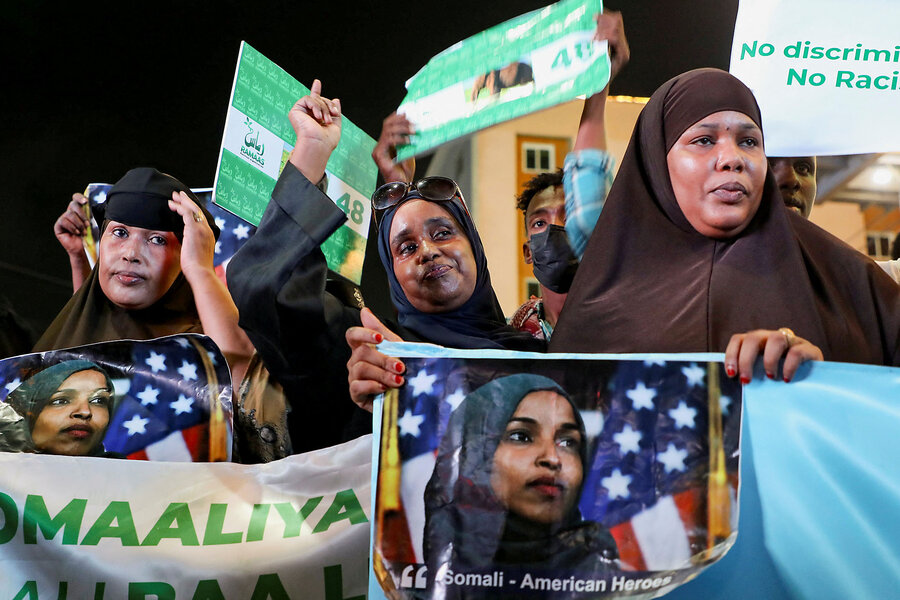
This month, President Donald Trump ended a Cabinet meeting with a vitriolic attack against Somali migrants. He called them “garbage,” said their country “stinks,” and declared that he does not want them in the United States. Immigration and Customs Enforcement raids and a promise to revoke protected status for certain Somali migrants followed.
The president’s actions are a response to recent charges brought against 78 people, mostly of Somali descent, in Minnesota who are accused of stealing hundreds of millions of dollars earmarked for social services in the state. But they mirror a broader trend of the Trump administration using the criminal conduct of individuals as a pretext to target an entire immigrant community, such as Haitians in Ohio and Venezuelans in Colorado.
As in those cases, critics say the president’s remarks play to stereotypes and obscure complex history.
Why We Wrote This
President Donald Trump’s recent dehumanizing remarks about Somali Americans play to stereotypes and obscure a complex history.
“Anyone who violates the law of the land must face the consequences of that,” says Afyare Abdi Elmi, a research professor of political science at the City University of Mogadishu, in Somalia’s capital. “But racially and ethnically targeting and profiling one group is not acceptable.”
Who are the Somalis in the U.S. and how did they end up here?
About a quarter of a million people of Somali descent live in the United States – one of the largest Somali communities outside of Africa. Of these, around 80,000 live in Minnesota, including prominent figures such as Rep. Ilhan Omar, the first Somali American elected to the U.S. House.

Ms. Omar’s story mirrors that of the diaspora at large: In 1991, when she was 8 years old, her family fled Somalia to escape a brutal civil war. The same year, a coalition of rebel groups overthrew the country’s longtime dictator, Mohamed Siad Barre, leaving the clan-based society in a power struggle and unable to form a united government.
Between December 1991 and February 1992, 14,000 people died in Mogadishu alone, while in one town hosting displaced people in the country’s southwest, drought and famine killed as many as 70% of children under the age of 5. Human Rights Watch called it the “most tragic year in [Somalia’s] modern history.”
By the mid-1990s, a community of Somali migrants fleeing the conflict began to settle in Minnesota, drawn to the wide availability of jobs that didn’t require fluent English – notably in the meatpacking industry.
Meanwhile, back in Somalia, a mosaic of rival warlords and clan-based militias surged into the sudden power vacuum created by Mr. Barre’s overthrow, including a group called Al Shabab – Arabic for “the youth.”
The Al Qaeda-affiliated group has now spent two decades waging a grinding terror campaign against Somali civilians, setting off bombs in buildings and on crowded streets, enforcing sharia law with stonings and amputations, and blocking access to humanitarian aid.
At the same time, repeated cycles of drought and flooding in recent decades have devastated Somalia’s farms – the engine of the country’s economy – leading to a deep hunger crisis and making “a bad situation worse,” says Thomas Warrick, a senior fellow at the Atlantic Council and a former Department of Homeland Security deputy assistant secretary for counterterrorism policy.
All of these circumstances – terror attacks, hunger, and poverty – continue to push Somalis to migrate. Some 4 million people are currently internally displaced in the country, and more than 700,000 live as refugees in other countries, including the United States.
Why is Trump so angry at the Somali community in Minnesota?
Mr. Trump’s most recent comments refer largely to a COVID-era fraud scandal when hundreds of millions of dollars were stolen from a federally funded nutrition program designed to provide meals to children during the pandemic. Federal prosecutors have charged dozens of people in the case, most of them of Somali ancestry.
Meanwhile, President Trump has also recently announced plans to terminate Somalis’ Temporary Protected Status, an immigration designation that lets migrants from certain countries stay in the U.S. temporarily because of wars, environmental disasters, or “other extraordinary … conditions.” He also initiated an ICE operation in the Minneapolis area called Operation Metro Surge, which has detained at least 19 immigrants, eight of them Somali.
That has created fear and panic among Somalis in Minnesota, the vast majority of whom are American citizens with no criminal ties.
“Somalis are contributing to society in so many ways,” notes Dr. Elmi, the Somali academic. “They have made positive contributions in hospitals, in the education sector, in the bureaucracy sector, in the service sector. They are a hardworking community.”
Those who commit crimes should be tried in courts, rather than the court of public opinion, he says, adding that Mr. Trump’s comments are “absolutely false and racist.”
Does the U.S. play any role in what’s happening in Somalia?
Yes. Because Somalia is the home base of one of Al-Qaeda’s most powerful affiliates and is located on a vital global shipping route, it has long been an important U.S. ally in the Horn of Africa.
So, when President Trump posted recently on social media about sending Somalis “back to where they came from,” he was talking about a country whose challenges his administration knew intimately.
“While the president speaks of Somalia as a domestic political concern, his counterterrorism advisers are trying to figure out how to end the terrorist threat from Al-Shabab [there],” Mr. Warrick says.
At the core of Somalia’s current troubles is this: Although the country has had an internationally recognized government since 2012, that government does not control all of Somalia’s territory.
In an effort to strengthen Somalia’s government, the United States has spent $500 million since the early 2000s training and equipping the Somali military. It has also conducted airstrikes against Al Shabab since 2003, the pace of which accelerated dramatically during President Trump’s first term.
The goal of this counterterrorism support is for Somalia to eventually be able to deal with Al Shabab and other terror groups on its own, Mr. Warrick says. But that requires more than military support. “There has to be considerable investment in building up the capacity of the Somali government,” he notes.
Historically, the U.S. has played a vital role in those efforts, but massive cuts to American aid are putting the future of that work at risk, Mr. Warrick says. That, in turn, leaves Somalia in a fragile situation that could drive even more people to flee.