Lawmakers gathered in closed-door briefings on Thursday to watch a video of a U.S. missile strike on a boat that the Trump administration claims was bringing drugs to America.
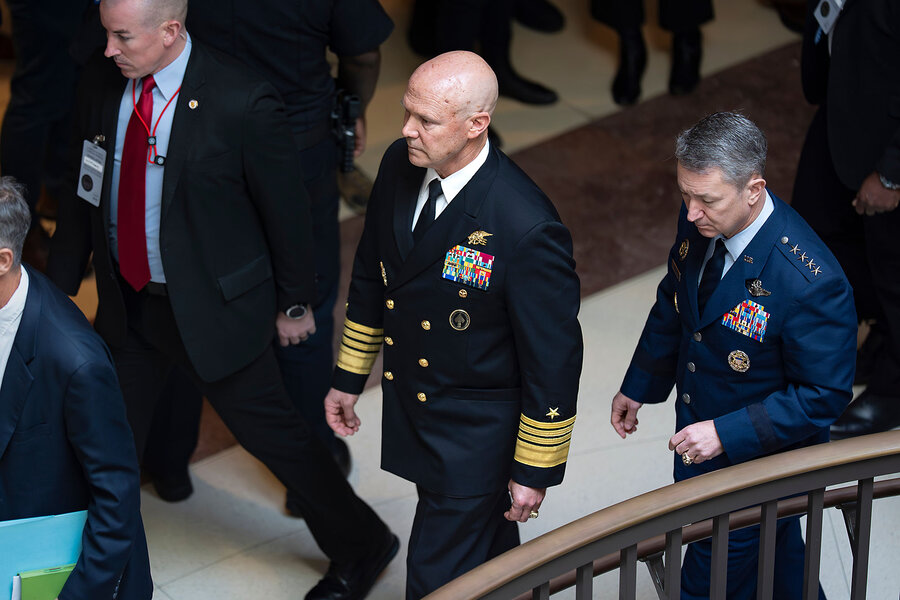
The footage showed a second attack ordered by Adm. Frank M. Bradley, then in charge of the U.S. military’s secretive Joint Special Operations Command. There is bipartisan agreement that the strike killed two shirtless survivors holding fast to an overturned hull.
The debate on Capitol Hill and beyond, which began with a published report about the orders governing that Sept. 2 boat strike, now centers on whether the strikes were legal and on whether the order for a second strike on survivors violated military law.
Why We Wrote This
With military leaders in the spotlight over drug boat attacks, how do troops know when to follow orders and when to push back?
On those points, lawmakers watching the same video came away with strong views that fell along party lines.
The top-ranking Democrat on the House Intelligence Committee, Rep. Jim Himes of Connecticut, said he saw “two individuals in clear distress, without any means of locomotion, with a destroyed vessel, who were killed by the United States.”
Sen. Tom Cotton, the Arkansas Republican who chairs the Senate Intelligence Committee, saw “two survivors trying to flip a boat – loaded with drugs bound for the United States – back over so they could stay in the fight.”

That September attack was the first in what has become a broader U.S. boat strike operation in the Caribbean Sea and Pacific Ocean, in which more than 80 people have been killed.
The Sept. 2 strike, and the debate surrounding it, is a case study in the sorts of wrenching decisions U.S. military leaders are charged with making, and for which they are required to study ethics, moral reasoning, and military law. More broadly, the Trump administration’s entire campaign against what it calls “narco-terrorists,” treating them for the first time as enemy combatants, has been criticized by some military experts as illegal.
The result is tension faced by U.S. troops empowered to kill for national security or political ends as they carry out missions: They could face harsh criminal sanctions for obeying an unlawful order – or disobeying a lawful one.
“That is the burden every military person bears,” says retired Maj. Gen. Steven Lepper, who served as an Air Force lawyer and instructed troops on the laws of war. “It is why they are trained continuously on their legal obligations.”
What kind of training about legal orders do service members get?
All new service members are instructed in the laws of warfare, including basics such as the Geneva Conventions, rules of engagement, and the Uniform Code of Military Justice.
Officers who lead troops, particularly those enrolled at American military academies, get more nuanced training – including required courses in ethics and moral reasoning, among other subjects.
A tenured professor at the U.S. Military Academy until he resigned earlier this year, Graham Parsons found that there was “no debate” when it came to classroom discussions about following illegal orders: Cadets agreed they would never do it. “That’s just bedrock.”
But the tougher case studies he presented to Army cadets forced them to grapple with questions such as how much risk commanders should take to minimize civilian casualties at the expense of their own troops’ safety. The law often isn’t clear on such points, Professor Parsons says. But among military leaders, “there is an obligation to manage that line.”

To learn how to do that, West Point cadets debate giving and receiving orders that are “not clearly illegal, but maybe clearly wrong,” he says.
One of his students’ favorite case studies involves a film called “Lone Survivor,” which has characters portraying Navy SEALs debating whether to kill a couple of Afghan goat herders who stumble upon – and could give it away should they inform the Taliban.
“Of course, they do the right thing [and let the herders go unharmed], but it comes back to bite them.” The goat herders do tell the Taliban, and Taliban fighters ambush the SEALs.
Lively classroom debate ensued. “My sense was that many were sympathetic, or more open, to the idea that they should’ve killed these guys,” Professor Parsons says.
Eventually, though, most concluded that killing the goat herders was not morally justifiable and that killing them ultimately proved to be unwise strategically as well. For those who thought the herders should have been killed, “We would always say, even if you disagree, you should know that the law says if you kill these people, you could be prosecuted” for war crimes.
Further up the ranks, U.S. military generals are required by congressional mandate to take a five-week workshop when they receive their first star to brush up on topics such as civil-military relations and the law.
How strong is the pressure to obey an order, regardless of its perceived legality?
Military law is clear: An order from a superior should be presumed lawful and is disobeyed at the peril of the subordinate.
That includes orders that troops might suspect are illegal, but are not. These are referred to by Peter Feaver, a professor at Duke University and an instructor in the course for new generals, as “awful but lawful” orders.

Members of the top brass sometimes have the impression that they can refuse orders that force them to do immoral or unethical things, Richard Kohn, a professor emeritus specializing in military history at the University of North Carolina at Chapel Hill, told the Monitor in an interview earlier this year.
He teaches the workshop alongside Professor Feaver. “We tell them, ‘There’s nothing in the Uniform Code of Military [Justice] or military law that says you can refuse an order just because you think it’s immoral or improper,’” Professor Kohn said.
But they also receive pointers on how to artfully, tactfully, and at times forcefully push back when offering their best military advice to their civilian bosses.
Military leaders generally hold that encouraging young soldiers to second-guess a superior’s orders can undermine discipline and the smooth operation of life-endangering missions.
The law endeavors to make it easier for the rank and file to follow orders by stating that an unlawful order is one so obviously criminal that a person “of ordinary sense and understanding” would clearly recognize it as, or already know it to be, illegal.
And when they have deep doubts about orders, they are taught to request clarification from their leaders, raise issues up the chain of command, or even, in some cases, to “slow roll” them.
Still, the pressure to follow unlawful orders can be significant.
When he was invited to speak to sophomores taking an Ethics and Moral Reasoning for Navy Leaders class in 2003 at the U.S. Naval Academy, Hugh Thompson warned midshipmen about this.
An Army helicopter pilot, Mr. Thompson found himself in the Vietnamese village of My Lai in 1968 as a massacre was taking place.
U.S. troops were bayoneting and shooting unarmed people, many of them women and children. Of the more than 500 killed, more than 150 were under the age of 12.
Mr. Thompson landed his helicopter in the line of fire “to prevent their murder,” reads the Soldier’s Medal citation he was awarded nearly 30 years later. He confronted the American commander who had ordered the killings and told him that he was prepared to open fire on U.S. troops should they harm any more civilians.

Mr. Thompson was “no peacenik,” he told the midshipmen. “I wasn’t that kind of guy. You know, I call a lieutenant ‘sir.’”
He attributed the massacre to low-level leadership, racism, and “negative peer pressure” that many soldiers there appeared to face in obeying orders. Of the 190 or so U.S. troops at My Lai, roughly 13 to 18 took active part in the killings, Mr. Thompson said. The rest stood aside.
Treated by many Americans as a traitor who had mutinied, Mr. Thompson was threatened with prosecution by lawmakers before being recognized decades later as a hero.
How likely is it that Admiral Bradley or others will be charged with taking illegal actions?
Based on reports from Admiral Bradley’s closed-door hearing, the Trump administration is continuing to build its case that the United States is in armed conflict with cartels and that the boat crews, which it alleges are carrying drugs, are “combatants,” many legal analysts say.
The drugs, Trump officials further argue, should be regarded as lethal weapons coming to American shores.
Critics of this argument say speedboats are not warships – and in some cases might not even be capable of reaching America. They also argue that while the 11-person crew killed on Sept. 2 might have been running drugs, they would be deemed criminals, not enemy fighters.
“Having drugs on [a] boat is not the same as having an armed force being arrayed against your military,” says Mr. Lepper, a founder of a new consortium of retired U.S. military lawyers called the Former JAGs Working Group. “We have argued that unless there’s more to it than that, what we’re seeing is not lawful.”
Beyond this, some military law scholars consider the second strike on the two survivors as an attack on shipwrecked persons. This is cited explicitly in the Defense Department’s Law of War Manual as an unlawful act. “I personally have used that example when conducting law-of-war training,” Mr. Lepper says.
Military officials, including Admiral Bradley, have reportedly told lawmakers that the hull still contained cocaine and that another boat could come along and retrieve it. The survivors, they further argued, could communicate their whereabouts to facilitate that move.
If this is an accurate rendering of the admiral’s response, then he makes a plausible case for the legality of a second strike, says retired Maj. Gen. Charles Dunlap, a former deputy judge advocate general for the Air Force and now executive director of the Center on Law, Ethics, and National Security at Duke University’s school of law.
Professor Dunlap notes that immunity from attack for shipwrecked belligerents “is conditional on refraining from any hostile act or attempt to escape,” according to the International Committee of the Red Cross. The ICRC specifically includes “attempting to communicate with one’s own party” as an example of a hostile act.
Whether Admiral Bradley and troops will be charged with any crimes hinges in part on the investigation that lawmakers have promised to undertake, analysts say, and ultimately also on whether they support the ways in which Trump officials are endeavoring to redefine enemy combatants and the nature of armed conflict.
For now, the admiral’s experience spotlights the responsibility senior officers bear, as the administration announced on Thursday that the U.S. military attacked another boat – the 22nd such strike since Sept. 2 – killing four more people.