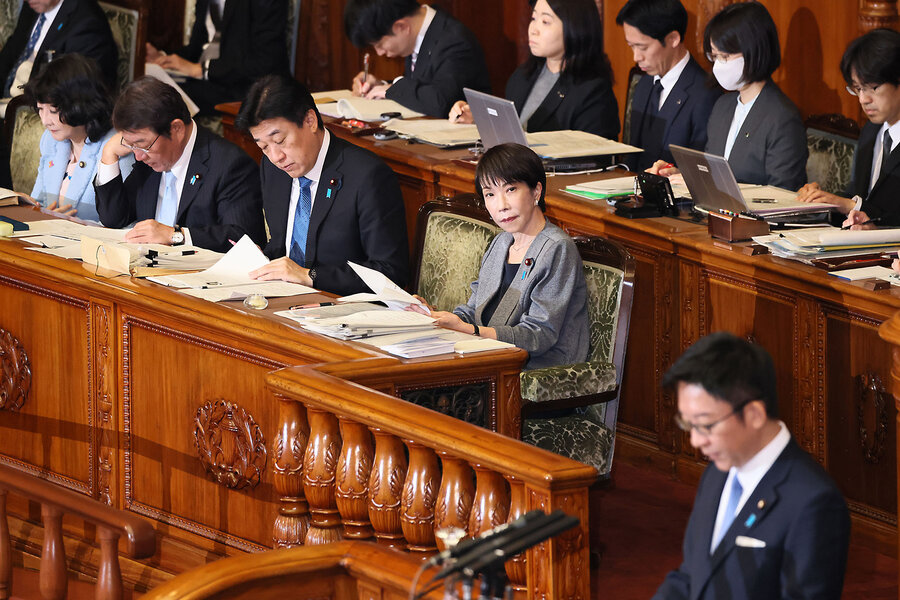
Unlike her predecessors, Japan’s new Prime Minister Takaichi Sanae has never been to a posh restaurant for dinner. She sleeps only 2 to 4 hours a night. All she does, she said shortly after her election, is “work, work, work, work, and work.”
Her remarks – which this week were named Japan’s “catchphrase of the year” – have caused a stir in a country notorious for karoshi, or death from overworking.
They wouldn’t have raised an eyebrow a few decades ago, when Japan was still basking in the glow of its postwar rise into an economic superpower, and workers who dedicated their lives to companies were celebrated as “corporate warriors.” But today, when Japanese workers appreciate work-life balance and scoff at overworked employees as “shachiku,” or company slaves, the words struck a nerve.
Why We Wrote This
An industrious leader is typically considered a positive. But in Japan – a country that has its own word for “death from overworking” – the new prime minister’s habits are reigniting a debate: How much work is too much?
Japan has made modest progress reigning in work hours, but the buzz around Ms. Takaichi highlights just how recent – and tenuous – these gains are. Her administration now plans to relax overtime restrictions, hoping it will appease the business community and help revitalize Japan’s economy. Shimasaki Chikara, standing manager at the Labour Lawyers Association of Japan, says it may do the opposite.
“Prolonged work … [can be] detrimental to physical and mental well-being of workers,” says the Yokohama-based lawyer. “It could also sap social vitality, undermining a work-life balance, women’s career development, men’s housework, and countermeasures to the falling birthrate.”
The prime minister is “out of touch with the reality,” he adds.

Death from overworking
Oizumi Junko watched her husband slowly lose his spark after transferring to a new junior high school in 2006. Between office work and athletic clubs, the once-passionate English teacher was suddenly clocking more than 100 hours of overtime a month. When the 2007 school year began, he often felt too sick to go to work. Ms. Oizumi urged him to see a doctor, but he declined, citing his busy schedule.
She wishes she had done more.
In February, after calming down a disruptive student, Ms. Oizumi’s husband took his own life. It was one of more than 100 official cases of karoshi recorded by the Ministry of Health, Labour and Welfare that year, but victim advocates say the actual number of deaths related to overworking is much higher.
Ms. Oizumi later partnered with other families impacted by karoshi to raise awareness about excessive overtime. They see some signs of progress.
In 2019, Japan limited overtime to 45 hours a month for most employees, following a widely reported case of one such worker, Takahashi Matsuri. Like Ms. Oizumi’s husband, Ms. Takahashi reportedly worked hundreds of hours of overtime in the year leading up to her suicide. Some major corporations, including Hitachi and Panasonic Holdings, have introduced a four-day workweek, with the Tokyo Metropolitan government and other municipalities following suit this year.
Official karoshi statistics have stayed relatively stagnant, but as awareness grows, the number of workers engaging in dangerous levels of overtime has declined. The Ministry of Health, Labour and Welfare reports that only 8% of full-time employees surpassed 60 working hours a week in 2024, down from 17.9% in 2003.
So when Ms. Takaichi called her aides to a 3 a.m. meeting in October ahead of legislative deliberations, Ms. Oizumi was appalled.
“It’s quite unthinkable,” says Ms. Oizumi, head of the Miyagi branch of the Association of Families of Considering Karoshi. The prime minister is “turning the clock back. I think it’s fine for her to study by herself at 3 a.m. But it’s wrong for her to involve others.”

Push for balance
Others defended Ms. Takaichi’s early morning meeting, arguing that long hours are part of public service.
“What’s the fuss?” asked veteran talk show host Furutachi Ichiro on his YouTube channel, which is followed by 626,000 people. “Come on! Why don’t bureaucrats work? Both politicians and bureaucrats are people’s servants in the truest sense.”
Mr. Furutachi went on to say that “if you support Japan’s economic growth, all of those in the private sector should also abandon their work-life balance.” On that point, he appears to be in the minority.
When asking about what amount of monthly overtime is “appropriate,” a 2023 government survey found that 87.6% respondents answered somewhere in the 1-20 hour range. Only 3.1% said that exceeding 45 hours would be appropriate, suggesting that most of the country would prefer stronger workplace protections.
And if economic growth is the goal, experts from the Meiji Yasuda Research Institute say prioritizing work-life balance should help – their 2023 survey on workplace habits showed that employees are more interested in building skills and working later into life when their hours are reasonable and it’s easy to take time off.
Even Ms. Takaichi has backtracked after harsh criticism over the meeting, apologizing for “causing trouble” to her aides, driver, and secret service guards.
Ms. Oizumi believes it’s important for all working adults to model the importance of work-life balance. Her group has been visiting high schools and universities to try and prepare students for the reality of entering Japan’s workforce.
“Nothing is more important than life,” she tells students. “So, please don’t push yourself.”