The Supreme Court on Thursday handed Republicans a major victory in the multi-state chess game of redrawing congressional district lines ahead of the 2026 midterm elections.
Earlier this year, Texas approved a new map that — based on existing enrollments — would create five districts where Republicans are likely to prevail. The new map was the subject of a lawsuit, which reached the U.S. Supreme Court.
“Texas is likely to succeed on the merits of its claim that the District Court committed at least two serious errors,” the unsigned opinion said.
The ruling is not the final word in the case but stays an appeal that would have set the new map aside while the lawsuit proceeds through the courts.
The opinion said that the District Court that ruled against Texas “failed to honor the presumption of legislative good faith by constructing ambiguous direct and circumstantial evidence against the legislature.”
Moreover, it added, the lower court “improperly inserted itself into an active primary campaign, causing much confusion and upsetting the delicate federal-state balance in elections.”
The ruling said the state “made a strong showing of irreparable harm and that the equities and public interest favor it.”
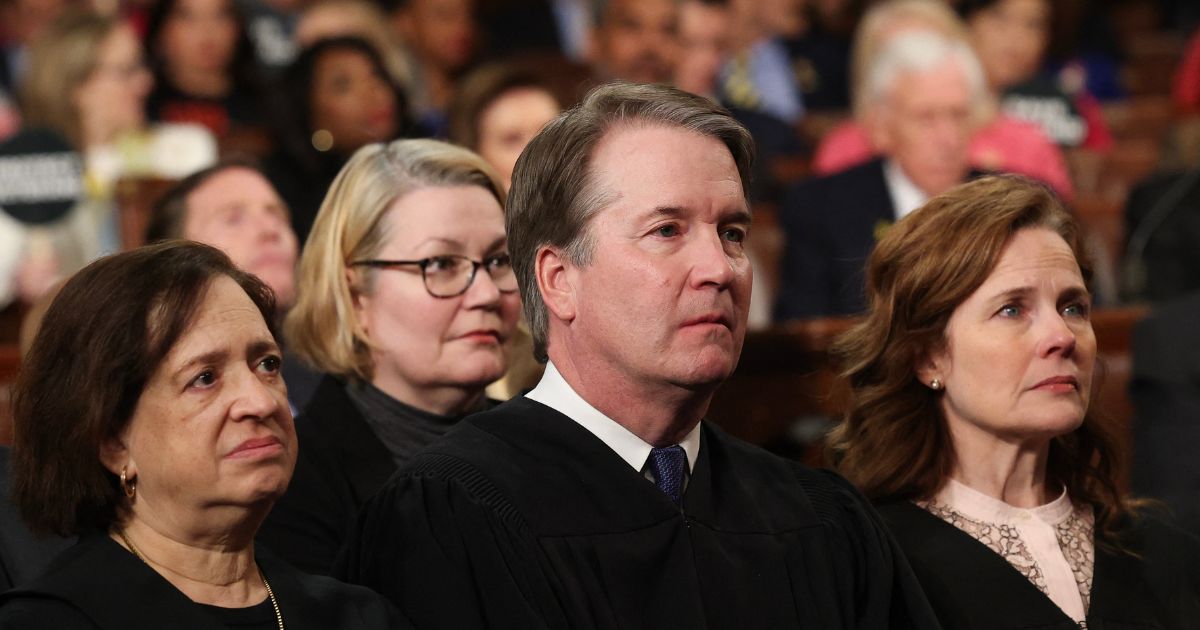
Justice Elena Kagan wrote a dissent supported by Justices Sonia Sotomayor and Ketanji Brown Jackson. She claimed the decision was reached by the majority “based on its perusal, over a holiday weekend, of a cold paper record.”
“Today’s order disrespects the work of a District Court that did everything one could ask to carry out its charge — that put aside every consideration except getting the issue before it right,” Kagan wrote.
“And today’s order disserves the millions of Texans whom the District Court found were assigned to their new districts based on their race,” the dissent said.
Justice Samuel Alito, joined by Justices Clarence Thomas and Neil Gorsuch, said the dissenters erred in saying that race was at the heart of the new map.
“First, the dissent does not dispute — because it is indisputable — that the impetus for the adoption of the Texas map (like the map subsequently adopted in California) was partisan advantage pure and simple,” Alito wrote.
“Because of the correlation between race and partisan preference, litigants can easily use claims of racial gerrymandering for partisan ends,” he added.
“Thus, when the asserted reason for a map is political, it is critical for challengers to produce an alternative map that serves the State’s allegedly partisan aim just as well as the map the State adopted,” Alito noted.
“Although respondents’ experts could have easily produced such a map if that were possible, they did not, giving rise to a strong inference that the State’s map was indeed based on partisanship, not race.”
As of now, new lines will position Republicans to gain nine seats — five in Texas, two in Ohio, one in North Carolina, and another in Missouri. Florida and Indiana are considering changes that would benefit Republicans, according to The Hill.
Democrats have redrawn lines to pick up six seats — five seats in California and one seat in Utah. Virginia and Maryland are considering new maps.

Advertise with The Western Journal and reach millions of highly engaged readers, while supporting our work. Advertise Today.