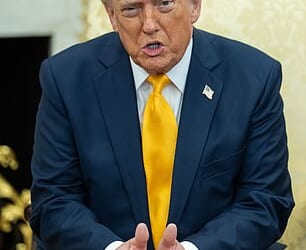
Long before he entered politics, Donald Trump became a household name with two simple words: “You’re fired.” Having carried him to television stardom, those words are also defining his second term as president, and his latest high-stakes trip to the U.S. Supreme Court.
Mr. Trump has dismissed dozens of executive branch officials, including leaders of a half-dozen agencies who, by law, can only be fired “for cause,” which is defined as “inefficiency, neglect of duty, or malfeasance.” The lawfulness of one of these firings will be argued before the Supreme Court on Monday, a court with a six-justice conservative supermajority that has already expressed tacit support for Mr. Trump’s claims.
The case, Trump v. Slaughter, could have major implications for presidential power and the American public more broadly. If the court rules in the president’s favor, the White House would have direct control of the leadership of agencies created by Congress to be independent or quasi-independent from the presidency, insulated from the shifting political tides of Washington and regulating everything from car seats to the country’s financial system.
Why We Wrote This
For 90 years, the Supreme Court has restricted the president’s ability to fire heads of independent federal agencies. The court, which takes up a case on the subject Monday, has hinted it might agree with President Trump’s argument to overturn that precedent.
“What’s at stake in this case is whether you can have independent thinking within the executive branch,” says Lauren McFerran, a senior fellow at the Century Foundation, a progressive think tank, and a former chair of the National Labor Relations Board.
Mr. Trump and his supporters view the stakes as the president’s inherent authority to run the executive branch as he sees fit, an authority he says flows directly from language in Article II of the Constitution, which says “the executive power shall be vested in” the president.
The Slaughter case “is an opportunity for the Supreme Court to restore the proper constitutional role of the president as being head of the executive branch,” says Hans von Spakovsky, a legal fellow at the conservative Heritage Foundation and a former commissioner at the Federal Election Commission.

Ninety years of precedent
Five years ago, the high court laid the groundwork for this major separation-of-powers dispute.
In Seila Law v. Consumer Financial Protection Bureau, the court in 2020 held – in a 5-4 ruling along ideological lines – that the structure of the consumer watchdog agency violated the Constitution.
Because the agency was headed by a single person whom the president could only fire “for cause,” its structure was “incompatible” with the Constitution, Chief Justice John Roberts wrote in the majority opinion. The structure vests “significant governmental power in the hands of a single individual … [who] is neither elected by the people nor meaningfully controlled (through the threat of removal) by someone who is,” he added.
That decision upheld a 1935 precedent established in Humphrey’s Executor v. United States. In that case, which involved the Federal Trade Commission, the court ruled that board members who don’t exercise “any executive function” can only be removed “for cause.”
“Rightly or wrongly,” Chief Justice Roberts wrote in the Seila Law opinion, in Humphrey’s “the Court viewed the FTC (as it existed in 1935) as exercising ‘no part of the executive power.’” Rather, the court at the time saw the FTC, which was created in 1914 to combat monopolies, as a legislative and judicial agency because it provided reports to Congress and gave recommendations to the courts.
With the Slaughter case, that “rightly or wrongly” question has returned to the justices.
A slow but sweeping change
Notably, the Slaughter case also concerns the FTC. Rebecca Slaughter, a former trade commissioner, sued Mr. Trump after he fired her without cause in March. The symmetry is central to Mr. Trump’s argument that, while the justices said the president couldn’t fire an FTC commissioner in 1935, the president should be able to do so now.
“The modern-day FTC exercises core executive power, and its heads must be fully accountable to the President,” Mr. Trump argued in a court filing. The filing cited, for example, the FTC’s ability to “file civil suits seeking monetary penalties.”
The Supreme Court has made similar arguments in upholding, on an emergency basis, Mr. Trump’s firings of Ms. Slaughter and other agency leaders, seemingly in defiance of Humphrey’s. When the court agreed to take up the Slaughter case on its merits docket, three justices dissented with a forceful warning for what that shift in the law could bring about.
“The majority, stay order by stay order, has handed full control of all those agencies to the President,” wrote Justice Elena Kagan in the dissent. “He may now remove … any member he wishes, for any reason or no reason at all. And he may thereby extinguish the agencies’ bipartisanship and independence.”
But as Justice Kagan noted, the six conservative justices on the court appear comfortable with expanding the president’s removal power in this way. The Court’s September preliminary order declining to reinstate Ms. Slaughter to her position while her case proceeds doesn’t guarantee Humphrey’s demise. But it’s a signal, among several, that the decision in Slaughter will likely favor Mr. Trump, legal scholars say. Such a ruling would have a slow but sweeping effect across the federal government.
“If the Supreme Court comes out and says, ‘We’re overruling Humphrey’s Executor’ … that will apply to every agency in Washington,” says Mr. von Spakovsky.
The consequences might not be felt immediately, but they could be significant, says Nicholas Bagley, a professor at the University of Michigan Law School.
“The day after the opinion comes down, nothing much changes. The officers in these agencies remain in these agencies,” he adds. “But they’re subject to removal by the president, and that gives him leverage over how they make their decisions.”
Hypothetically, it means the president could tell the Securities and Exchange Commission – an independent agency that monitors and regulates the financial sector – how to go about its investigations, Professor Bagley continues.
“Will it matter for a single [investigatory] decision? It’s hard to say,” he says. But “instead of going it alone, they’ll have to look to the White House to pursue whatever policy [they] want to pursue.”
Allies of Mr. Trump have argued that the president is more accountable to the public than unelected civil servants – and courts should uphold the president’s ability to remove agency heads and staff. A president who “uses his or her office to reimpose constitutional authority over federal policymaking can begin to correct decades of corruption and remove thousands of bureaucrats from the positions of public trust they have so long abused,” wrote the authors of Project 2025, the conservative blueprint for Mr. Trump’s second term.

The Fed exception
While the conservative justices might have already signaled the end of Humphrey’s, they have also already carved out an exception for the Federal Reserve in this new legal landscape. It is not surprising, experts say.
America’s financial stability has long been considered a consequence of the Fed’s independence from the executive branch. If political leaders can influence the central bank, the logic goes, the bank will favor short-term political gain over long-term economic benefits.
In a separate case about Mr. Trump’s firing of Gwynne Wilcox, a former chair of the National Labor Relations Board, the court held (again 6-3) that the president could fire Ms. Wilcox without cause. The two-page emergency order specified that this conclusion did not apply to the Fed’s leadership because the central bank “is a uniquely structured, quasi-private entity.”
With those sentences, “the Supreme Court was sending a pretty clear signal that they’re concerned about the Fed,” says Ms. McFerran.
The emergency order has no precedential force, however, so the court would have to formalize this exception for the Fed in one of its opinions this term. It could be the Slaughter case, or it could be a separate case about Mr. Trump’s firing of a Fed governor, Lisa Cook.
Scheduled for oral argument in late January, the Cook case is slightly different because Mr. Trump says he fired her for cause – specifically over allegations that she committed mortgage fraud. (She has yet to be formally charged, and Ms. Cook says there is no basis for the allegation.)
Ultimately, the Supreme Court’s conservative supermajority appears poised to greatly expand the president’s ability to fire leaders of important executive branch agencies. But it also appears there will be legal hurdles to navigate in that process.
“The conservative justices on the court are pretty committed to [that] idea,” says Professor Bagley. “The thing that has slowed them from putting that into operation has been the Fed.”
Now, he adds, “they appear willing to create an exception for the Fed, even while they eliminate the independence of every other agency.”