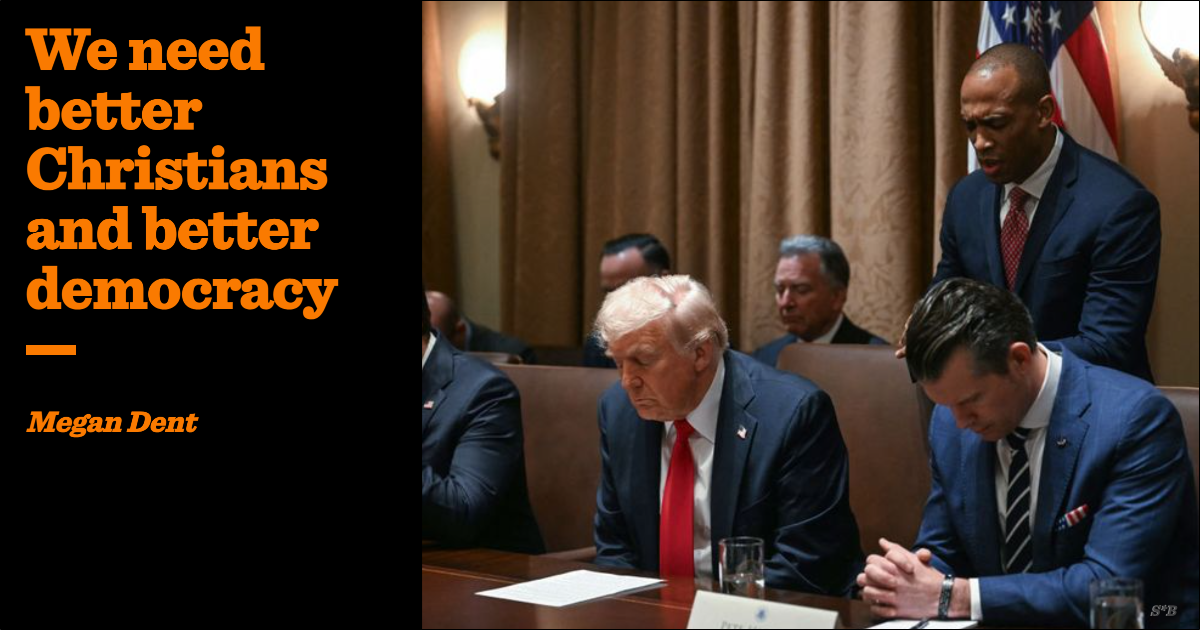
When Donald Trump claimed that he could shoot somebody on 5th Avenue and not lose any voters, he exposed a hidden ailment in US politics. The American evangelical movement — a broad sweep of conservative, often non-denominational Protestant churches — has turned a blind eye to the kind of depravity they supposedly deplore.
How did it come about that two thirds of the most socially reserved, no-sex-before marriage, God-fearing morality police would elect, multiple times, a bullish sex offender, his history checkered with pornstars and multiple marriages?
In Cross Purposes: Christianity’s Broken Bargain with Democracy (Yale, 2025), Jonathan Rauch — self-described gay Jewish atheist — argues that American Christianity has turned its back on its core theology, imperilling both itself and the liberal democratic order of the country.
Rauch contends that the Founding Fathers designed the republic around the guarantee that Christianity would produce virtuous, governable subjects. “Our Constitution was made only for a moral and religious people,” wrote John Adams. “It is wholly inadequate to the government of any other.”
Christianity and democracy need each other, Rauch argues, because neither of them can adequately answer the existential questions that preoccupy us. Secular philosophy fails to offer adequate foundations for human morality — what is right? — nor satisfy the mysteries of mortality — what happens when we die? On the other hand, theologians cannot explain the metaphysical impossibility of the supernatural — summed up by Ruach as “miracles” — nor the age-old problem of “theodicy” — why would a benevolent God allow evil?
In this schema, Christianity and democracy are each “intrinsically reliant on the other to build a morally and epistemically complete and coherent account of the world.” For Rauch, the Christians are letting the democracy side down by allowing too many secular values to dilute their theology. “Rather than shaping secular values, [the church] merely reflects them, and thus melts into the society around it. It becomes a consumer good, a lifestyle choice, or just another channel for politics.”
Rauch is right that when the term “evangelical” becomes “a political uniform”, rather than a religious identity, the churches have betrayed their own moral mandates. But this is far from unique in Christian history. The problem is less that Christianity has suddenly and dramatically succumbed to MAGA and more that the Christian churches have always struggled to follow Christ. Just ask the German Evangelical Church between 1933-45, or indeed, the current Russian Orthodox Church praying for Putin’s victory in Ukraine. When partisan politics “backflow” into Christianity, the faith loses its integrity. And yet that faith can only be influential when it is legible within its host culture. Christianity has always had this problem. It may be a bug, not a feature, but it’s a pretty intractable bug.
Rauch claims that a declined Christianity plunges democracy into crisis. But his argument lacks specificity, beyond the claim that evangelicals voted for Trump. His notion of “sharp Christianity”, as “divisive, fearful, partisan, and un-Christlike”, with “dangerously illiberal implications”, echoes the language that many use to characterise the MAGA movement itself. And it’s not wrong. If Christians were more Christian, they may indeed avoid voting for Trump. But since this is the substantive argument of the book, the subtitle — “Christianity’s broken bargain with democracy” — is misleading. Rauch explores a very specific subset of American Protestantism and its connection with a particular political movement. Notable absences in his analysis include American Catholicism and its decades-long pro-life lobby, or the Episcopal Church’s wholesale adoption of progressive politics. These are two of many cases that both support and complicate Rauch’s claim that Christian churches should steer clear of partisan politics, but don’t feature.
For Rauch, we should look to the Church of Jesus Christ of Latter-Day Saints as an example of how Christians might preserve their theological distinction while bulwarking civic liberalism. This leads to a strange crash course on Mormon theology, which gets rather muddled. He congratulates the Mormon church on taking its American heritage seriously, for instance in regarding the American Constitution as “a divinely inspired document”. But elevating a civic treatise to the level of sacred text seems like the ultimate problematic intermingling of faith and politics: exactly what Rauch rejects.
He enthuses over the Mormon rejection of Augustine’s doctrine of original sin. Instead they “celebrate[s] Eve’s act and honor[s] her wisdom and courage in the great episode called the Fall.” In eating the forbidden fruit, Eve unlocked human freedom, which the Mormon prophet and founder Joseph Smith extolled when he described man as “a moral, responsible, free agent.”
This theology of agency is better placed than its glum Augustinian counterpart to prize freedom of expression and conscience in the public square, Rauch argues, and is “but a short step to Madisonian pluralism.” He implies that the evangelical churches would do well to adopt this more democratically-amenable theology — a “live and let live” approach — rather than their business about original sin. Here again, Rauch contradicts himself. If you have to retrofit a theology to better suit a democracy, you’re engaged in the very cross-contamination of religion and politics that his book warns against.
Democracy is undoubtedly better preserved when Christians are better at following Christ
A classical liberal through and through, Rauch defends liberalism itself against any accusation that it has contributed to the breakdown between democracy and Christianity. He takes aim at post-liberals — Patrick Deneen, Sohrab Ahmari and others — claiming that they mistake liberalism as inherently self-undermining, when really it just has self-undermining tendencies. He doesn’t shy away from illustrating the extent of those tendencies, citing a survey on changes in American values which revealed that the only value that rose in estimation in the past fifty years was “making money.” Not religion, patriotism, community, or family — this is the vacuum that post-liberalism rushes into. But as Rauch argues convincingly, if liberalism has failed, post-liberals are also failing. It’s for them to identify “concretely and specifically, what regime is better.”
Rauch’s work is elegantly written and easy to read. It serves as a broad reminder of the religious underpinnings of post-Enlightenment political philosophy, and as a call for secular society to regard the Christian church as a significant “a load-bearing wall” in American civic life, and not just as a “basket of deplorables”. Despite his marked omissions and disproportionate focuses, Rauch’s basic tenets are right. Faith should hold politics to account for its morality. Democracy is undoubtedly better preserved when Christians are better at following Christ. If only.