Every budget creates winners and losers. This year, the Chancellor claimed hers was about fairness, public health and responsibility — particularly when it came to online gambling. Higher taxes on activities seen as socially harmful, we were told, would raise revenue and curb excess. On the face of it, that argument is politically saleable.
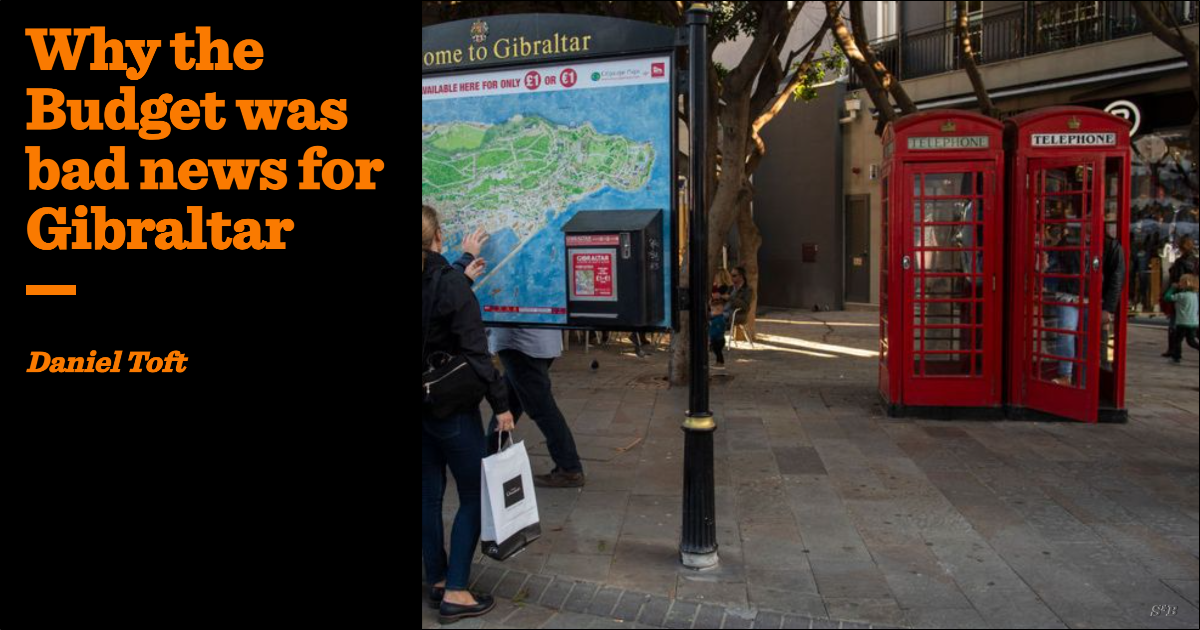
Yet look beyond Westminster and the numbers tell a very different story. Arguably the single biggest loser in this budget is not households in the UK, a particular sector of the UK economy, or a certain geographic area of the UK. It is Gibraltar — a British Overseas Territory that now finds itself staring down the barrel of an economic shock it did not vote for, did not design, and cannot easily absorb.
The unprecedented budget decision to almost double remote gaming duty, from 21 per cent to 40 per cent, and raise online betting duty to 25 per cent will be felt most keenly in Gibraltar. While the UK will collect the revenue, Gibraltar will absorb the pain because its economy, jobs market, and public finances are uniquely exposed. Online gambling is not a side industry on the Rock, but a key plank of Gibraltar’s modern economy.
This did not happen by accident. For decades, Gibraltar has positioned itself as a well-regulated, compliant jurisdiction aligned to the UK. Online gambling companies were encouraged to base themselves there, create high-value jobs, investment, and pooled expertise. In return, Gibraltar built a regulatory ecosystem that supported British consumer protection and tax compliance, and a sustainable local economy. This relationship worked. And since 2014, gambling businesses based in Gibraltar have been required to pay UK gambling taxes when they transact with UK customers; a so-called “place-of-consumption” tax.
Industry and government representatives in Gibraltar have warned that the tax rises will add hundreds of millions of pounds of additional costs, force companies to restructure, and ultimately place thousands of jobs at risk. The knock-on effects could be severe: a shrinking tax base, weakened public services and pressure on housing, healthcare and social support systems in a community of just 34,000 people.
Crucially, these warnings were not an afterthought in the wake of the Chancellor’s announcements: they were delivered loud and clear in the weeks and months leading up to the budget by representatives of HM Government of Gibraltar. The Rock’s Minister for Justice, Trade, and Industry, Nigel Feetham, who is responsible for Gibraltar’s gambling sector, travelled to London on a number of occasions to warn politicians and officials that dramatic gambling tax increases would have a “devastating” impact on the territory. He spoke publicly of losses running into the tens of millions of pounds and warned that Gibraltar’s public finances would be seriously undermined.
Those warnings were not only raised privately with UK ministers but formally acknowledged on the record in Gibraltar itself. In a statement to the Gibraltar Parliament following the Budget, Nigel Feetham described the tax rises as unprecedented and warned that they put at risk an industry Gibraltar has spent decades building, with direct consequences for jobs, revenues and public services. His remarks made clear that Gibraltar’s concerns had been clearly articulated and well understood. Further, when the UK and Overseas Territories met shortly afterwards at the annual Joint Ministerial Council in London, the official communiqué made no mention of the changes at all. No acknowledgement of Gibraltar’s vulnerability. No commitment to mitigation. No signal that Gibraltar’s concerns had been heard.
From a UK domestic standpoint, the Chancellor’s approach may appear tidy. Online gambling is easy to tax: it is, rightly or wrongly, perceived as harmful and associated with large corporate profits. But this framing has ignored the reality that well-regulated jurisdictions like Gibraltar are part of what keeps gambling safer, not makes it dangerous.
There is also a deeper issue of fairness. Gibraltar is not a foreign economy free-riding on the UK. It is a British Overseas Territory whose economic model developed under UK regulatory assumptions and encouragement from Whitehall. When Westminster makes a fiscal decision that disproportionately damages one territory’s economy, it cannot be brushed aside as collateral damage or ignored.
Diversification is often offered as a casual answer. But economies cannot diversify overnight after decades of specialisation or on command, especially smaller ones with the physical and demographic constraints of somewhere like Gibraltar. You do not simply replace a major pillar of employment and revenue at the stroke of the Chancellor’s pen.
What makes this case stand out is not simply that Gibraltar lost, but that it lost so heavily, and without protection
None of this is an argument against taxing online gambling or tackling gambling-related harm. It is an argument for proportionality, responsibility, and awareness of our British Overseas Territories. The UK could have phased-in the changes more gradually, introduced transitional measures, or recognised Gibraltar’s exposure through tailored solutions that work for their economy. Instead, it opted for a blunt fiscal instrument that plugs a hole in the UK government’s finances while exporting economic pain to a much smaller economy which is led to believe it has a special and trusted relationship with the UK.
Budgets are statements of priorities, and this one appears to have prioritised domestic UK optics, internal politics, and a scramble for revenue over sensitivity to our territories beyond the mainland. For most UK voters, the consequences of this will never register. But for Gibraltar, they may define the next decade and beyond.
Every budget has losers. What makes this case stand out is not simply that Gibraltar lost, but that it lost so heavily, and without protection. If the UK is serious about its responsibilities to its Overseas Territories, it should recognise that reality before lasting damage is done.