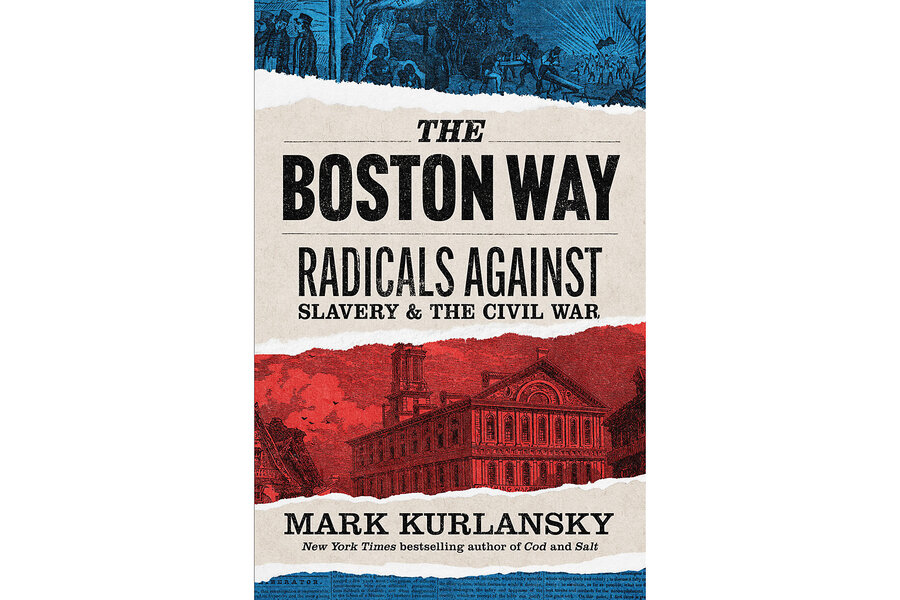
Mark Kurlansky has written 40 books, but he’s best known for “Cod” and “Salt,” two works in which he looked at common food items with fresh eyes. He has a signature gift for inviting readers to consider the familiar in new ways, which is why “Cod” and “Salt” became bestsellers.
Kurlansky is up to something similar in “The Boston Way,” his new book about how 19th-century pacifists navigated the prospect of an American civil war to end slavery. Hundreds of books have been written about the Civil War, but Kurlansky breathes new life into the subject by taking a more novel slant. He focuses on a subset of Americans in and around Boston who saw slavery as an unmitigated evil, but were horrified by the thought that their fellow citizens might try to settle the matter by killing each other.
Readers might wonder if Kurlansky, who’s best known for writing about food, is up to the challenge of a Civil War narrative. But in addition to his chronicles of cod and salt, along with lively volumes on oysters, milk, salmon, and onions, he’s also churned out books of social history, including “1968: The Year That Rocked the World,” and “Nonviolence: The History of a Dangerous Idea.” In an author’s bio on the dust jacket of “The Boston Way,” Kurlansky makes his own views on nonviolence clear. We learn that he “refused to serve in the Vietnam war, and has opposed every war since.”
Why We Wrote This
A group of abolitionists in Boston urged nonviolent action against slavery, arguing that violent conflict would not solve the issue. Instead, they argued, a civil war would create a backlash and stall progress toward rights for African Americans.
But wasn’t the cause of freeing American slaves worth fighting for? The case for a nonviolent alternative was made most vigorously by William Lloyd Garrison, a Boston abolitionist who rests at the center of Kurlansky’s story. Garrison predicted that if emancipation came about through violence, it would create even more hatred, delaying by at least a century the day when African Americans secured their rights. “It has been taking even longer than that,” Kurlansky concludes.

“The Boston Way” appears at a time when polarized politics are inviting some social commentators to wonder if Americans might collectively take up arms against each other again. Such a prospect might seem unthinkable to most of us, but as Kurlansky suggests, the thought of civil war seemed unthinkable to many antebellum Americans, too. Like last year’s “The Demon of Unrest,” Erik Larson’s account of the days just before the attack on Fort Sumter, “The Boston Way” persuasively immerses readers in the national mood shortly before the Civil War. Kurlansky drops us into this long-ago world quickly – so quickly, in fact, that readers might need some time to get their bearings.
John Brown, the militant abolitionist who would eventually be hanged after seizing a federal arsenal, pops up on the first page, and the trouble starts a few sentences later when he and Garrison get together in Boston in 1857 and debate the best way to end slavery.
“The meeting was a disaster – a shouting match, according to some accounts,” Kurlansky tells readers. Brown was unswayed by Garrison’s calls for nonviolence, using Old Testament passages to invoke notions of vengeance and divine wrath. Kurlansky seems to smile on the page as he quotes a standard rebuttal to such arguments from abolitionist Lydia Maria Child: “What a convenient book the Old Testament is, when ever there is any fighting to be done.”
Child, a bracing and often witty writer, is one of the stars of “The Boston Way,” and other leading women thinkers of the day, including Margaret Fuller, Susan B. Anthony, and Elizabeth Cady Stanton, show up, too. Kurlansky positions the cause of nonviolent opposition to slavery within a larger spirit of social experiment that has long defined Boston political culture. But even by Boston standards, Child and her allies were ahead of their time. “Child was one of several women of prominence in the abolitionist movement,” Kurlansky writes, “and soon others joined. This in itself was a growing controversy in a society where women were not expected to be involved in politics.”
Kurlansky’s chapters buzz like a period version of a talk show, with chatty appearances by Ralph Waldo Emerson, Henry David Thoreau, John Greenleaf Whittier, and Frederick Douglass. One complication is the book’s lack of an index – a vexing omission given its multiplicity of figures and its ambitions as a work of scholarship.
There is, alas, no need for spoiler alerts in discussing “The Boston Way,” since readers know that Garrison and like-minded thinkers couldn’t steer their fellow countrymen away from armed conflict. But Kurlansky argues that the efforts of Garrison’s circle, known as the Boston Clique, weren’t in vain.
“The great leaders of nonviolence, charismatic figures such as Mohandas Gandhi and Martin Luther King Jr., are often remembered as rarefied geniuses who hatched their ideas from the ether,” Kurlansky writes, “but the ideas and tools of nonviolent activism have been pursued by many people many times, and though a small group in nineteenth-century Boston may be little remembered today, what they did, what they learned, and what they taught, have lived on.”