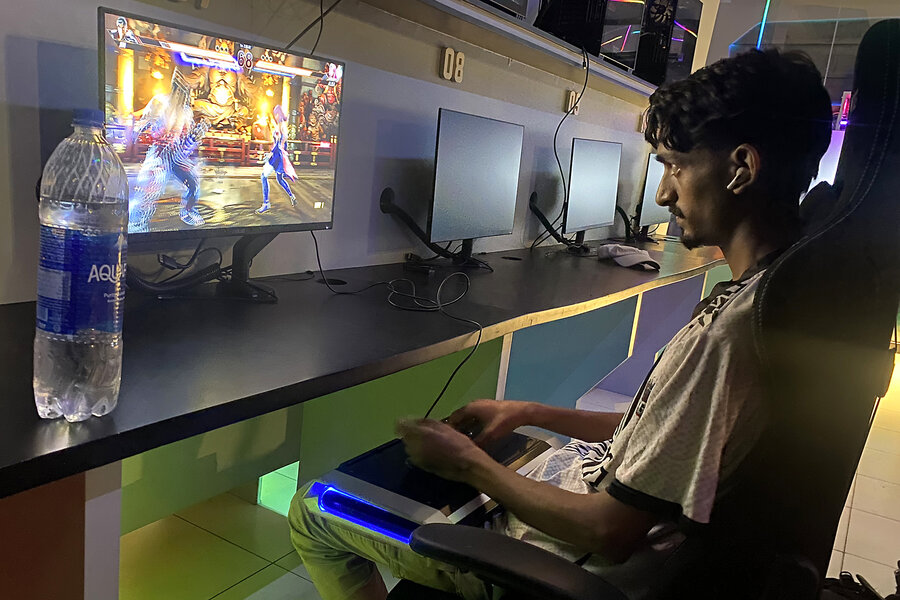
In a crowded, dimly lit arcade in downtown Lahore, 16 of the finest Tekken players in the world are battling it out for $3,500 and the title of champion.
On screen, their avatars throw punches and roundhouse kicks with exaggerated sound effects. But in person, the atmosphere is friendly – between rounds, the contestants clap each other on the back, offer tips on mastering the video game, and analyze matches on a flatscreen TV.
Players from America, Japan, and South Korea have historically dominated the Tekken franchise, launched in 1996 and now in its eighth iteration. The emergence of Pakistan – with its chronic electricity outages and economic insecurity – came as a surprise to the global Tekken community.
Why We Wrote This
A retro video game has become an unlikely source of national pride in Pakistan, where a thriving arcade culture encourages collaboration – and produces some of the strongest Tekken players in the world as a result.
However, these very challenges may have laid the foundation for Pakistani players’ success.
The proliferation of online gaming and at-home consoles have created a multibillion dollar global e-sports industry, while also turning video games into an at-home hobby. But in Pakistan, where a new Playstation costs more than double the average monthly income, gamers must still go to their local arcade to play. There, they’ve found mentorship and developed new techniques that give them an edge against foreign competitors.
Indeed, experts say the country’s rise into a Tekken powerhouse is rooted in the values of community and collaboration.
“Unlike other parts of the world, Pakistan still has a strong arcade culture,” says Mohammad Zeeshan, the tournament organizer. “Because players compete against each other face-to-face, there is greater scope to share ideas and give each other feedback.”
Tekken training grounds
Today, three of the top 10 global Tekken players are Pakistani. They come from a world in which arcades have taken on the characteristics of regional dojos, with groups of players traveling around the country to represent their home.
“If you were good, you’d go and challenge others for supremacy,” says Tekken commentator and analyst Nosherwan “Silverfox” Khan. “From that, this aspect of community sprung up, and that’s how everyone leveled up.”

One of the contestants at the Pakistani PC Gamers tournament in Lahore is 19-year-old Zaryab Khan, who goes by the sobriquet “Foxce.” Mr. Khan describes his first couple of years playing the game as a formal apprenticeship.
After going to his local arcade in Rawalpindi “just to watch,” he asked one of the players to take him on as a pupil. He was told that he had to commit seriously to learning the game.
“My teacher told me I had to come every day,” he says. “From then on, I decided that I would devote two hours a day to learning the game.”
Mr. Khan is now one of the best players in the country, driven by a desire to win respect for his city. “No one from Rawalpindi was famous in the [Tekken] scene,” he says. “Now everyone knows that Rawalpindi has talent.”
The unique challenges of playing Tekken in Pakistan have also led to several innovations, most notably the use of the “claw” technique, where the player arches their wrist and attacks the buttons more vertically. Proponents of the technique say this allows for faster reaction times and greater accuracy.
“Our arcade machines would have really stiff buttons, and the playing space was really small so the claw technique pretty much emerged out of necessity,” says Sikander “Sikkify” Khan, a Tekken commentator. “The technique allows you to conceal the commands you’re inputting from an opponent who’s sitting next to you.”
Barred from competing
Talent is not always enough to guarantee success, at least internationally. The weakness of the Pakistani passport, which is ranked 101 out of 104 by The Henley Passport Index, means that many of these Tekken masters struggle to get the visas to attend international tournaments, where prize pools can exceed $100,000.
When Arslan “Ash” Siddique shocked the Tekken world by winning the 2019 EVO championship – the world’s most prestigious fighting game tournament – he used his victory speech to call attention to the talent pool in his native country.
“There are many other strong players like me in Pakistan waiting for an opportunity to compete globally,” said Mr. Siddique, who went on to win six more EVO championships.
Among them is Ahsan Ali. Of the 18 tournaments he was slated to compete in over the last two years, Mr. Ali was only able to compete in two.
“This difficulty of getting visas is an ongoing problem,” he says. “We only get visa appointments a couple of days before the tournament,” and there often isn’t enough time to process the application.
But that hasn’t stopped players from dreaming. At the Lahore tournament, everyone wants to be another Arslan Ash, and to show the world that Pakistan’s Tekken dominance is here to stay.