My late father was a prominent minister of the Free Church of Scotland — its top theologian and principal of its college, in easy command of French and Gaelic, Greek and Latin and Hebrew.
But one most Scottish male habit he never broke. When you handed him his daily paper — usually around the time of his elevenses — he immediately flipped it over and read it backwards. All the news of the world — the outbreak of war, a midair collision, Marxist insurrection or sensational scandal — could not trump that vital morning fix: the latest news of Glasgow Rangers.
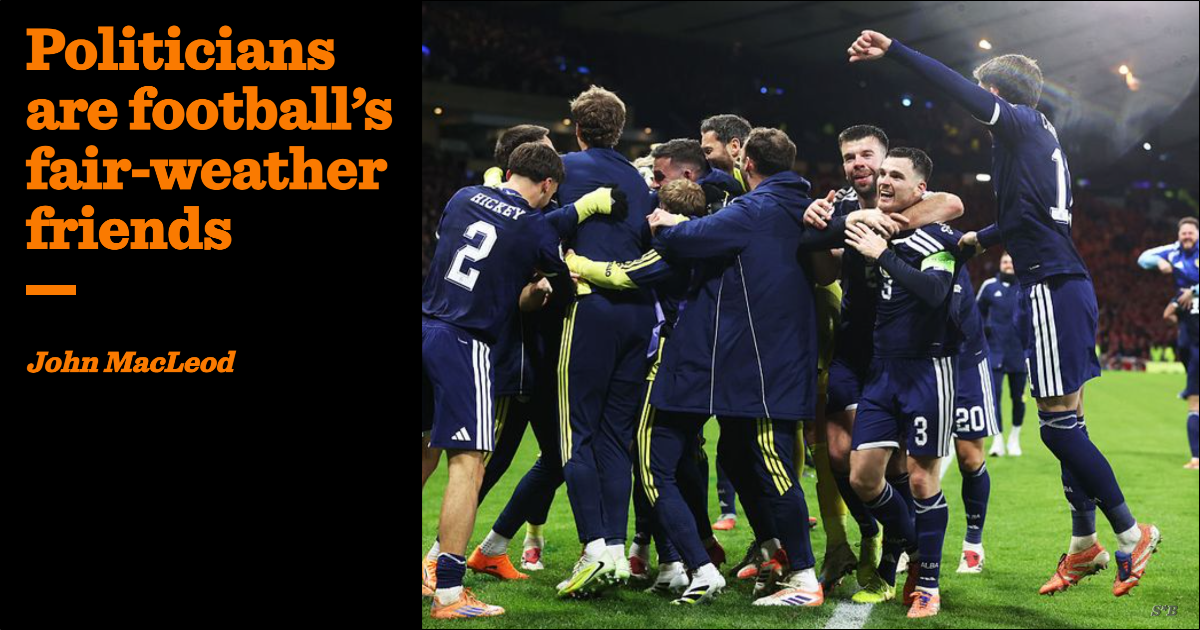
On 18th November, to general Caledonian delirium, Scotland’s national side thumped Denmark 4-2, thus qualifying for the World Cup finals for the first time in many years.
You have to be thirty-five, at least, to remember Paris ‘98. Scots have been conceived, raised, educated, married off, made babies and begun ever so slightly to grey who were not then even alive. They have followed the Scotland squad through its largely, um, fitful fortunes in the spirit of a tribe long inured to the last stand, the lost cause and the forlorn hope.
That Scotland — as Alex Salmond once darkly cracked — when, the day our ship comes in, we’ll all be at the airport.
The Hampden triumph will be remembered as particularly glorious because the outcome of the match was in genuine doubt till stoppage-time — at ninety minutes, Scotland and Denmark were 2-2, and a draw was all the Danes needed — and because three of Scotland’s four goals were absolute corkers.
If the boring one — Lawrence Shankland’s mobbed goalmouth tap-in off a deft corner-kick — was boring, it remained one more goal than the similar sitter Scotland’s Steve Nicol infamously “choked” against Uruguay in Scotland’s last-gasp chance at Mexico ‘86.
It is not to take anything away from Kieran McTierney’s lethal missile, or Kenny McLean’s audacious lob from behind the halfway line, to suspect the goal immortalised, just three minutes into play, will be Scott McTominay’s glorious, impossible, upside-down bicycle-kick.
The image is already a meme; already, online, they are flogging the merch: mugs, mousepads, framed prints. Endearingly, seconds after his balletic brilliance, McTominay raced to the stand, arms outstretched, shouting for his mum.
Ironically, for most of the match Scotland did not play very well. “We are absolutely honking,” wailed one fan on social media and in his best Glaswegian. But the lads were on their home-turf, and the hungrier; the massed fans roaring and desperate. “In the last part of the game,” manager Steve Clarke, 62, all but sobbed, “the crowd was still with us. Everybody was in the stadium. Nobody left because they could smell magic…”
Ironically, our political class has never been that comfortable with the ee-aye-addio of Association football
Naturally, politicians were all over it within moments of the final whistle, for they could smell opportunity. They sent their congratulations, posted things on social media, and laid early-day motions. Even the Prime Minister stuck his oar in, bitterly conscious that, in just over an hour and a half, a bunch of men in shorts had, for a day or two, united Scots everywhere in a manner of which the typical Westminster or Holyrood party-hack could only dream.
Ironically, our political class has never been that comfortable with the ee-aye-addio of Association football. Many, especially those of privileged upbringing and private schooling, no doubt think — sotto voce — that it is ever so frightfully common.
Then they are conscious of all the risks in backing a side, donning colours and favours, mangling the name of some golden-boots or other or — the horror — suddenly being asked, live on air, to explain the offside rule. There is unease about a baying, yobby world — still very male, pale and stale — of high emotion and long memory.
In their more imprudent Beautiful Game moments, politicians have often inadvertently added to the gaiety of nations. Trying to vaunt the glory of a country where “multiple identities work,” David Cameron — a known Aston Villa fan — once inexplicably vented, “Of course, I’d rather you supported West Ham.”
Liz Truss, who was Prime Minister for almost the lifespan of a lettuce in 2022, mewed that Britain “needed to invoke the spirit of Don Revie” — a disastrous manager of the Three Lions, five decades ago, and a known, vocal Labour supporter. Matt Hancock, cornered on Sky News, had inexplicably convinced himself Marcus Rashford was really Daniel Rashford, and Liberal Democrat leader Ed Davey decided to mark the evening the Lionesses won through to the European Final by posting a “politician goes to pub and is normal bloke” snap of himself leering with a pint.
“There’s nothing like a spontaneous, candid shot that captures a moment,” retorted someone crushingly, “and this is nothing like a spontaneous, candid shot that captures a moment.”
Scottish football is particularly distorted and fraught because, save for a spell forty years ago when Aberdeen and Dundee United briefly emerged as the “New Firm,” it has been dominated for as long as anyone can remember by the two great clubs of Glasgow, Rangers and Celtic.
Both roiling fan-bases are politicised in the worst way. We have long grown used to Celtic fans waving the Irish tricolour and singing such diverting ditties as “The Broad Black Brimmer of the IRA”. Now the Palestinian flag is in vogue. Sinister elements among Rangers support are linked to the far Right — and one means the far Right, Combat 18 and so on, not the froggy Farage. In the latest faintly bonkers trope, Rangers fans have been brandishing the image of Charlie Kirk.
It was not, notoriously, till 1989 that Rangers could bring themselves to sign up their first Catholic player, Mo Johnston. Some of the less herbivorous fans promptly burned their strips for the cameras. In fact, far more consequential was the signing, several years earlier, of such English hunks as Terry Butcher — the first step in what has proved the steady hollowing-out of the Scottish game, which at the very top, these days, no longer involves that many Scots.
Much, especially in the early years of devolution and because Labour hoped to embarrass the Nationalists, was made of “Scotland’s Shame” — the squalid spites of sectarianism.
In fact, even a quarter-century ago, it was hugely exaggerated. A problem largely confined to west-central Scotland: Larkhall’s shame, perhaps, but the country’s?
My father’s first pastoral charge was the parish of Kilmallie, in Lochaber — broadly, Corpach and Caol. Till the boy-minister pasted his driving-test, he was chauffeured about by Fr John Morrison, the local priest. District-Nurse Martin, no less Catholic, supervised my mother through three pregnancies; Donald Wynne, the local butcher, brother of a very Monsignor, gave her a parcel of free meat for every Communion season (a biannual 5-day event when two visiting ministers kept five days of special services and expected to dine well between them.)
They were our friends: not operatives of the Papal Antichrist. Fife-and-drum bigotry barely made it past Dumbarton — far less the Ballachulish ferry.
A problem, moreover, imported rather than home-brewed — the sustained post-Famine migration to Scotland, largely from County Antrim, included many Protestants — and that had peaked in the years of slump after the Great War: at the International Eucharistic Congress in Edinburgh, in June 1935, there was a serious riot. Nowhere, anywhere, in Scotland is the Pope burned in effigy, as still happens in at least one Sussex community on Bonfire Night.
Historians of the calibre of Sir Tom Devine — himself Catholic — have been pointing this out patiently for years. Which did not stop the Scottish Parliament, in 2012, from passing the silliest legislation ever to belch from Holyrood, the Offensive Behaviour at Football and Threatening Communications (Scotland) Act.
The SNP had months earlier won an overall majority — amidst an electoral framework supposed to make that impossible — and thus railroaded this bin-fire of a Bill through Holyrood without amendment, adequate debate or the backing of a single opposition MSP.
The Glasgow Herald rightly stormed that this was “knee-jerk legislation” which would have to be revisited, for “Scotland cannot arrest its way out of sectarianism.” Professor Devine slammed it as “the most illiberal and counterproductive act passed by our young Parliament to date… a stain on the reputation of the Scottish legal system for fair dealing.” One presiding Sheriff described it witheringly, from the bench, as “mince.”
The unease grew all the greater when the police arrested one fan at an Edinburgh match for the enormity of wearing a FREE PALESTINE T-shirt — and when the sometime Justice Secretary, Kenny MacAskill, celebrated that folk could be convicted under the new statute even if no one’s peace had actually been breached.
This, he harrumphed, had been the failing of the old order. “Hence, when a crowd was singing an offensive song and few others were about to object then there couldn’t be a conviction. A legislative change was needed to address this. The absence of good people to be offended doesn’t make something inoffensive if it patently is offensive…”
“So we now have,” retorted commentator Alex Massie, “as he candidly admits, the invention of people who might have been offended by the singing of a football song if they had existed. If a song is sung in the forest but there is no-one there to hear it, has it been sung at all? Who knows?”
The vast majority of the musical numbers that had MacAskill and colleagues clutching their pearls ranged from the mawkish to the rather funny: anthems to such total IRA losers as Seán South of Garryowen, or send-ups of Ulster Unionism like Kinky Boots. “No reasonable person concludes that the singing of The Sash (or its green equivalents) is an incitement to violence or religious hatred,” Massie pointed out.
“It’s just a football song. If you thump or stab someone after the football, it’s not because you were singing The Boys of the Old Brigade half an hour earlier; it’s because you’re a thug. And we have sufficient laws to deal with thuggishness already.”
Once voters had in 2016 deprived the Nats of their majority, the Act was sensibly repealed in 2018. But the belief that there is such a thing as a right not to be offended is increasingly incorrigible, raising its head at such junctures as the 2024 European Championships in Germany, when police chief Peter Both told England fans — ironically, on the eightieth anniversary of D-Day — “not to be dicks.”
The ”dickery” in question was the fans’ wont for singing “There Were Ten German Bombers In The Air” — to the tune of “She’ll Be Coming Round The Mountain When She Comes” — whenever there were German fans about to tease.
With all respect to Herr Both, it’s hardly the Horst-Wessell-Lied, there were indeed many German bombers in the British skies during the Second World War, the RAF from England did shoot quite a number of them down, and — on balance — most people in England think this was a good thing.
The song is particularly funny because Germans do not think it funny at all — nor have they been averse to their own taunting jingles, such as an English-baiting number about Mad Cow Disease.
The whole point of football, not least as an emotional and cultural safety-valve, is that for ninety minutes men of all ages get to behave like demented, dancing 10 year-olds — a licensed silliness that seems to bewilder too many politicians and leaders of opinion.
It is in this uncomprehending spirit that the new Government is now intent on creating a Football Regulator, for oversight and regulation of part of our national life — and, indeed, a significant part of our economy — that has been rolling on perfectly well without any Government involvement at all.
Enough to have anyone rousing up the bus for a few happy stanzas of Es waren zehn deutsche Bomber in der Luft.
Though I like to think Daddy could have rendered it in New Testament Greek.