The six missiles fired by an Israeli drone last week precisely perforated the walls of a Beirut apartment, blasting out two floors that rained car-crushing debris on the streets below and killing Hezbollah’s top military commander, Haytham Ali Tabatabai.
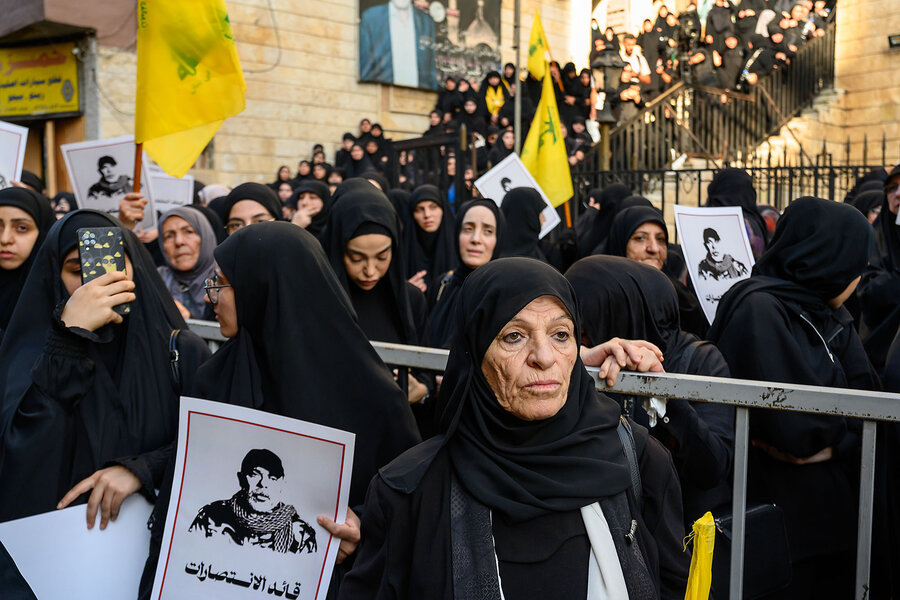
Vows of revenge echoed the next day through the cramped streets of Haret Hreik, the Hezbollah stronghold in Beirut’s southern suburbs, as flag-waving Hezbollah supporters carried the coffins of Mr. Tabatabai and two other militia operatives to burial.
One year after a ceasefire ended 14 months of Israel-Hezbollah fighting – which left the Iran-backed Shiite militia deeply shaken and weakened – the Israeli military continues an overshadowing presence across Lebanon. Almost daily, Israel strikes at targets ranging from Hezbollah’s fighters, weapons depots, and suspected arms factories, to construction equipment.
Why We Wrote This
A year after an Israel-Hezbollah ceasefire, the Lebanese people are still caught in the middle. The ceasefire requires Hezbollah to disarm and Israel to withdraw. Neither has happened, even as Beirut works to fulfill its part of the bargain.
The conflict took some 4,000 Lebanese lives, according to the Lebanese Ministry of Health, which does not differentiate between fighters and civilians. Yet during the ceasefire, Israeli strikes have killed some 330 more, one-third of them civilians, according to the Lebanese Army.
For Lebanese, the sense of an ever-present Israel is felt uneasily, from drone-patrolled Beirut all the way to the south of the country. There, residents have also grown used to the gnawing buzz of drones – and now live cheek-by-jowl with five hill-top Israeli positions on seized Lebanese territory.
The result is the creation of a de facto Israeli buffer zone inside Lebanon, despite ceasefire conditions requiring Israel’s full withdrawal. Indeed, it mirrors Israel’s continued occupation of a border strip in southwest Syria, after the fall of Bashar al-Assad last December.

Scott Peterson/Getty Images/The Christian Science Monitor
But Israeli officials and media – frustrated by Hezbollah’s refusal to disarm north of the Litani River, which is also required by the ceasefire – have in recent weeks stated that Israel plans renewed “preventive strikes” against the militia.
“The way Israel has interpreted this ceasefire seems consistent with what is shaping up as a wider regional policy towards imposing de facto buffer zones with its neighbors that it doesn’t have comprehensive security agreements with,” says David Wood, the Beirut-based senior Lebanon analyst for the International Crisis Group.
“There is a ceasefire in place, but in name only, given that Israel has reduced but not ceased its fire,” he says.
Lebanese Army deploys south
The Lebanese Army has deployed 10,000 troops south of the Litani, cut off 11 smuggling routes, and now formally controls the border area, completing the first stage of a Hezbollah disarmament plan, as per the ceasefire, and mandated by the government last August. According to the Associated Press, the army holds 200 posts south of the river, and since September found 74 tunnels once used by Hezbollah, 175 rocket launchers, and 58 missiles.
Hezbollah maintains it is abiding by the ceasefire. But its top leaders also vow revenge for their losses, and will not discuss complete disarmament while Israel occupies Lebanese land.
“The Resistance stands firm, possessing what makes us as strong as mountains standing against fierce winds,” Hezbollah leader Sheikh Naim Qassem said Friday, at a memorial for his slain military chief. “We are ready to discuss the [national] defense strategy … not to relinquish our strength under any formula, and not to evade the current agreement.”

The United Nations in the past year has tabulated more than 10,000 cross-border violations into Lebanon – most from Israeli drone flights.
Among Israeli targets have been cement factories as well as bulldozers and heavy construction equipment – including 300 pieces destroyed in a single set of strikes in October. Israel claimed the vehicles were Hezbollah “engineering equipment used to rebuild.”
“Israel has very deliberately targeted efforts to rebuild,” says Mr. Wood. “Israel will point, always, to the fact that the ceasefire agreement acknowledges both Lebanon and Israel’s inherent right to self-defense, but Israel has deliberately adopted a very broad definition.
“In the early days of the ceasefire, we heard a lot about Israel responding to an ‘imminent threat,’ [but] Hezbollah hasn’t fired a shot at Israel for a year now.”
Israeli Prime Minister Benjamin Netanyahu said the assassinated Mr. Tabatabai had led efforts to rearm, and that “Israel will not allow Hezbollah to rebuild its power and we will not allow it to pose a threat … again.”
Defense Minister Israel Katz said Israel is “determined to continue the policy of maximum enforcement in Lebanon and elsewhere.”

Strikes haven’t stopped
At the Beirut funeral, a grim reminder of the heavy toll already taken against Hezbollah could be seen in the wounds of one drummer in the marching band. He was injured when thousands of Hezbollah pagers and walkie-talkies, secretly rigged with explosives by Israel, were detonated in September 2024.
Those blasts killed or immobilized many of the militia’s members, and marked the start of an Israeli onslaught that killed nearly all its top leaders – including the widely revered Sheikh Hassan Nasrallah – and ravaged its arsenal of more than 150,000 missiles and rockets.
Such a devastating assault was not what Hezbollah expected when it began limited rocket strikes into Israel in October 2023, in solidarity with its ally Hamas’ lethal cross-border attack on Israel from Gaza.
“There has never been a true cease-in-fire,” says Kandice Ardiel, spokeswoman for the United Nations Interim Force in Lebanon (UNIFIL), which has monitored southern Lebanon since 1978. “We are not seeing Hezbollah military activity south of the Litani. … We have not seen anything militarily that has been rebuilt. We have not observed that.”
Still, tens of thousands of Lebanese civilians have not been able to return home. And while Israel has demonstrated a granular degree of intelligence regarding Hezbollah, some Israeli explanations of its actions confuse Lebanese.
The Israeli army’s Arabic spokesman, Lieutenant Colonel Avichay Adraee, for example, recently warned on social media that Israel had detected “dozens of terrorist infrastructures” built by Hezbollah in the southern village of Beit Lif. Alarmed locals summoned the Lebanese Army and UNIFIL to demonstrate that they should not be targeted.

Scott Peterson/Getty Images/The Christian Science Monitor
“In Beit Lif it caused a panic, because people were saying it is not true. People called the army and said, ‘Come to our houses and check, and you will see,’” says Ms. Ardiel.
“People have come back to Naqoura and Alma el-Shaab,” she says, referring to two villages on the hill above UNIFIL headquarters, “and some villages, but right along the Blue Line [U.N.-demarcated Lebanon-Israel border] people are afraid. And with these five Israeli positions and the inflammatory rhetoric from both sides, it doesn’t give people a sense of security.”
The Shiite village of Naqoura survived the war largely intact, but now barely a house remains standing and the mosque is destroyed – with most damage done by occupying Israeli troops after the ceasefire.
“Trying to stay on the sidelines”
Further up the hill but only partially wrecked is the Christian village of Alma el-Shaab. Residents say that, after they fled last autumn, Hezbollah fighters moved in to battle Israel, and Israeli forces then occupied the town for four months.
Those Israeli troops have withdrawn south to an outpost visible from the village, not far from a new Lebanese Army position. But Christians who have returned, like Sami Btaich, whose house was used by both Israelis and Hezbollah, feel Israel’s proximity.
He returned to a home filled with trash, filth, and wartime stains. A Star of David was spray-painted on the nearby church.

Scott Peterson/Getty Images/The Christian Science Monitor
Mr. Btaich says Hezbollah later came to retrieve bodies and left mines and detonation wire in sacks in his home.
“We are trying to stay on the sidelines, not with Hezbollah or Israel, [but] we still get slapped by both,” says Mr. Btaich. “We have nothing to do with this war, but look what happened to us.”
Dug-in Israeli tank positions and trash remain. Graffiti left by the Israelis reads: “We are not here against you [Christians], but unfortunately we need to come here, because Hezbollah is here.”
Mostly, it is the frequent buzz of drones that signals Israel’s omnipresence. Any movement attracts a drone. Mr. Btaich recalls one coming “right in front of my face” while he worked on his car a year ago.
“We are living extra careful. It’s risky, it’s dangerous, but we have to live with it,” he says. He believes Israel will establish a 1,000-yard-deep buffer zone as a “new border for them.”
“They think Lebanon and Syria are part of their land,” says Mr. Btaich. “Trust me, the Israelis are going nowhere. … I feel there is another round [of fighting] coming. Nobody can stop them.”