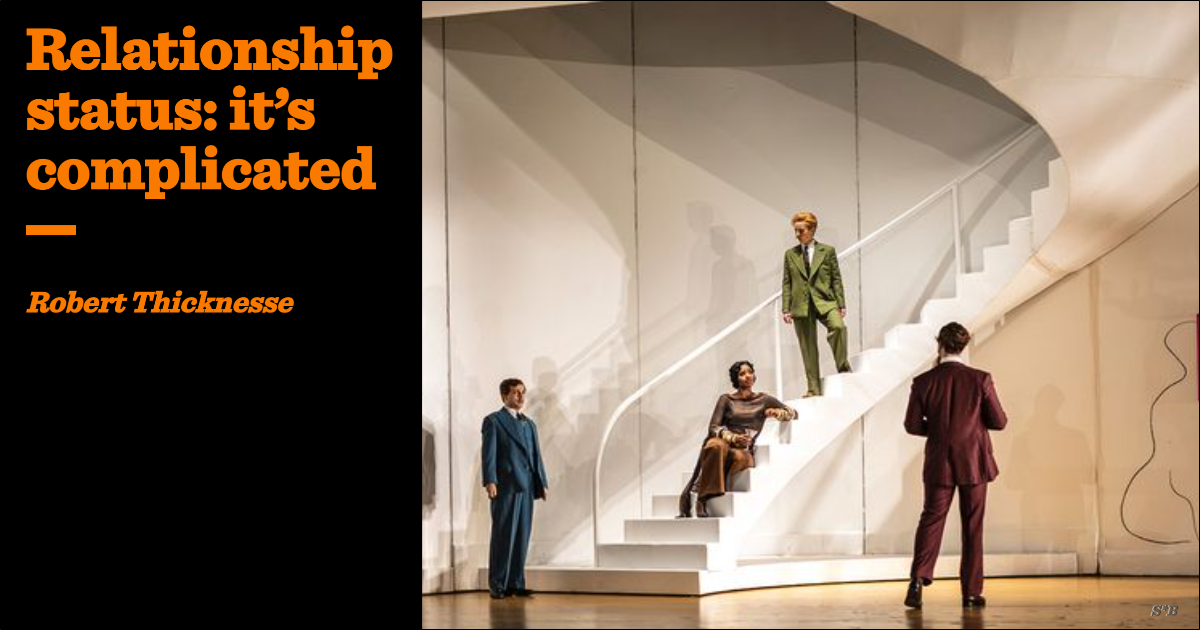

Any show that allows us to study Lee Miller’s breasts at leisure (in a blow-up montage of Man Ray’s famous snap) obviously has a lot going for it. And there’s still more that vaut le voyage in a highly ENO-ish (in a good way) show at the Coliseum which made the not exactly packed house very happy. Perhaps we are right back where we started? After all, the original run in 1730 was a flop, closing after seven performances. But, despite ENO’s constant bad-news cycle — they’ve just lost their chief exec to the Roundhouse — this felt like a triumph, this thoroughly English opera (yes, yes, I know it was written in Italian) performed by a terrific and mostly English young cast, and still making the point that there’s nothing to touch Handel, at least when he’s performed with love and good faith, unlike in Covent Garden’s recent assaults on the likes of Theodora and Semele.
In fact it’s a pretty patchy piece, something neatly finessed in Christopher Alden’s jokey production, first seen in 2008, which relocates the Queen of Naples to a Twenties Parisian salon where this beautiful, stylish, sexy heroine juggles a bunch of hopeful lovers: a humdrum story, in fact, but one that draws you in over nearly four never wearisome hours to the point where you find yourself, much to your own surprise, caring what happens to the not terribly prepossessing personnel, and realising their idle chit-chat is saying whacking great things about love and life through Handel’s cool muse.
The director, understanding he’s dealing with a pretty iffy crew — even Partenope comes over a bit shallow — decides to help us along with a few gentle laughs: he has a weakness for long build-up scenes with a custard-pie payoff, which I assume everyone likes. The choice of this supposedly Parisian set-up — Partenope as a sort-of Coco Chanel, her rival Emilio (in the original, an unfriendly invading neighbour, king of Cumae) a sort-of Man Ray, stalking about photographing the insides of people’s heads. Cute little bits of surrealism intrude, banana hats and gasmasks for a hand of whist. It’s foolish enough, but you might think the connection is that both Handel and the Surrealists understood the erotic nature of the psyche and the unconscious mind.
Partenope is billed as a comedy — it ends with a double wedding, so I guess it must be — but the humour lies largely in Handel’s ironic treatment of his humanly flawed characters. Partenope’s current squeeze, Arsace, is a vain love-addict who has dumped his true soulmate Rosmira for the glitzy attractions of the heroine; but Rosmira has followed him, bought a stick-on moustache and is pretending to be another of Partenope’s hopeful suitors. Arsace thinks this “Eurimene” looks a bit familiar, but basically butches out the awkward situation until the truth becomes unavoidable, he does that thing of realising that other people actually have feelings too, and returns to Rosmira. This leaves the path clear for Partenope’s other suitor Armindo, presented as a clutzy but true-hearted fall-guy.
And that’s really it. But the slow burn of the dramaturgy fills out these sketchy creatures through the mysteries of melody and orchestral accompaniment as they grapple clumsily with inconvenient but rather central dilemmas of the human condition. For the most part it’s not Handel’s first-division level, but it’s helped by a greater than usual variety of forms (quite a lot of blessedly short arias amid the long showpiece da capo jobs), with even the occasional ensemble thrown in, and a divertingly chatty (even catty) recit between these people whose problems (and eccentric ways of dealing with them) are certainly not boring. Alden’s reconfiguring of the small war between Partenope and Emilio as a sort of banana fight in the salon is jolly, and the foolishness all pretty much hangs together.
It is the scorned Rosmira who grabs our hearts, though — the terrific young mezzo Katie Bray outraged, punchy and heartbroken by turns as she tries to win back the fickle Arsace — including one of those time-stands-still periods where the pair work out what to do, and Arsace begins to find a way back to becoming his true self. He is sung by the current top-of-the-pops counter-tenor Hugh Cutting, a very cultured performer who takes Arsace beyond the mere flibbertigibbet into something much deeper and conflicted. Nardus Williams does everything asked of her as Partenope, elegant, serene and gorgeous-toned, reaching extreme levels of beauty in the aria “I am as flighty as moths in moonlight…”, voice and playful violin line creating a kind of musical nirvana. The American counter-tenor Jake Ingbar plays nebbishy Armindo with the right kind of affecting hopelessness, too.
Peace and respect and decent behaviour can be achieved with a bit of effort and goodwill (and spite and shaming, too)
Apart from taking Partenope’s first aria way too fast, conductor William Cole keeps things moving with a nice variety of pacing and feeling in the pit — again, Partenope is not wildly exciting sonically, but there’s a nice horn-backed aria and finally a gorgeous thing with lulling watery violins, a couple of flutes and plucked bass as Arsace does the very Handelian thing of being honest with himself while in the process of falling asleep.
What we might call Handel’s English semi-comedies — Xerxes is another — end with a particular quality of reconciliation that foreshadows the Mozart of Figaro but without Mozart’s amazing sense of a divine blessing descending on the little world he has created (representing the whole big world). Handel stubbornly and marvellously remains earthbound: this human mess is sorted out by humans through trial and (mostly) error, and the hard-won harmony is equally but differently moving, an acceptance of human folly that doesn’t pretend to be able to make the world perfect, but suggests that peace and respect and decent behaviour can be achieved with a bit of effort and goodwill (and spite and shaming, too). There’s a real heart-warming frisson in receiving that message loud and clear across three hundred years, a stone’s throw from where Handel first sent it out into the ether in the Haymarket.