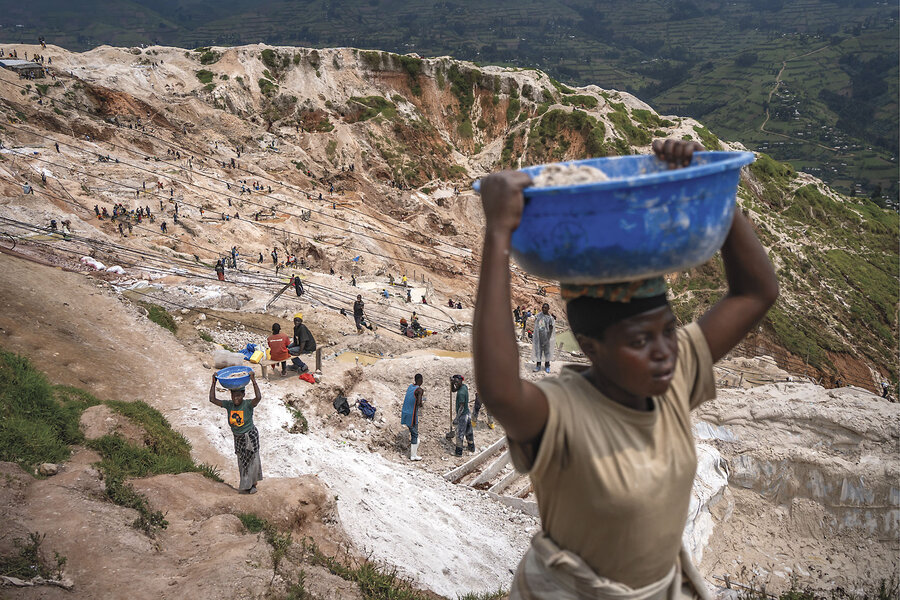
Along the ripped flanks of the Rubaya hills, in the northeast of the Democratic Republic of Congo, hundreds of workers dig through one of the world’s largest concentrations of coltan – a mineral that fuels both the 21st-century economy and one of its longest-running conflicts.
It does not matter to them, they say, who controls these mines. It could be the Congolese government, which has struggled for decades to assert its authority from a capital city some 1,600 miles away. It could be one of the militias tied to neighboring Rwanda, which took control of this swath of Congo last year.
Or it could be the United States, which this summer brokered a peace agreement between Congo and Rwanda. That could be a first step, U.S. officials have said, to an economic agreement that could help Americans move into a minerals market long dominated by Chinese companies.
Why We Wrote This
The need for critical minerals has brought the United States to one of the world’s longest running conflicts. A fragile deal Washington brokered between the Democratic Republic of Congo and the rebel M23 group shows how economics might lead toward peace.
“In Rubaya, we dig for whomever is in charge,” says a young miner named Amani, as he emerges from a dark tunnel wearing a headlamp.
In this particular spot, that means Ponchelin Mtunzi, who runs one of the access points into the 7,400-acre mining site. He has been mining the area for 15 years and knows the value of his leased 2,000-or-so-square-foot plots.

“It’s an incredibly rich place, a paradise for a farmer,” says Mr. Mtunzi, who paid nearly $20,000 for his last plot – more than 540 times the monthly salary of a rural Congolese person. “In one week, you can make your investment profitable. The whole hill is mineralized.”
It is a bounty that has attracted President Donald Trump, who has put a priority on rebuilding American access to and processing of critical minerals. These are minerals that the U.S. Geological Survey describes as essential for national security and modern-day technology, but which currently have a vulnerable supply chain. The Trump administration has invested heavily in international mineral projects, from Canada to Southeast Asia. Here, the U.S. leader sees the potential for a double win – both as a dealmaker and a peace-builder.
But the realities on the ground, in one of the geologically richest and most troubled regions in the world, show just how complicated extending this effort to Congo may be. Already, there are signs that the U.S.-brokered peace deal is coming apart.
In 2023, Congo supplied 40% of the world’s tantalum, an essential mineral found in coltan rock and used in key industries, such as telecommunications, defense, and aerospace. Approximately one-fourth of Congo’s output comes from the Rubaya mines.
It takes three hours along a narrow mud road shaped by frequent heavy rains to reach the mining site from the city of Goma, the capital of Congo’s North Kivu province.

In the decades since the 1994 Rwandan genocide set off a regional conflict here, hundreds of armed militias have fought over this territory. The conflict has displaced more than 7 million people, including more than 100,000 since the beginning of this year alone. Some, like the powerful Congo River Alliance (AFC), which includes the prominent March 23 Movement rebel group (M23), are connected to the Tutsi ethnic group whose members were massacred during the genocide and which now rules Rwanda.
This group seized large swaths of territory in the region in 2021, pledging to eradicate the remains of Hutu militia that took refuge in this part of Congo soon after the genocide. In April 2024, the AFC seized the Rubaya mines.
Before that, the area was held by another group, called “Wazalendo,” or “patriots” in Swahili. This was an auxiliary of the Congolese army, and made a practice of pillaging Rubaya’s riches, according to miners there.
“They paid themselves by stealing bags of minerals from us,” says Mr. Mtunzi. He says he is pleased by the new group in charge. “The AFC/M23 doesn’t do that. Our prayer is that they stay in Rubaya.”
But even that sentiment belies the violent complications of this region. Mr. Mtunzi is Kinyarwanda-speaking, and shares an ethnic background with the Tutsi warlords.

The U.S. Department of the Treasury has set sanctions on the militias, specifically citing their involvement in what are often called “conflict minerals.”
Even with its unrest, Congo attracts the highest amount of mineral exploration investment in Africa, around $130.7 million in 2024, according to the Center for Strategic and International Studies. Much of this investment comes from China. Chinese companies have long operated in eastern Congo, and some analysts say they have exploited the conflict and warring groups for economic advantage. Chinese firms have equity in 15 of the country’s 19 copper and cobalt projects and control 80% of cobalt production.
Two American companies also launched mining operations in the region this year, including KoBold Metals, which is backed by billionaires Bill Gates and Jeff Bezos and has acquired a stake in the Manono lithium deposits south of Rubaya.
But regardless of the international owners, militia groups benefit from mining here.
The AFC/M23, for instance, makes no secret of profiting from the mines under its control.
“The mining business continues as it always has. To say that we benefit from it – obviously. Why don’t you ask … if we benefit from agriculture?” said Corneille Nangaa, the coordinator of the movement’s political branch, during a meeting this past April in his new headquarters in Goma.

But that money does not only stay with the militia group, analysts say.
A United Nations investigation found that ore from the Rubaya mine is regularly transported into Rwanda, where it enters a global smuggling network. Smugglers will often buy fake certifications for their products to launder them into “ethical” mineral supply chains – including those that end up in the United States, according to investigators.
“We need to bring everyone to the table, not just the Rwandans and Congolese, but also the Burundians, Ugandans, Tanzanians, and all the stakeholders who profit from the diversion of minerals from eastern DRC,” says Zobel Behalal, senior researcher with the Global Initiative Against Transnational Organized Crime think tank. “This three-decades-old conflict will need more than deadlines to be solved.”
Analysts say the U.S. is signaling that it will punish those responsible for destabilizing the peace process in eastern Congo, which is essential to any agreement on Congolese minerals. Still, despite diplomatic pressure and the July ceasefire signed in Doha, Qatar, between Congo and the M23 with American mediation, fighting has resumed in eastern Congo.
“Donald Trump wants to be the president who resolves conflicts without sending ground troops,” says Paul-Simon Handy, regional director of the Institute for Security Studies based in Addis Ababa.
But when it comes to stopping the violence, he cautions, “American diplomatic levers are not enough.”