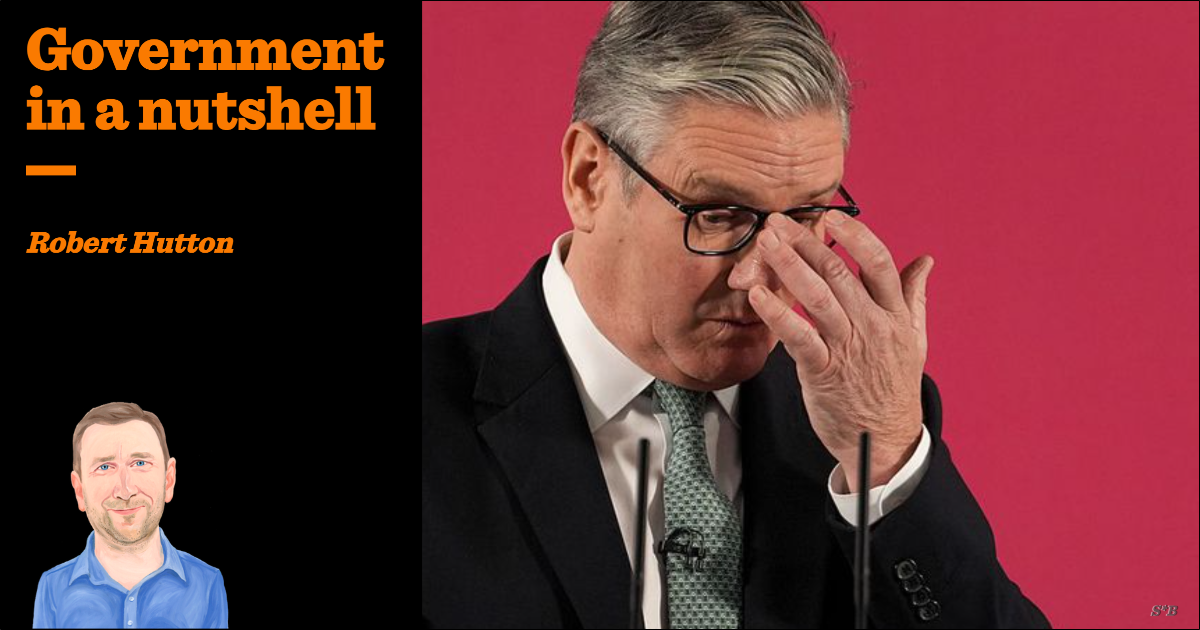

“That,” Keir Starmer said, “is the purpose of this government in a nutshell.” We looked around, anxiously. Had we missed it? He’d finally explained what he thinks he’s doing, and we hadn’t noticed. Hopefully someone was filming.
The prime minister was addressing us in a community centre in London on last week’s Budget. It was, taken in isolation, a decent speech: he was passionate about lifting children out of poverty and clear-eyed on the things holding back the economy, from over-regulation to Brexit. The moment the speech hit difficulty was when you remembered that the person making it had spent 18 months avoiding addressing these problems. It was like listening to a lecture on overpopulation from Boris Johnson.
“I am proud we scrapped the two-child limit,” Starmer said. “That is what a Labour government is for.” He sounded like he meant it. And yet last year he removed the whip from seven Labour MPs for voting to abolish the two-child limit.
He railed against “unnecessary red tape” and “well-intentioned but fundamentally misguided, environmental regulations” with all sincerity. But his government is currently introducing well-intentioned employment regulations. Presumably those feature only strictly necessary red tape.
And he complained that Brexit had “significantly hurt our economy”. It is certainly news that a British prime minister is finally able to say that a decade of making it harder to sell things abroad has not been the economic triumph that we were promised. But what is he proposing to do about it?
Fortunately for Starmer, the attendant reporters were much more interested in the weird inside-Westminster story of how the Budget was spun. This was, for reasons that probably make sense if you spend 18 hours a day on Twitter, the focus of the Conservative Party’s attack on Rachel Reeves over the weekend.
Kemi Badenoch had set out the case the previous day on the BBC. One of the Tory leader’s articles of faith is that she is the only person in her party who is capable of appearing on TV or speaking at the despatch box. This is made especially piquant by the actual quality of her performances.
“The chancellor called an emergency press conference telling everyone how terrible the state of the finances were,” Badenoch stormed to Laura Kuenssberg, “and now we have seen that the OBR had told her the complete opposite.” Is that bad? That sounds like it might be good?
Apparently not. “Because of that I believe she should resign.” The Tory leader has given three different reasons why Reeves should resign in the past month, and of all these, “actually, Britain’s economy is in better shape than the government says” is definitely the most surprising.
Starmer did, if anyone was listening, explain why the run-up to the Budget had seemed to be characterised by chaos and uncertainty about whether tax rates were going up: it is because that was what was happening inside government. He and Reeves really had been on the point of raising rates, before they’d decided not to. If you want to know how desperate things are for this government, they can’t even release marginally better-than-expected public finance figures without getting mauled in the press.
As for the Tories, in three years they’ve gone from “it’s completely fine for the prime minister to lie to Parliament about events he was photographed attending” to “ministers should have to resign if their aides whisper things to journalists that turn out not to be true”. Perhaps we should welcome this vast elevation of professional standards, but let’s see if the standard turns out to be enforced should they regain office.
We did get a resignation on Monday evening, but it was from the chairman of the Office for Budget Responsibility, Richard Hughes, over last week’s unfortunate leak. A report had revealed that at least one previous report had leaked the same way without anyone noticing. Apparently a poorly implemented website is to blame.
Hughes might have survived that, but ministers were clearly furious with him for his interventions over the Budget. Starmer that morning had complained about the OBR’s decision to conduct the review of productivity that led to the growth forecast downgrade that caused all the problems. “I’m not angry,” he said, sounding like a headmaster demanding to know why the sixth form had hoisted a pair of underpants up the school flagpole. “I’m bemused.”
If that hadn’t been enough of a signal, Chief Secretary to the Treasury James Murray had conspicuously failed to back Hughes when he addressed the Commons on Monday afternoon. Only when news of the resignation came through did he finally find some warmth. “May I offer from the despatch box our thanks for his dedication to public life,” Murray said. Now that really is government in a nutshell.