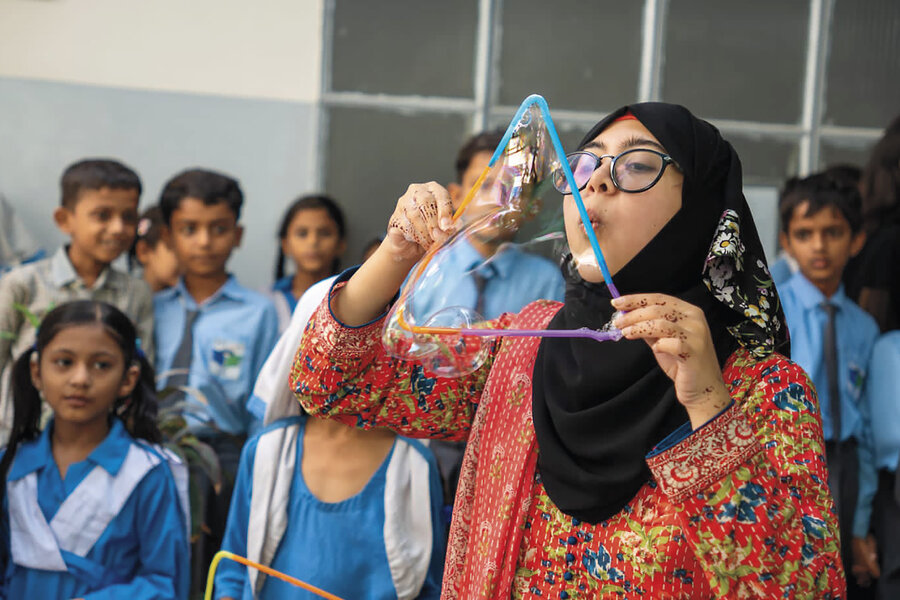
Twelve years ago, Lala Rukh led a science workshop for children in a slum area of Karachi, Pakistan’s most populous city. The kids had fun making slime, bubbles, and tiny explosions in water.
But, at the end, a child posed a question that broke Ms. Rukh’s heart. “They came up to me and said, ‘When will you come back?’” she recalls.
Ms. Rukh had not planned to come back.
Why We Wrote This
Lala Rukh believes science instruction is not only for the elite. By connecting science to kids’ daily lives through play-based activities and hands-on workshops, her social enterprise is getting marginalized children excited about learning.
At the time, she was based in Norway, working for a social enterprise that aims to stoke young people’s interest in science, technology, engineering, and math. But because Ms. Rukh’s parents are Pakistanis, and she had spent much of her childhood in Lahore and Karachi, she retained a deep connection to Pakistan.

The Karachi girl’s question moved Ms. Rukh. “That planted the seed in my heart that I should take this work to Pakistan,” she says.
In 2017, she founded Science Fuse, a social enterprise that primarily teaches children in impoverished areas, including Machar Colony in Karachi. The sprawling slum area is home to immigrant families such as ethnic Bengalis, most of whom are denied Pakistani citizenship. Now based in the United Kingdom, Ms. Rukh logs on to her computer most days at 4 a.m. to connect with team members in three Pakistani cities who conduct in-person science workshops for children and teachers. She also facilitates the work of freelance educators across Pakistan who lead in-person or remote sessions. To date, Science Fuse has taught tens of thousands of marginalized children.
Kanika Gupta, a Monitor contributor based in New Delhi, interviewed Ms. Rukh via video in September. This transcript has been condensed and edited for clarity.
Q: You have worked with the kids in Machar Colony, who are called Pakistan’s invisible children. What kinds of challenges do the children face?
Most of that community that is settled in Machar Colony, they are fishermen and they are fisherwomen. They catch the fishes and the shrimps, and they gut them. The children are mostly out of school, and they help and support their parents in catching the fish.

The settlement itself has very poor infrastructure, no drainage system. It’s the most vulnerable community in [Karachi]. There are some schools, but these schools are either government schools or very low-income private schools. The quality of education is never to a standard where these children can engage in activities or learning that is inspiring, that will give them the skills to lead a better life.
Q: Why do you think science education is important for this community?
Because every child, irrespective of where they come from, has an inherent curiosity. You can’t say that science is just made for people who have a lot of money or people who look a certain way or who come from a specific background. Everywhere, every child has the right to high-quality education that can allow them to fulfill their own potential. First, to build a life of dignity for themselves. And then, secondly, as a tool to solve the problems of their communities.
Science, it gives you the tools to imagine solutions. It gives you problem-solving skills. It gives you critical-thinking abilities. It gives you grit and resilience. And it gives you an understanding of how the world operates. For a community like this, science education can be very powerful.
We teach science through play-based activities. That is even more important for a child who hasn’t gone through mainstream school. If they’re out of school, you can’t really put them into a mainstream school and expect them to catch up like other children.
Q: Tell me about the first science workshop you did in Machar Colony. What did you teach?
We reached out to an organization, Imkaan. They have a space called Khel, which means “play” [in Urdu]. This is an informal learning center where children from Machar Colony who are out of school come, and they’re given different educational experiences. We said to Imkaan that “We work in STEM education, we make science playful. How about we introduce this to your teachers?”

These teachers, they come from the very same community. If you empower them, and if you teach them something, it’s going to stay with the community, and it will benefit many more children.
We selected four teachers. These four teachers, especially the female teachers, lacked a lot of confidence, and they were very shy. So, the first thing we did was that we went to Khel, we gathered the children around us, and we did something called a science show.
We literally take very low-cost materials – for example, eggs – and we put lots and lots of weight on the eggs. Then we ask the children, “Do you think the eggs are going to break?” And the eggs don’t break, actually, because they have that arch shape.
We tell them that the arch shape actually distributes or spreads out the force. You’re teaching them about structures, about weight, about forces. You also teach them about Newton’s third law. Concepts that in a physics classroom or in a physics textbook may sound very complicated suddenly become very playful. They become very interesting.
Because these experiments use materials that are low-cost and easily available, the children will continue them at home.
Q: What kind of participation did you see from the teachers and students?
The teachers were very intrigued, very interested, very engaged. That’s the whole idea – that we don’t make it sound alien. We connect it to their everyday life.
We’ll explain it in an easy way and then encourage them to use that same language when they’re speaking to the children. And not use that jargon-heavy textbook language.
“You don’t know anything, we know everything” – that’s not our attitude.
Pakistan’s teachers are the biggest workforce in the country. They’re under-resourced, they’re overworked. They don’t often get the right kind of salaries. So, we always create this atmosphere where we empathize with them. We tell them that, “OK, we are going to work with you, sit with you, and teach you all of the things that we know. And also learn from you.”