Immigrants in the United States face rising scrutiny as President Donald Trump vows to crack down on Afghan nationals and others seeking U.S. protection. The policy shift follows a pre-Thanksgiving attack in the nation’s capital that killed one National Guard member and left another critically wounded.
The suspect, an Afghan national, was lawfully let in by the government in 2021.
That year, the U.S. evacuated tens of thousands of Afghans after American troops withdrew from Afghanistan and the Taliban retook power. Many Afghans who served alongside U.S. troops sought protection, fearing persecution under the new regime. The speed and chaos of the exodus sparked security concerns, especially among Biden administration critics. When he returned to office, President Trump restricted pathways for Afghans to enter and remain in the U.S., and narrowed reunification options for family members still abroad.
Why We Wrote This
A Trump deportation campaign was already underway before Nov. 26. But the shooting of National Guard members has prompted stepped-up measures to limit entry and to scrutinize Afghan and other immigrants already in the U.S.
The Afghan community is bracing for a new round of crackdowns that could target other immigrant communities as well. Since the Nov. 26 attack, Trump administration officials announced a reexamination of all Afghans who entered during the Biden years, a pause on visas for Afghans, stricter vetting, and a freeze on asylum decisions for people of any nationality. The flurry of actions expands upon other administration decisions this year restricting Afghans and others already in the country legally – along with those trying to come.
Much about the shooting remains unknown, including motive. Mr. Trump says he doesn’t blame all Afghans but that “so many bad ones” came on planes four years ago. The government frames the shooting as a security failure of the Biden administration. Yet at this early stage, reports suggest that the suspect underwent multiple layers of vetting – potentially spanning both presidents – before shooting two service members near the White House.

Afghans and their advocates have condemned the attack and braced for backlash.
“Generalizing an isolated case of an individual and dehumanizing a community … can incite violence against the community,” says Mahdi Surosh, project manager at the Center for Victims of Torture’s Raahat Project, which offers mental-health services to Afghans in Minnesota. He says many have sought safety in the U.S. from violence at home not too different from that seen in the National Guard shooting.
Security concerns around Afghan evacuees
Several Republican-led states have sent National Guard members to Mr. Trump’s anti-crime campaign in the nation’s capital. The shooting killed Spc. Sarah Beckstrom and critically injured Staff Sgt. Andrew Wolfe, both of the West Virginia National Guard.
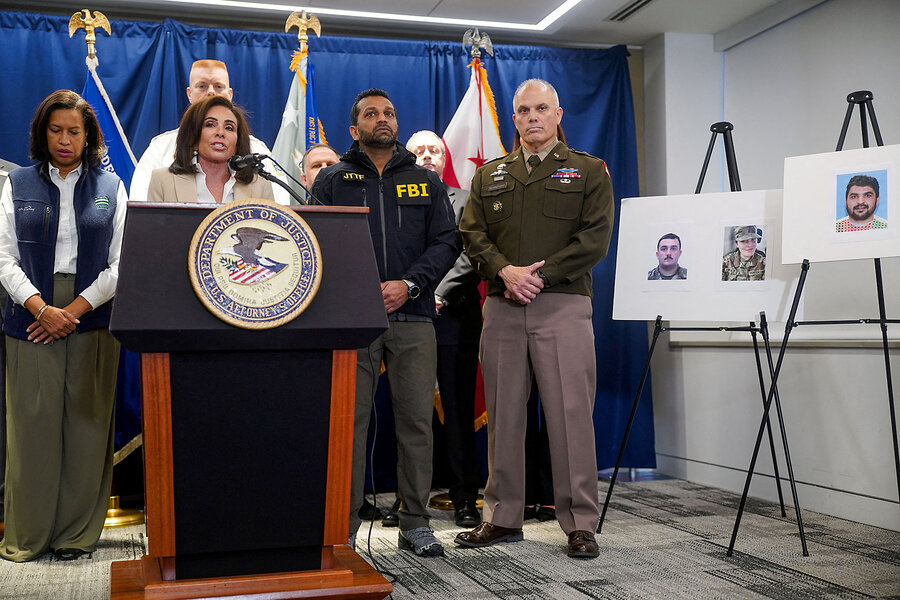
The suspect, Afghan national Rahmanullah Lakanwal, traveled from his home in Washington state to Washington, D.C., officials say. Multiple news reports suggest he had worked for a secretive CIA-aligned unit in Afghanistan. The violence he encountered disturbed him, a friend told The New York Times. The Biden administration lawfully paroled Mr. Lakanwal into the U.S. in September 2021 during the Operation Allies Welcome evacuation effort. The Trump administration reportedly granted him asylum this spring. U.S. Citizenship and Immigration Services has not responded to a Monitor request for confirmation. A first-degree murder charge is expected.
On the Sunday NBC News show “Meet the Press,” Homeland Security Secretary Kristi Noem said the suspect was “radicalized since he’s been here in this country.” She did not provide further details but confirmed investigations of Mr. Lakanwal’s acquaintances are ongoing.
The White House and Republican lawmakers have raised security concerns about Afghan arrivals under the former president’s watch. A federal inspector general under the Biden administration found concerns with the screening of evacuees, including incorrect or missing personal data. The Department of Homeland Security “may have admitted or paroled individuals into the United States who pose a risk to national security and the safety of local communities,” says the 2022 watchdog report. A report released this June by the Justice Department’s audit division defended the FBI’s screening of Afghan evacuees.

Other recent public-safety threats have pulled Afghans into the news. Two Afghan nationals this year pleaded guilty to involvement in a 2024 Election Day plot to receive firearms and ammunition to commit a terrorist attack, allegedly through links to the Islamic State. In April, an Afghan man in Virginia was declared dead after a shoot-out with police at a traffic stop. The man was captured on police body camera video saying he’d worked with “special forces” and should have joined the Taliban. The day before the National Guard shooting, another Afghan national who entered the U.S. during Operation Allies Welcome was arrested in Texas for threatening to bomb a Fort Worth building, according to Department of Homeland Security spokesperson Tricia McLaughlin.
Stepped-up restrictions following attack
Following last week’s attack in the nation’s capital, President Trump previewed a crackdown on immigrants in general and Afghans in particular.
“We must now reexamine every single alien who has entered our country from Afghanistan under Biden,” Mr. Trump said in a video message. “And we must take all necessary measures to ensure the removal of any alien, from any country, who does not belong here or add benefit to our country.” The government had already planned to review all refugee admissions under the prior administration, according to news reports on an internal memo.
An agency that oversees legal immigration, the U.S. Citizenship and Immigration Services, said Thursday that it would implement new vetting restrictions for nationals of 19 “high-risk” countries, including Afghanistan.
USCIS also announced that the agency had suspended all decisions on asylum. As of June, the latest data available, there were more than 1.5 million asylum applications pending with the agency.
The pause is enforced “until we can ensure that every alien is vetted and screened to the maximum degree possible,” said Director Joseph Edlow. The administration had previously curbed asylum-seeking at the border. The State Department on Friday also announced a pause on issuing visas for Afghan passport-holders.
An Afghan green-card holder in Boston, who asked not to have her name published due to security concerns, says she completed background checks, biometrics, and interviewing before arriving lawfully under the Biden administration. Her work with the U.S. government afforded her a Special Immigrant Visa.
“It’s so hard to go through everything again … just to prove that you are eligible,” she says. “It’s sort of retraumatizing people.”
Reexamining all Afghans who entered under the prior administration would also be a huge allocation of resources, says Shawn VanDiver, founder and president of #AfghanEvac, a nonprofit started during the U.S. withdrawal from Afghanistan to evacuate local allies. The White House instead should “spend their money, and their time, on the national security programs that President Trump shut down that probably could have detected” the shooter, he says. Earlier this year, for instance, the administration pulled funding from a national database tracking domestic terrorism, and sought to withhold other Homeland Security money from Democrat-led states.

Supporters of the White House embrace the policy-change announcements.
“The president’s first obligation is to protect national security,” including through a strong vetting system, says Ira Mehlman, media director at the Federation for American Immigration Reform, a Washington-based group advocating lower immigration levels. He adds that the president has wide latitude to exclude immigrants, endorsed by the Supreme Court.
Moreover, the administration’s restrictions on lawful pathways underscore how demand to immigrate here outstrips the country’s will to accommodate, says Simon Hankinson, senior research fellow at the Heritage Foundation’s Border Security and Immigration Center. “It isn’t possible for everybody who wants to come to America, or any other developed country, to do so,” even legally, he says.
An expansion of existing Trump policies
The immigration restrictions announced since Nov. 26 ratchet up the Trump administration’s previous limitations.
The White House in June announced an entry ban on nationals from Afghanistan and 11 other countries, citing “foreign policy, national security, and counterterrorism objectives.” The administration also ended Temporary Protected Status for Afghanistan in July, which allowed thousands of Afghans to temporarily live and work in the U.S.
More broadly, the president has moved to end that temporary legal status for people from multiple other countries this year, including Haiti, Venezuela, South Sudan, and Myanmar. He capped all refugee admissions – a heavily vetted legal path – at a record-low 7,500 this fiscal year and is prioritizing white South Africans for those spots.
Meanwhile, many Afghans who assisted the U.S. are stuck in countries like Pakistan, where they face deportation back to Afghanistan. And Afghan allies who settled in the U.S. yearn to bring family members still abroad to join them.
In a Thanksgiving social media post, President Trump said he would “permanently pause migration from all Third World Countries.” He singled out Somalis in Minnesota – where some of the immigrant community members are under investigation for fraud – and claimed refugees are “taking over” the state.
Specifics about implementing the Truth Social post are unclear, along with Mr. Trump’s pledge to “remove anyone who is not a net asset to the United States, or is incapable of loving our Country.”
The Afghan woman in Boston says the U.S. gave her a haven and hope. Now, she says she’s “lost and in fear.”