This article is taken from the December-January 2026 issue of The Critic. To get the full magazine why not subscribe? Get five issues for just £25.
The Conservative Party is teetering on the brink. After its worst ever general election result last year, its support has — remarkably — plummeted still further. Whether the most successful political party in democratic history can survive in any meaningful form is now deeply questionable.
Our electoral system means that UK-wide parties which drop much below 30 per cent of the vote tend to be brutally punished in terms of their representation in the Commons. This would be especially true of the Tories whose base of support is relatively evenly spread across much of Britain. If an election were held today, with the party consistently in the sub 20 per cent zone, the Conservatives would be eviscerated.
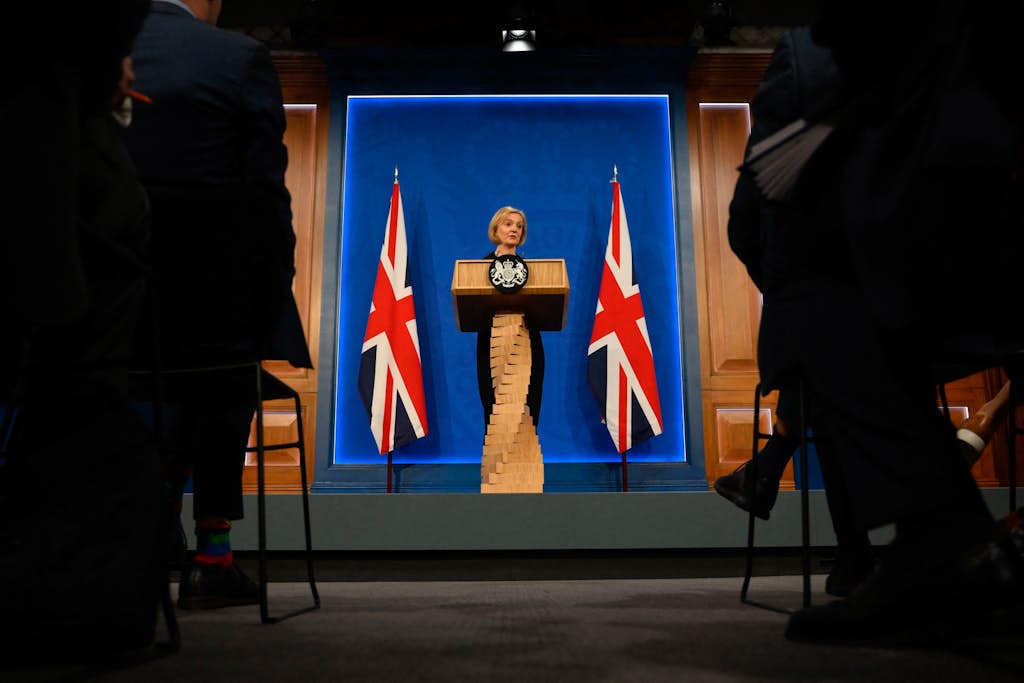
To understand if there might be a way back for the Conservatives, one needs a theory of how they came to be in such a parlous state. In these pages last month, Paul Goodman suggested the principal reason was losing a reputation for competence. Liz Truss and her Chancellor’s ill-fated mini-budget are, for Paul, the defining moment at which the public’s faith in Toryism evaporated.
I don’t buy into this analysis. I think something much deeper is happening and that the ramifications for the Conservative Party — and British conservatism more generally — are enormously more profound.
It is worth revisiting the facts around the 2022 mini-budget, even if in electoral terms impressions tend to count more than stone cold economic truths. Liz Truss was unfortunate that on her short watch, the music stopped and the bomb exploded.
In the autumn of 2022, the era of ludicrously low interest rates was, at last, coming to an end. The Bank of England failed to follow the Fed in raising interest rates and had been asleep — or even blind drunk — at the wheel when it came to the risk posed by liability-driven investments. In its own internal review of the market turmoil at that time, the Bank concluded that two thirds of it was down to their own behaviour.
In my experience, if someone accepts two thirds of the blame for something, it is likely that they are responsible for more than 90 per cent of it. Nevertheless, Truss was prime minister. The political buck stopped with her, and she fell on her sword after just seven weeks.
An oft-repeated explanation for the failure of the Truss approach was that she was spending like topsy whilst simultaneously seeking to cut taxes. If so, this would be the exact opposite of fiscal conservatism and — for some — this is the reason her economic policy lacked credibility.
It is true that there was a massive £150 billion-plus energy bailout package, but this had been in place for some time before the market turmoil hit. Also, her tax reductions around national insurance and corporation tax were trailed weeks in advance (months even, given that she had made this a centrepiece of her leadership bid).
The attempt to reduce the top rate of income tax from 45p to 40p may have been politically controversial, but it was a rounding error in fiscal terms (indeed, it may even have led to more revenue for the Treasury owing to the Laffer curve effect).
Liz Truss also wanted to take a hawkish approach to welfare payments by allowing them to rise only in line with wage growth rather than by the rate of inflation, which was enormously higher at the time. Big savings would have been made, but this proved unpalatable to many of her colleagues.
What Truss discovered was that a large number of her Tory parliamentary colleagues simply did not have an appetite for cutting tax or reducing spending. She may stand fairly accused of overestimating the support that Conservative MPs would display towards the policy agenda of an incoming prime minister, but that is a criticism of tactical party management not of the content of economic policy.
The truth is that Liz Truss failed — at speed — in piloting through a platform because the Tory party was hopelessly divided. Incredibly, of the five consecutive prime ministers from 2010 to 2024, she was the only one actually to reduce the overall tax burden, albeit only by a smidgen.
Her successor, Rishi Sunak, avoided exposing the deep divisions in the parliamentary Tory party through the imaginative strategy of doing nothing. In his last conference speech as prime minister, he promised to abandon a tranche of the HS2 rail line, phase out cigarettes one year at a time and encourage more young people to study maths. There was no grander vision than this that the Conservatives were capable of uniting around.
If the Truss-Kwarteng mini-budget really was the key reason for the Conservatives’ dramatic electoral decline, proponents of this theory need an explanation as to why the party’s polling position has worsened still further since last year’s general election. Somewhere around a third of those who supported the Tories in 2024 no longer do so today. Who are these 2.2 million people for whom the failures of the Truss administration were no barrier to voting Conservative last July, but have apparently become an enormous impediment to doing so since then?
Have these two million people spent the last 16 months reading economic textbooks and now concluded that a top marginal tax rate of 45p, rather than 40p, is at the appropriate point on the Laffer curve after all? It sounds most unlikely.
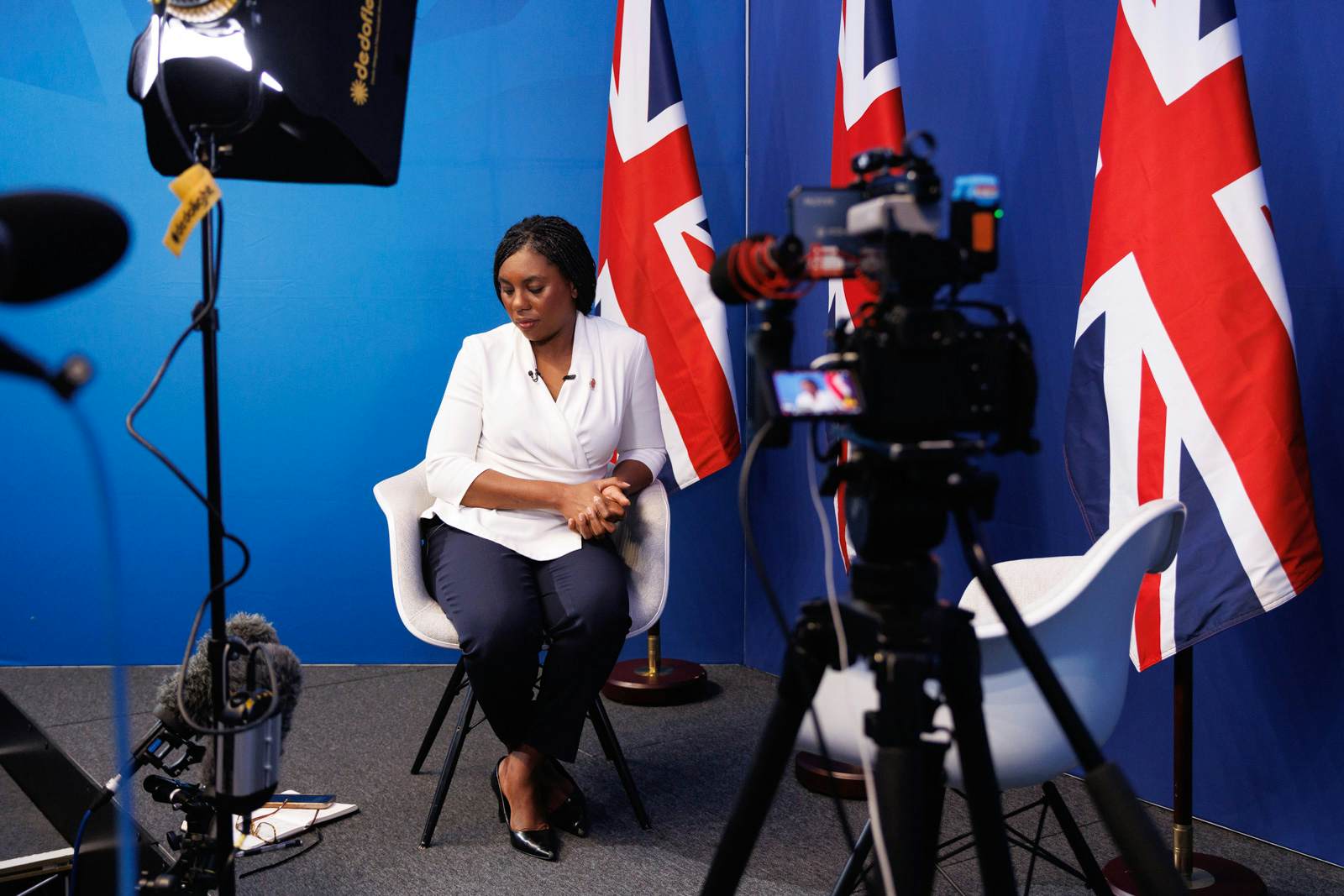
For those who buy into the “chaos and incompetence” theory of Tory decline, there is a further mystery. For all of the criticism of Kemi Badenoch for not cutting through sufficiently in the media narrative or failing to score enough points at PMQs, she has undoubtedly overseen a year of (almost unprecedented) Conservative calmness and unity. This is a rather noteworthy achievement, and one that has gone largely unremarked upon because it involves something you don’t see rather than something you do.
Badenoch has managed, admittedly at a slow pace, to shift the Tories away from the ludicrous 2050 carbon net zero commitment and towards a pledge to leave the European Court of Human Rights. She has achieved these policy pivots with barely a murmur of resistance or discontent from any of her parliamentary colleagues or from any faction within the party.
If the underlying problem for the Tories was that they were unleadable, divided and prone to backbiting, a year of tranquillity under Kemi surely should have gone some way towards lancing that boil. Why, then, have poll ratings not improved?
Even more bewildering is that, despite their lowly standing, the Conservatives remain the most trusted of any of the political parties in terms of running the economy. This, surely, is as good a metric as anyone could find for “competence”, yet it has not translated into any uplift in support, quite the opposite.
Competence, trust, unity and discipline all matter in politics. As do charisma, clarity of message and media impact. But these are not the driving factors that determine which political tribe people feel they belong to.
Paul Goodman argues that the public tend to choose “the least incompetent option”. That might be true of who we bank with, or where we shop. But our political loyalties are more visceral. There may be a measurable advantage in a political party proving to the electorate that they can adequately manage a spreadsheet — but it is not the core, brand proposition.
Beyond regaining a reputation for competence, the party faces a much more metaphysical question. As the historian and academic Steve Davies has argued, we are going through — and approaching the end of — an enormous realignment in our politics. Not just in the UK, but across the Western world. These realignments happen infrequently, perhaps once every 50 to 100 years.
The key feature of a political realignment is not that new parties emerge and older parties die (though this may be a feature); it is that the very construction of political tribes changes fundamentally. The theory assumes that people assemble into their tribes based on one principal and one secondary aligning factor.
From the end of the Second World War until recently, the principal aligning factor had been where you stood on economics. If you tended to support free markets, low taxes, fiscal discipline, capitalism and a small rather than extensive state, you’d very likely have found yourself in the centre-right tribe: in Britain, a Tory; in the US, a Republican; in France, a Gaullist; in Germany, a Christian Democrat. Likewise, believers in the state having a large role to play in providing welfare, running a wide range of industries and correcting apparent market failure, tended to align with voting Labour, Democrat, French Socialist or German SPD.
The secondary aligning factor was where you stood on “social freedoms” — civil liberties, gay rights, lifestyle choices and the like. The big two tribes across most Western countries were a broadly social conservative, pro-capitalist tribe on the centre-right and a liberal-leaning, social democratic tribe on the centre-left.
This has now changed. Over the last decade, the key aligning force that determines your political tribe has shifted from the “economy” to “identity”. Basically, how do you approach nationhood, culture and history?
If you are unambiguously proud of your nation’s history, concerned that immigration levels are too high, and sceptical about international institutions such as the EU, the ECHR and the World Health Organisation and global efforts to tackle climate change, you now find yourself in the new tribe of the right. If you think your country needs to apologise for past misdeeds, that we should welcome large numbers of people from other cultures and be an enthusiastic member of a raft of global institutions to tackle environmental and economic problems, you find yourself in the new tribe of the left.
Economics still matters in this new alignment, but it is only the secondary aligning factor. Whether you are a state interventionist or a free marketeer is not the key thing that defines which tribe you now find yourself in.
If the main parties of the old alignment wish to flourish under the new alignment, they will need to adapt and change almost beyond recognition. They must choose which tribe they wish to represent. If they fail to do so, they will wither and perhaps even die altogether.
Donald Trump may be a Republican president — but today’s GOP under the new alignment bears almost no resemblance to the party of Eisenhower, Ford or even Reagan. It has reinvented itself as a new tribe reflecting the new alignment. Similarly, the Democrats may still technically be a continuation of the party of JFK and Bill Clinton but, increasingly, in name only.
Elsewhere, the French Socialists and French Gaullists — the two powerhouses of the old alignment — still technically exist, but barely. The new battle is between Emmanuel Macron’s liberal globalists and Marine Le Pen’s nationalists. In Germany, the Christian Democrats and Social Democrats are both struggling to hold on to support in the face of the growing popularity of the right-wing AfD and of the radical left.
Britain is, later than most other Western countries, now going through the final stages of its own realignment. We can’t yet be sure of the party labels the two big tribes will wear, but Reform is currently making a strong case to be one of them.
The problem for the Conservatives is that they have not yet understood that this major realignment is reaching its last stages, and they have therefore failed to decisively pick a side in this new era of politics.
Economic competence won’t be enough to make you one of the two big tribes
In too many areas, the Conservatives are ambiguous when it comes to the major issues which split us into our new political tribes. They channel a certain degree of patriotism and national pride but mix this in with several dashes of globalism.
They apparently think that climate change is a major problem but believe we can buy more time to deal with it. They remain unclear on the extent to which they wish to unravel the post-Blairite consensus but think it a jolly good idea to trim back the civil service — but only to its 2016 levels. On the big, binary questions of the day, the Conservative answer often seems to be 0.5.
The Tories’ principal strategy simply seems to be to try and score highly on economic competence. There’s nothing dishonourable in that — indeed it was the route to electoral victory over many past decades. But it won’t be nearly enough, in the new alignment, to make you one of the two big tribes.
The plight of the Conservative Party is not due to the Truss mini-budget, nor to Kemi Badenoch not being on television enough. It is not even because the electorate think the Tories are incompetent or untrustworthy. All of these things may have had some sort of electoral impact but none of them are key.
The central issue is that the political terrain has shifted, and the Conservatives have refused to shift with it. This leaves them stranded in no-man’s land. You might not be entirely clear about Nigel Farage’s and Reform’s precise policies in every area, but you know exactly which battlefield he and his troops are standing in.
Until the Conservatives grasp that politics has fundamentally realigned and clearly decide which lane to pick within the new system, the party’s electoral decline will continue — and probably at pace.