BBC chairman Samir Shah today told MPs the corporation is too slow to admit errors and should have responded quicker to a controversial edit of Donald Trump.
In an appearance before the House of Commons’ Culture, Media and Sport committee, Mr Shah was grilled about a damning leaked impartiality memo.
The document raised concerns that a Panorama episode included selective editing of a speech made by Mr Trump before disorder at the US Capitol in 2021.
The US President has since threatened to sue the BBC for up to $5billion, while two senior BBC bosses – director general Tim Davie and news chief Deborah Turness – have quit the corporation amid a furious row.
The documentary was broadcast a week before the US election, with clips of the speech spliced together so it appeared he had told supporters he was going to walk to the US Capitol with them to ‘fight like hell’.
When asked on Monday why the BBC board did not apologise for the edit when it was first flagged, Mr Shah told the committee: ‘Looking back, I think we should have made the decision earlier. I think in May, as it happens.
‘I think there is an issue about how quickly we respond, the speed of our response. Why do we not do it quickly enough? Why do we take so much time? And this was another illustration of that.
‘We should have, the collective, we should have pursued it to the end and got to the bottom of it and not wait, as we did, until it became public discourse.’
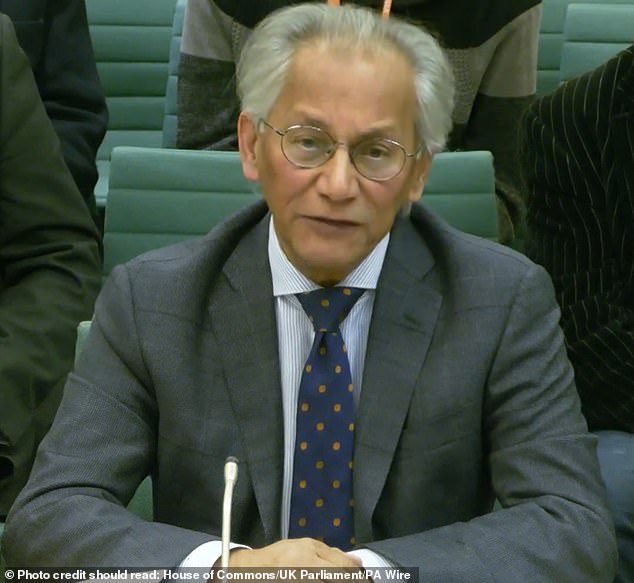
BBC chairman Samir Shah today told MPs the corporation is too slow to admit errors and should have responded quicker to a controversial edit of Donald Trump
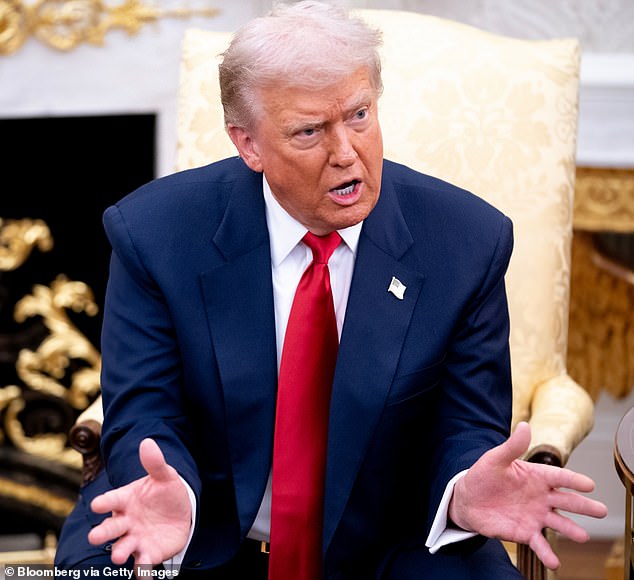
The damning memo raised concerns that a Panorama episode included selective editing of a speech made by Mr Trump before disorder at the US Capitol in 2021.
The US President has since threatened to sue the BBC for up to $5billion, while two senior BBC bosses have quit the corporation
Following reports of the leaked memo, it took nearly a week for the BBC to issue an apology.
When asked about the delay, Mr Shah said: ‘I needed to understand what went wrong and to get the right answer. Getting the right answer is really important.
‘It took time to get it right. We knew what the actual apology was for. I said it wasn’t just about splicing, the editing. It was about the impression and that had to be done properly and investigated thoroughly.
‘I needed to be sure and I was right about what I was saying. This is a very, very important error, and I needed to make sure that what I was apologising for was fully sourced and fully right. It needed to be right, and it took its time.’
Mr Shah also told the Committee he ‘spent a great deal of time’ trying to stop Mr Davie from resigning.
‘I do not think the director-general should have resigned,’ he said.
‘I think that the act by the director of news was an honourable and proper act. I think she (Turness) took responsibility for which I will again say I applaud her for doing so.
‘I do not think that that meant that the director-general at all had to resign. However, when you read the director-general’s reason for resigning, certainly this was one factor, but he also says there were many other factors that led to that.
‘Can I say the board wishes that the director-general had not resigned. He had our full confidence throughout.’
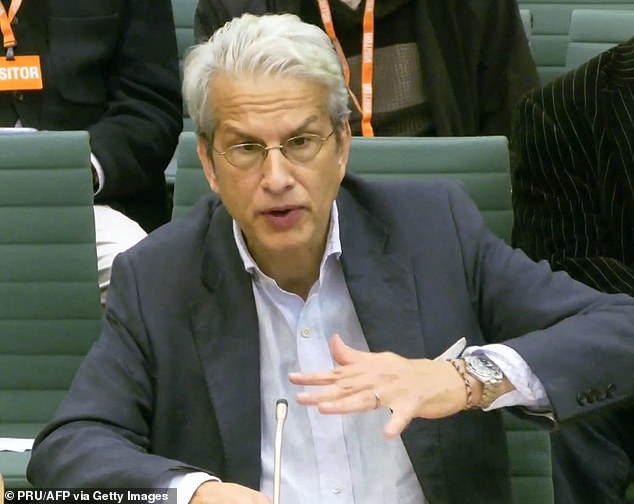
Michael Prescott, a former external adviser to the BBC’s editorial standards committee, authored the dossier that raised claims of bias
Earlier, the former adviser to the BBC who penned the damning memo on impartiality told the committee he did so because he saw ‘incipient problems’ that were ‘getting worse’.
Michael Prescott, a former external adviser to the BBC’s editorial standards committee, told MPs he did not know how his memo – which he shared with the Department of Culture, Media and Sport and regulator Ofcom – had been leaked to a newspaper.
‘At the most fundamental level I wrote that memo, let me be clear, because I am a strong supporter of the BBC,’ he told the committee.
‘The BBC employs talented professionals across all of its factual and non-factual programmes, and most people in this country, certainly myself included, might go as far as to say that they love the BBC.’
But Mr Prescott added: ‘What troubled me was that during my three years on the BBC standards committee, we kept seeing incipient problems which I thought were not being tackled properly, and indeed I thought the problems were getting worse.’
Mr Trump threatened the BBC with a billion-dollar litigation after the report was made public while US regulator the Federal Communications Commission (FCC) launched an investigation.
Mr Prescott added: ‘There was no ideology at play, no party politics.
‘If you take the example of the US elections report that came before the committee, if it had found that had been Kamala Harris misrepresented, not Donald Trump, I would have acted in exactly the same way.’
He added: ‘I never envisaged events playing out in the way they did, I was hoping the concerns I had could and would be addressed privately in the first instance.’
Asked if he thinks the BBC is institutionally biased, he said: ‘No I don’t… I do not think it’s institutionally biased.
‘Let’s be very clear. Tons of stuff that that the BBC does is world class, both factual programming and non factual programming.’
Asked if he is biased, Mr Prescott told MPs: ‘It’s always a tough job, isn’t it? Spotting your own biases.
‘I mean, you know, when you read about these centrist dads, I think I’m a centrist dad. That would probably cover it.’
The former journalist spoke of ‘incipient problems’ in the BBC and added: ‘We were finding the odd problem here, the odd problem there.
‘And the crucial thing was, when I say odd problem here and there, every single thing we spotted, as per my memo, seemed to me to have systemic causes.
‘And the root of my disagreement and slight concern even today is that the BBC was not, and I hope they will change, treating these as having systemic causes.
‘There’s real work that needs to be done at the BBC.’
Mr Shah has previously apologised on behalf of the BBC over an ‘error of judgment’ and accepted the editing of the 2024 Panorama documentary gave ‘the impression of a direct call for violent action’.
Despite the apology, Mr Trump said he would proceed with legal action for ‘anywhere between one billion dollars (£759.8 million) and five billion dollars (£3.79 billion)’.
BBC News reported that the broadcaster had set out five main arguments in a letter to Mr Trump’s legal team as to why it did not believe there was a basis for a defamation claim.
Mr Prescott told MPs on Monday that Mr Davie did a ‘first-rate job’ as director-general but said he had a ‘blind spot’ toward editorial failings.
Asked if the Panorama episode, Trump: A Second Chance?, had tarnished Mr Trump’s reputation, Mr Prescott added: ‘Probably not’.
‘I can’t think of anything I agree with Donald Trump on,’ he told the committee.