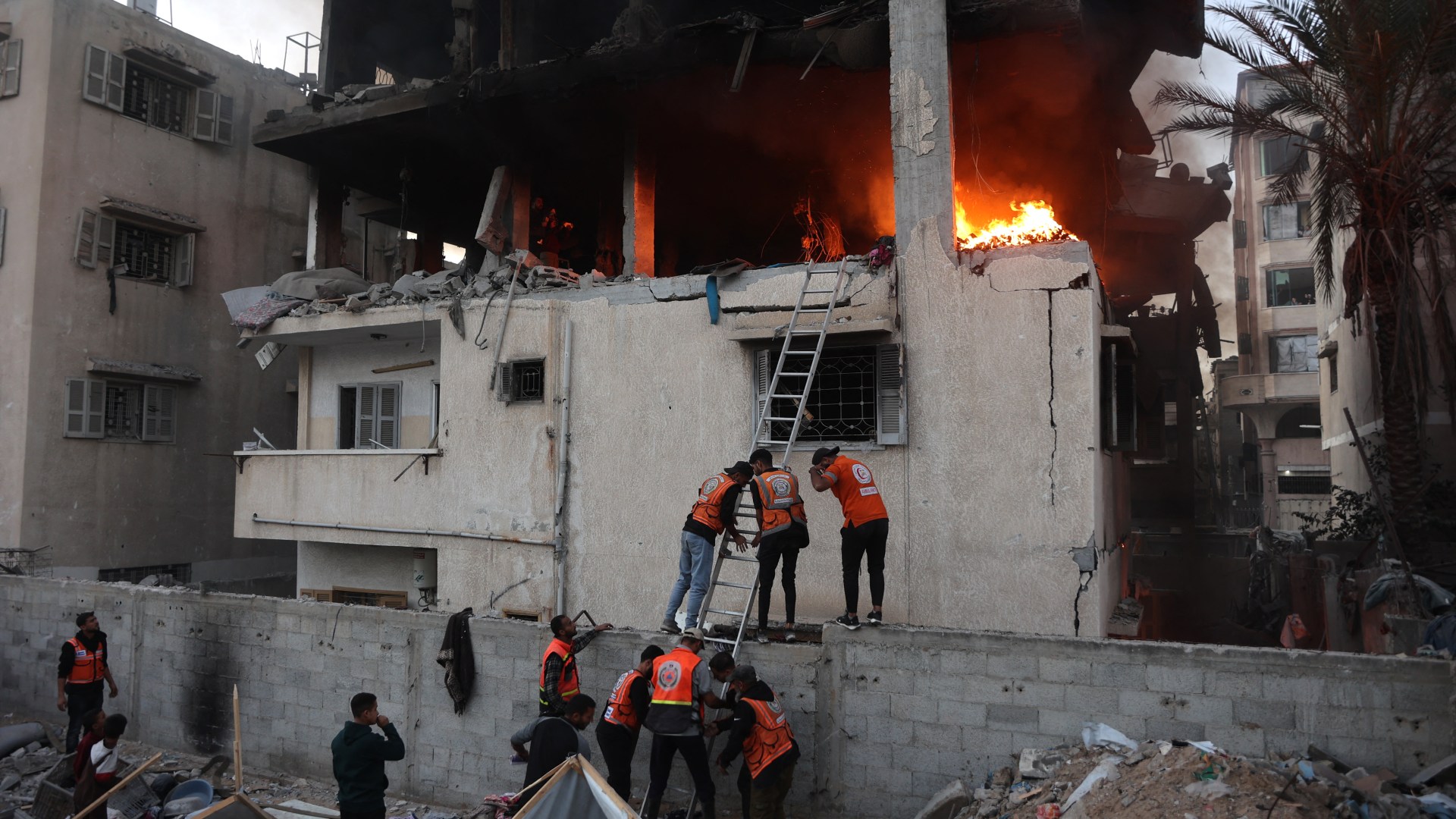
ISRAEL have launched a fresh wave of airstrikes on Gaza, killing at least 24 people in the latest test of the fragile ceasefire.
Benjamin Netanyahu said the blitz killed five senior Hamas members after a “blatant violation of the ceasefire agreements” by the terror group.
Gaza health officials said 24 people died in four rounds of strikes, which also injured 54, including children.
The assault came after Tel Aviv claimed an “armed terrorist” crossed into Israeli-held territory before shooting at troops in southern Gaza.
Israel said the gunman exploited “the humanitarian road in the area through which humanitarian aid enters southern Gaza”.
Luckily, no soldiers were injured in the shooting, the Israel Defense Forces (IDF) added.
Hamas called the IDF’s allegations baseless and said it was committed to the ceasefire which was enforced on October 10.
Since the peace deal, the IDF says three of its soldiers have been killed, while Gaza say 316 people have died in Israeli airstrikes.
The deadly assault comes as international efforts to rebuild Gaza start to gain momentum.
On Monday, Donald Trump’s blueprint for peace was greenlit by the UN Security Council.
The deal will see what has been dubbed an International Stabilisation Force deployed in the war-torn strip.
It will also allow Trump’s transitional government to be implemented – and provides a possible future path to a Palestinian state.
The Don’s 20-point plan – which could include Sir Tony Blair – means Gaza will become a terror-free zone that does not pose a threat to its neighbours.
It will be redeveloped for the benefit of the people of Gaza, “who have suffered more than enough”.
Trump’s draft resolution is backed by 13 countries including the UK, France and Somalia.
One of the most crucial parts of the plan is the “Board of Peace” – a transitional governing body Trump is set to chair until the end of 2027.
The US president said he intends to bring in “powerful world leaders”, with Sir Tony Blair the first name floated so far.
Blair reportedly “gets on well” with Benjamin Netanyahu, and boasts nearly 30 years of experience in the Middle East.
The resolution lays the groundwork for an international force to work alongside Israel, Egypt and a newly trained Palestinian police force to secure border areas and begin the demilitarisation of Gaza.
Hamas members who “commit to peaceful coexistence and to decommission their weapons will be given amnesty”, and that those wishing to leave will be granted safe passage to third countries.
However, while Hamas is excluded from any role in governance, there is no clause explicitly demanding the militant group disbands entirely or leaves Gaza.
The resolution also calls for the resumption of humanitarian aid deliveries at scale through the UN, the Red Cross and the Red Crescent.
In Jerusalem, Israeli President Isaac Herzog called the Security Council’s decision a “historic diplomatic achievement… that can and must lead us to the ‘day after’ in Gaza and throughout the region”.


A ceasefire between Israel and Hamas came into effect on October 10 as part of the plan’s first phase.
Israel has partially withdrawn forces but still controls around 53 per cent of Gaza, and both sides have accused each other of violations.