On the first Tuesday in January, a plot of land next to the village of Kidlington in Oxfordshire was listed for sale by one of London’s best-known online auction houses.
Bidding for the site, a dogleg-shaped field of roughly four acres, started off at around the £100,000 mark. By the time the virtual gavel fell, it had reached £150,000. The buyer was a 38-year-old gentleman named Daniel James Winstone. He hailed from Littlehampton in Sussex, according to a raft of ID documents submitted to the auctioneer, and boasted blond hair, a flat nose and various tattoos on his neck.
So began a remarkable series of events that this week placed Mr Winstone unwittingly at the heart of both a perplexing criminal investigation and a major political scandal. At its centre is that four-acre field. It sits on greenbelt land adjacent to both the A34 dual carriageway and the River Cherwell, which joins the Thames amid the dreaming spires of nearby Oxford.
Previously grazed by sheep, and surrounded by trees, half of the site is now covered by an enormous mound of festering rubbish, measuring roughly 10 metres high, six metres wide and more than 100 metres long. A second 100 metre-long pile of trash, stretching to a gateway at the northern end of the field, has meanwhile been buried beneath a thin layer of topsoil.
This mountain of stinking, toxic waste is quite the eyesore: it measures roughly 12,000 square metres (equivalent to a dozen Olympic-sized swimming pools) and has been illegally fly-tipped over a period six months, in one of the worst environmental crimes in British history.
To the dismay of locals, who spent the summer desperately trying (and failing) to stop the desecration, this act of ecological vandalism was carried out under the nose of the authorities. Cherwell District Council, which requires taxpayers in Kidlington to sort household waste into four bins, was told about it in June.
Along with Oxfordshire County Council, which handles planning enforcement, and the Environment Agency (EA), which is allegedly responsible for preventing such crimes, they then visited the field in early July. As I shall explain, their so-called ‘enforcement’ was woeful.
As for Thames Valley Police, whose HQ is less than three miles away, they didn’t even try to arrest the perpetrators of the appalling crime.
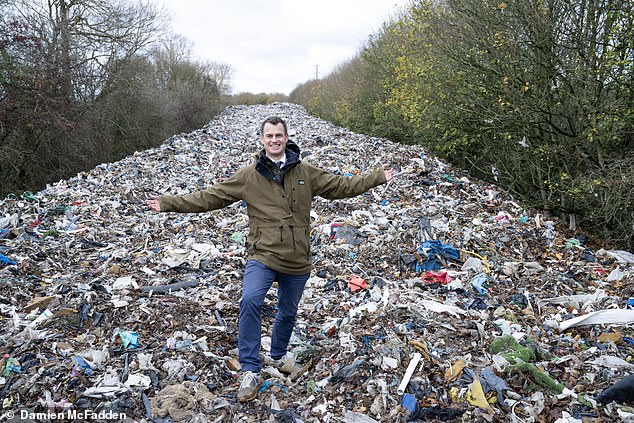
Guy Adams visits an area near Kidlington, Oxfordshire, where there sits an enormous mound of festering rubbish, measuring roughly 10 metres high, six metres wide and more than 100 metres long
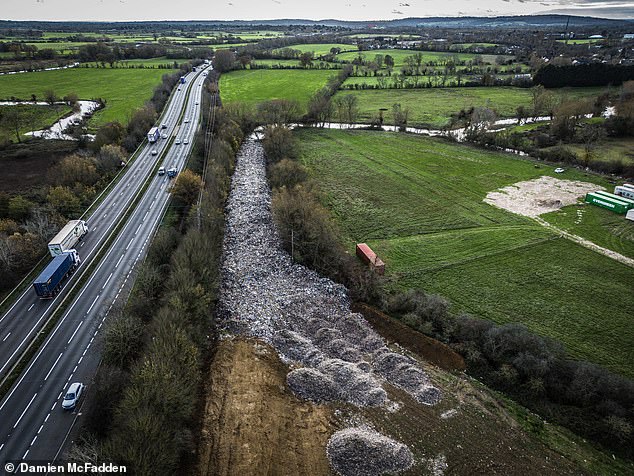
This mountain of stinking, toxic waste sits on greenbelt land adjacent to both the A34 dual carriageway and the River Cherwell, which later joins the Thames
So fresh lorryloads of shredded refuse continued to be dumped in this previously green and pleasant corner of the Cotswolds on a nightly basis, as summer turned to autumn.
It wasn’t until late last month that the site was belatedly closed down. By then, of course, it was too late. For as we enter winter, every fresh rainstorm will leach toxic chemicals into the soil and towards the Cherwell.
When I visited this week, nearby drainage ditches were already filling up with polystyrene and bits of plastic. Steam rose from several parts of the stinking trash mountain, stoking fears that it could end up combusting, pumping poisonous gases into the air and generating yet more hazardous waste. Environmentalists, meanwhile, reckon cleaning the whole thing up will cost an astonishing £25million.
Anger over this abject failure of officialdom extends to the very highest echelons of Government: Sir Keir Starmer this week declared those responsible for the ‘disgusting’ mountain of waste ‘need to be put before a court’.
All of which brings us back to Daniel James Winstone, the man who bought the field.
He no longer lives in Littlehampton, which turns out to be the former address of his late mother, Pam, and step-father Philip, but is instead registered to a council flat in south London, some 60 miles from Kidlington. Meanwhile his £150,000 property investment has backfired, spectacularly: as owner of the site, the law in theory makes him responsible for putting it right.
This is, of course, terribly unfair. For it should be stressed that there is no evidence Mr Winstone had anything whatsoever to do with the unlawful dumping of landfill waste on his land.
If anything, he is as much of a victim of this heinous crime as anyone else. After all, a court order prevents anyone – even him! – from accessing the four-acre field, rendering the property he purchased ten months ago more or less useless. Meanwhile the Environment Agency and Oxfordshire County Council have for months been bombarding him with letters about the crisis.
To fully understand how and why this scam was executed, we must wind the clock back some 30 years, to the dying years of John Major’s government. In 1996, the Chancellor Kenneth Clarke introduced a ‘landfill tax’ designed to encourage Britons to recycle more. It meant that councils, companies and individuals disposing of waste classed as ‘active’ – in other words, biodegradable – would be liable to hand over cash to the Government.
Initially, the tax was fixed at a modest £7 per tonne. But like so many stealth taxes, it crept up.
During Tony Blair’s first year in Downing Street, the rate was increased to £10, and by the time New Labour had left office in 2010, it was £40. Under David Cameron, it had by 2015 reached £82.60, and in Jeremy Hunt’s last budget before the 2024 election, the rate was whacked up from £103 to £126 per tonne. Rachel Reeves is reportedly now mulling a plan to tax waste disposal even more. Therein lies a problem. For landfill taxes have now become so large that criminal gangs can make serious amounts of money via illegal fly-tipping.
Specifically, the going rate for disposing of a lorry full of waste is north of £2,500. If you take it to a licensed site where one must pay tax at £126 a tonne, that leaves only a small amount of room for profit. If you can unlawfully dump it in a field or woodland, the whole amount goes in your back pocket. A House of Lords inquiry in October concluded that, thanks to this phenomenon, 38 million tonnes of waste are being illegally dumped in the UK each year. That’s enough to fill Wembley Stadium 35 times. In remarks that seem eerily prescient, its author Baroness Sheehan said that although the public routinely report such crimes, little is done to prevent them. ‘It is difficult to conclude that incompetence at the Environment Agency has not been a factor,’ she observed.
All of which brings us to the field near Kidlington, which forms part of a 16-acre plot. It had for several decades been owned as an investment by a former diplomat, who had retired to Oxford after serving as Britain’s consul in Tenerife. But last summer, the man, who was by then in his late 80s and in poor health, decided to place the site on the market. In 2024, a property investment company from West London struck a deal to buy it, paying £175,000, or roughly £10,500 per acre. The firm then divided it into eight plots of varying sizes and began selling them at auction. The first went on sale on January 7.

Billy Burnell, a local angler, walked along the Cherwell in September and realised to his shock that a fresh load of rubbish had been dumped nearby
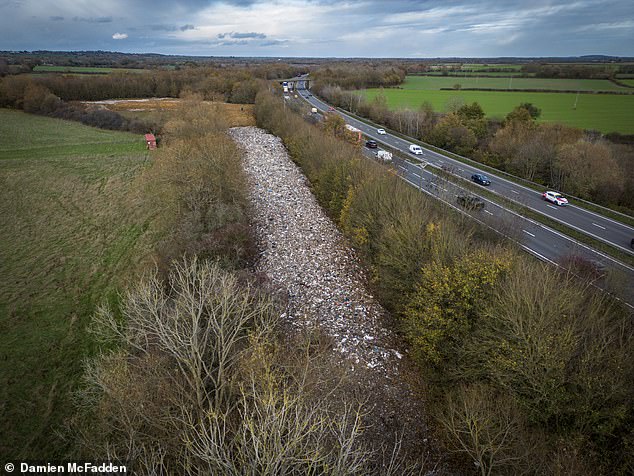
As we enter winter, every fresh rainstorm will leach toxic chemicals into the soil and towards the Cherwell
Like all bidders, Daniel James Winstone was required to undergo anti-money laundering checks, before being allowed to take part. After he’d successfully bid £150,000 for the field, Land Registry records show that an Uxbridge law firm, EDC Lord, was hired to handle the remainder of the purchase. The fee was paid in cash.
So far, so normal. Yet it didn’t take long for a criminal gang to spot an opportunity. In a cunning move, they didn’t start illegally fly-tipping on the site until late spring, when trees surrounding the field were covered in leaves, making the field almost entirely invisible from the A34.
Someone then built a 10ft-high metal barrier at the entrance gates, filling gaps in the hinges with rubber. This meant that the site was also invisible from the other nearby highway, the Bicester Road. In other words, they could operate in virtual secrecy.
No one knows exactly when illegal fly-tipping then started. But by June it was going on in earnest. As many as four lorries were arriving daily, suggesting the gang was making up to £70,000 per week.
We must assume that, home in south London, two hours drive away, poor Mr Winstone had no idea what was unfolding.
The criminals didn’t entirely escape scrutiny, however. A 22-year-old local named Joshua Eastwood, who had purchased a nearby plot at a different online auction, began to notice lorries arriving in suspicious circumstances. A peek through the trees revealed huge mounds of waste.
Eastwood reported the whole thing to Cherwell District Council in June. Other locals, who used a footpath adjacent to Eastwood’s land, also appear to have raised the alarm around this time.
The council won’t say exactly when it received the first report of illegal waste-tipping. But it didn’t exactly swing in to action overnight. Instead, the authorities waited until Wednesday, July 2, to show up at the scene. On that date, officials from the EA and District Council, along with a representative of Oxfordshire County Council visited the field.
At this stage, you might expect the eco crime to have been instantly stopped, while a proper law enforcement operation swung into action. But you’d be wrong.
For rather than immediately blocking the entrance gate, impounding vehicles and getting police to lie in wait to arrest the perpetrators of this appalling crime, the EA decided to issue ‘a cease-and-desist letter to ensure further tipping was prevented’.
First, though, they had to track down the landowner. While the Daily Mail was able to identify Mr Winstone in 72 hours, the keystone cops leading the fly-tipping investigation seem to have taken more than four weeks, during which time the desecration continued on an almost daily basis.
It seems they took a fortnight to even look at Land Registry records. For, on July 17, an ‘enforcement officer’ from the county council visited the former diplomat’s solicitor in nearby Charlbury, where he attempted to serve a ‘planning contravention notice’.
The document had been prepared on the (incorrect) basis that the ex-diplomat still owned the field and was therefore responsible for the mess. In fact, the registry hadn’t updated its records to include its sale.
‘One of the questions I asked [the council officer] was: “Have you sealed the site?”’ recalls the solicitor. ‘He replied that it wasn’t for his authority to do but for the Environment Agency to do.’ He offered to help investigators track down the current owner but no help was ever sought. Asked about the incident this week, the county council said: ‘Our officers have worked with the best information available throughout.’
Eventually, on July 31, contact was made with Mr Winstone. But although daytime visits from lorries full of waste seem to have ceased around this time, Eastwood began noticing drop-offs occurring after dark throughout July and August. Every time one happened, he would report it to the EA, to no apparent avail.
‘If you were here late at night in the summer, or the early hours of the morning, two or three [lorries] would come off the carriageway from the M40, do a loop of the roundabout, pull in, dump,’ he recalled this week. ‘An excavator comes in, shifts it all, and then they’re gone. By morning it’s all over and by the time we can report it they’ve done another load.’
Eastwood even recorded some of the illegal drop-offs, handing film to the EA. But it came to naught. He last recalls seeing evidence of an overnight visit by the illegal tippers in September.
By this stage, rubbish had started to be dumped in an area of the field directly adjacent to the Cherwell, screened on both sides by tall trees growing along drainage ditches.
When I visited this week, it seemed the waste came largely from council-run schools and colleges in the south-east of England. It included a sign from the Furze Platt Infant and Junior Schools association, in Maidenhead, various laminated teaching aids and documents from an un-named establishment in Crawley. All of the rubbish had been ‘pre-shredded’, a process that breaks it into small pieces and helps render it harder to identify. Billy Burnell, a local angler, walked along the Cherwell in September and realised to his shock that a fresh load of rubbish had been dumped nearby. Realising this presented a risk of a major catastrophe, he filed an official report to the EA on the tenth of the month. ‘They told me not to worry because they already had an investigation underway and thought it had all stopped. But they were wrong. And all they seemed to have actually done in their investigation was put up some notices saying there was suspicion of illegal activity,’ he recalls.
‘When I spoke to the EA’s officer, she said they were hoping to seize vehicles left there. But what’s the use of that? If it had been me in charge, I would have put up surveillance cameras, started filming the trucks, getting licence plate numbers and following them around to find where this all leads, rather than just sitting behind a desk hoping everything goes away.’
It wasn’t until October 23, after the case had begun to attract attention in the local Press, that the EA actually went to court and had the site closed down. The agency this week insisted that they had carried out a ‘swift response’ and are now overseeing a criminal investigation.
‘This is a sickening case of large-scale illegal waste dumping and we share the public’s disgust,’ it said. ‘We have launched a major investigation and are working closely with the police and other partners to find those responsible and bring them to justice.’
Among those helping with inquiries will be Daniel Winstone, who – through no fault of his own – is now the unhappy owner of rural Britain’s most appalling crime scene.
Additional reporting by Nick Pisa and Jaya Narain