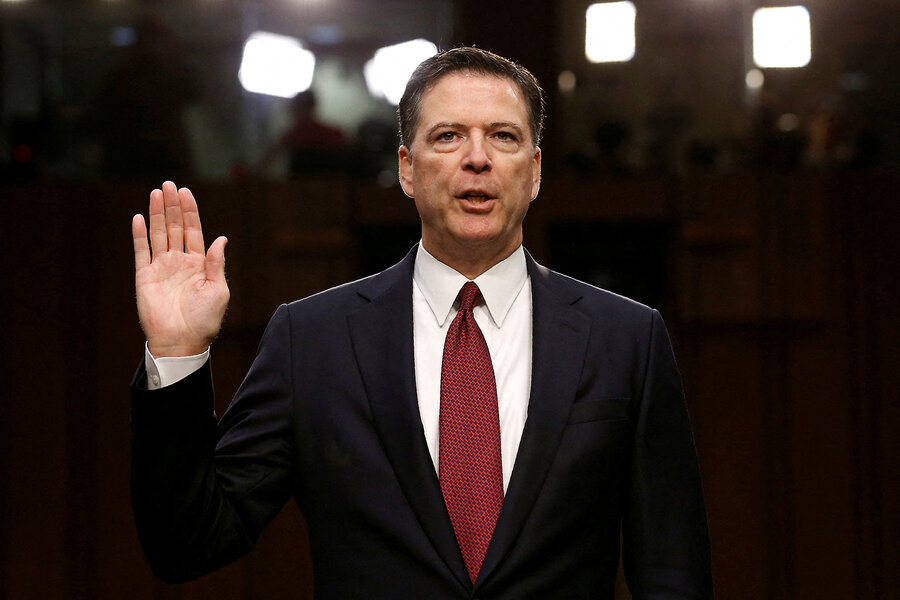
President Donald Trump personally called for the prosecution of former FBI Director James Comey, a political adversary since his first term in office. But after a flurry of courtroom events this week, the prosecution appears to be hanging by a thread.
The Trump administration has tested the boundaries of the U.S. justice system throughout his first year back in office – especially by trying to install loyalists in influential positions at the Justice Department, which has historically been expected to operate above political influence.
The Comey case is part of what critics describe as the co-opting of the DOJ for a campaign of legal retribution against his political opponents, including Mr. Comey and New York Attorney General Letitia James. Supporters back the president’s actions as rectifying the “lawfare” they claim the Biden administration and other Democrats pursued against Mr. Trump and his allies. The potential collapse of the case against Mr. Comey also intertwines with some long-running themes of the Justice Department in the first year of the new Trump term: the administration’s desire to install top federal prosecutors without U.S. Senate approval.
Why We Wrote This
A central theme of President Donald Trump’s return to office has been his call to prosecute his perceived political enemies. In one of the most high-profile efforts, against a former FBI director, a series of government missteps means the case might collapse.
The government charged Mr. Comey in September with one count of false statements and one count of obstruction of a congressional proceeding – both relating to testimony he gave to the Senate Judiciary Committee in 2020.
Mr. Comey has pleaded not guilty to both charges. But it appears the case might never see the inside of a courtroom anyway.
“Everything about the proceedings of the last week is unusual,” says Shane Stansbury, a former federal prosecutor in New York.
What are the concerns with the grand jury process?
There are several, but the most pressing one is that the federal prosecutor in charge of the case appears to have made a grievous procedural error in front of the grand jury.
Before any criminal charges can be brought against an individual, a prosecutor must secure an indictment from a grand jury. The confidential proceeding is meant to ensure that the government doesn’t improperly prosecute someone.

That process is one-sided. The grand jury only sees evidence and hears from witnesses called by the prosecutor. In the Comey case, however, it appears that the lead Justice Department prosecutor might have misled the grand jury.
That prosecutor is Lindsey Halligan, the interim U.S. Attorney for the Eastern District of Virginia. A former personal lawyer for Mr. Trump with no prosecutorial experience, the president handpicked her for the position after pressuring the former top prosecutor for that district, Erik Siebert, to resign – reportedly after Mr. Siebert questioned the strength of the case against Mr. Comey. The U.S. Attorney’s Office for the Eastern District of Virginia declined to comment for this story.
Days later, Ms. Halligan secured the indictment against Mr. Comey. But a whirlwind set of legal developments this week might sink the case.
On Monday, a magistrate judge in the district ordered the government to release the grand jury materials to Mr. Comey’s attorneys because of “a disturbing pattern of profound investigative missteps” from the Justice Department that “potentially undermine[s] the integrity of the grand jury proceeding.”
“The Court recognizes this is an extraordinary remedy,” added Judge William E. Fitzpatrick in his opinion. But “the prospect that government misconduct may have tainted the grand jury proceedings, [means the] disclosure of grand jury materials under these unique circumstances is necessary to fully protect the rights of the accused.”

U.S. District Court Judge Michael Nachmanoff stayed that order at the government’s request later that day, and scheduled a hearing, held on Wednesday. That hearing resulted in the admission from Ms. Halligan that she had never shown the final indictment to the full grand jury.
According to news reports, the jurors had rejected one count in a three-count indictment. Ms. Halligan then reportedly redrafted the indictment to leave out the rejected charge and showed it to one member of the grand jury and the panel’s foreperson, the latter of whom signed it. That is not, in and of itself, illegal. Federal law allows an indictment to be returned by the grand jury foreperson alone, according to Andrew McCarthy, a former assistant U.S. attorney writing in the National Review, especially when the indictment was returned at a late hour, as was the case with the Comey prosecution.
“I believe there are major problems with the Comey charges that should cause the indictment to be dismissed pretrial. I don’t believe that the unusual genesis of the two-count indictment document is one of them,” added Mr. McCarthy.
Jeffrey Cohen, a former federal prosecutor in Massachusetts, agrees that the details will determine “if this was a harmless error or not.” But the misstep has serious implications, he says.
“The important principle is that it’s the grand jury making the charging decisions, not the prosecutor,” he says.
“We don’t like the idea, nor should we like the idea, that prosecutors can just go around charging people. There needs to be a check on that power, and that check is the grand jury,” he adds.
Judge Nachmanoff on Wednesday said he would not immediately rule on the future of the case.
In a court filing submitted Thursday, Ms. Halligan called the grand jury matter a “clerical inconsistency” and submitted a transcript showing the foreperson said the grand jury had voted on the two-count indictment, according to The Associated Press.
Are there other issues with the case?
Another issue raised by Mr. Comey’s lawyers relates to his claim that the case should be dismissed because the prosecution is “vindictive and selective.”
“The government has singled out Mr. Comey for prosecution because of his protected speech and because of President Trump’s personal animus toward Mr. Comey,” a court filing argued.
Mr. Trump has shown substantial interest in the case. In September, he publicly criticized Mr. Siebert because he had not yet brought charges against Mr. Comey and Ms. James.

“I want him out,” the president told reporters on Sept. 19.
Three days later, Ms. Halligan was sworn in as the interim U.S. Attorney for the Eastern District of Virginia.
Does an “interim” attorney status matter?
The “interim” tag means neither Ms. Halligan’s appointment nor Mr. Siebert’s required Senate confirmation.
Whether you can have two “interim” U.S. attorneys consecutively is up for debate, and Mr. Comey is also arguing that his prosecution should be thrown out because Ms. Halligan was unlawfully appointed.
He is not the first person to make this argument. Across the country, defendants have been challenging their prosecutions because the cases were brought by federal prosecutors appointed on an interim or acting basis without Senate confirmation.
Judges in three states – Nevada, New Jersey, and California – have ruled that top federal prosecutors had been serving unlawfully.
In a hearing this month, a different federal judge appeared skeptical of the lawfulness of Ms. Halligan’s appointment. U.S. District Cameron McGowan Currie has said she hopes to issue a ruling by Thanksgiving.
It’s unclear what will happen first – a ruling on the grand jury issues from Judge Nachmanoff, or a ruling on the unlawful appointment question before Judge Currie – but there’s no question that the Justice Department’s prosecution of Mr. Comey is on thin ice.
Normally, a judge may give the DOJ the chance to go before the grand jury again. That might not be possible here, experts say. The statute of limitations for the charges against Mr. Comey passed on Sept. 30, eight days after Ms. Halligan’s appointment.
“It just seems like this was a rushed job. It doesn’t look like the government had the opportunity to be more deliberate,” says Professor Stansbury, who teaches at Duke Law School.