Described by the late Queen as her ‘annus horribilis’, 1992 saw the Royal Family suffer many tragedies – including the Great Fire of Windsor.
The blaze began in Queen Victoria‘s Private Chapel and spread from there, as Queen Elizabeth II and Prince Philip‘s planned wedding anniversary celebrations on November 20 went up in smoke.
It burned for 15 hours, with over 200 firefighters and one million gallons of water needed to put it out.
However, the first sign that something was wrong came from one of the castle’s picture specialists as the royal residence was undergoing extensive renovations at the time.
‘Can you smell burning?’ asked Charles Noble, when he returned to the Private Chapel after a coffee break, according to a royal book.
Just a couple of minutes later, chief picture restorer Viola Pemberton-Piggott looked up towards the curtains, ahead of the altar’s alcove and screamed: ‘Oh my God! Look! Fire!’
A number of artworks were stored in the Chapel on that fateful day, as alarm bells were sounded across Windsor Castle before fire trucks began arriving – but nobody realised the scale of what would quickly become a major world event.
By 11.45, the chapel had been utterly consumed by the blaze. Over the course of three hours, 225 firefighters from seven counties battled the 40ft flames tirelessly.
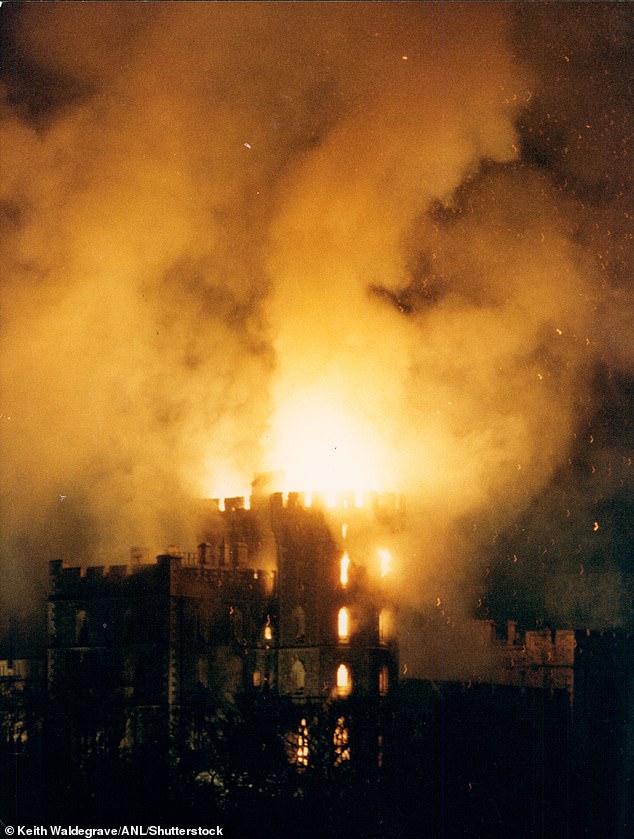
On November 20 1992, Charles Noble, one of the picture specialists, returned from a coffee break to Queen Victoria’s Private Chapel and asked the forewarning question: ‘Can you smell burning?. But it was too late – by 11.45 the chapel had been utterly consumed by the blaze
The 15-hour fire, which was not extinguished until 2.30 the following morning, caused damage to 115 rooms, including nine state rooms. St. George’s Hall, a gallery where banquets were held, had collapsed completely, taking with it the floors of Brunswick Tower.
The damage was so extensive that it would take five years to restore Windsor Castle to its earlier glory – at the eye-watering cost of £36.5million.
According to the Palace’s report on the fire, approximately 370 people helped to save items, including 125 castle employees and community members. The cause of the blaze was believed to have been a faulty spotlight.
Fortunately, only two works of art were lost in the blaze – a rosewood sideboard and a large painting by Sir William Beechey that couldn’t be taken down from the wall in time.
Writing in his book Power and the Palace, royal biographer Valentine Low detailed the extent of the damage to the royal residence, as well as the emotional impact the blaze had on the late Queen.
While Queen Elizabeth had been in London at the time the fire first broke out, she had quickly rushed to Windsor in a desperate bid ‘to see the damage for herself and to rescue what she could from her apartments,’ Mr Low wrote.
Poignant images showed the Queen – dressed in a headscarf, raincoat, and wellington boots – looking incredibly forlorn as she surveyed the damage to her beloved childhood home.
Formerly Prince, Andrew Mountbatten Windsor, who had been in Berkshire at the time and helped to organise the rescue operation, said his mother had been left ‘absolutely devastated’ by the fire.
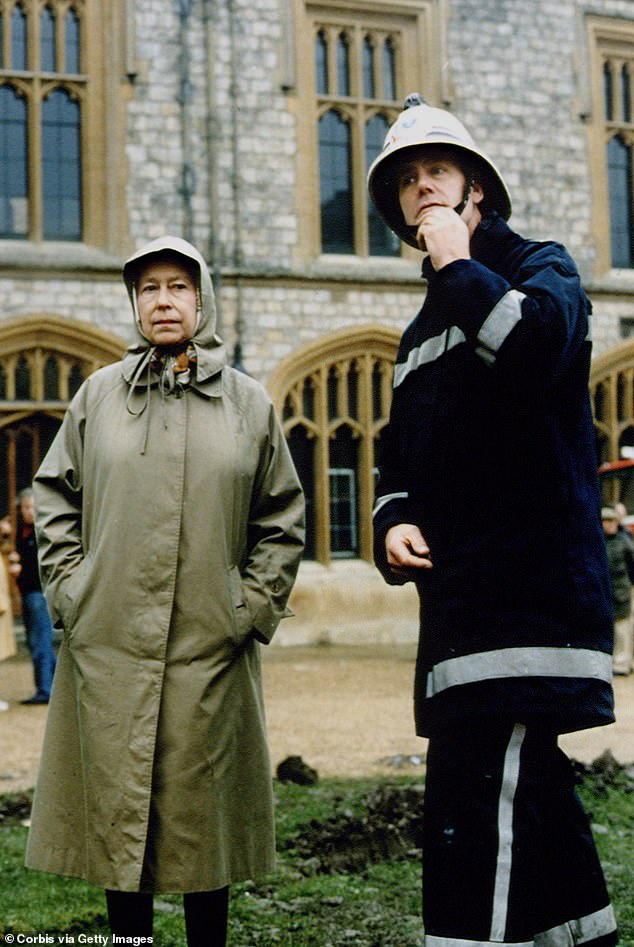
Poignant images showcased the late Monarch looking incredi bly forlorn an dressed in a headscarf, raincoat and wellington boots as she looked on anxiously at the horrific damage to her beloved childhood home
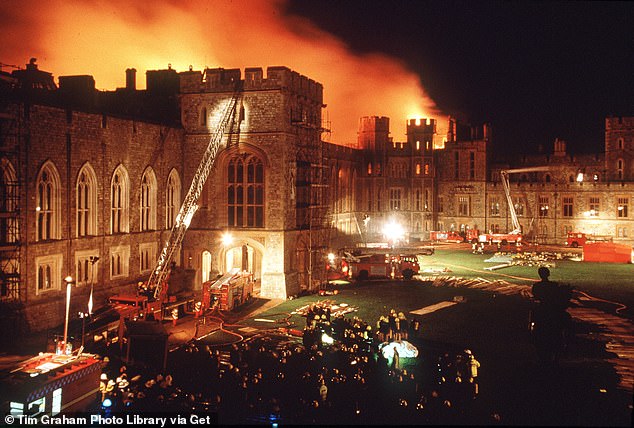
The 15-hour fire, which was not extinguished until 2.30 the following morning, caused damage to 115 rooms, including nine sate rooms. St. George’s Hall, a gallery where banquets were held, had collapsed completely, along with the floors of Brunswick Tower
When asked how the monarch reacted at the time, Buckingham Palace press officer Dickie Arbiter said: ‘Probably the same reaction as yours if you saw your home burning down. Very upset.’
After arriving at the Castle, the Queen and then-Prince Charles assessed the damage and supervised the removal of remaining items from the iconic royal home.
She was said to have been left so shocked by the scenes that she put her hand over her mouth, and Andrew – who has since been stripped of his title – told reporters at the time: ‘It’s horrific, dreadful, terrible.’
He added: ‘I was down there in the Mews doing research for the Staff College when I heard the alarm. I went straight up to see what I could do.’
Andrew assisted the rescue team with carrying several objects out of the chapel and described himself as part of a ‘human chain’, before adding: ‘I had hold of some really heavy pieces of furniture, passing it along.’
According to Mr Low, when the late Monarch returned to Buckingham Palace later that day, the staff ‘left their offices to greet her at her private entrance in a show of moral support’.
Such support was highly appreciated by Her Majesty, with her former press secretary, Charles Anson, describing the ordeal as ‘ghastly’.
The extent of the devastation was so great that shortly after, the Secretary of State for National Heritage, Peter Brooke, announced that public money would be used to fund the restoration – estimated at around £40 million.
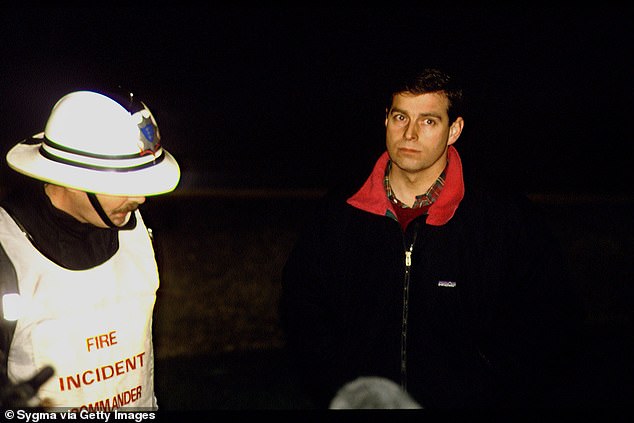
Andrew Mountbatten Windsor, who had been in Windsor at the time and helped to organise the rescue operation, described his mother’s anguish at the ghastly fire – adding that she had been left ‘absolutely devastated’
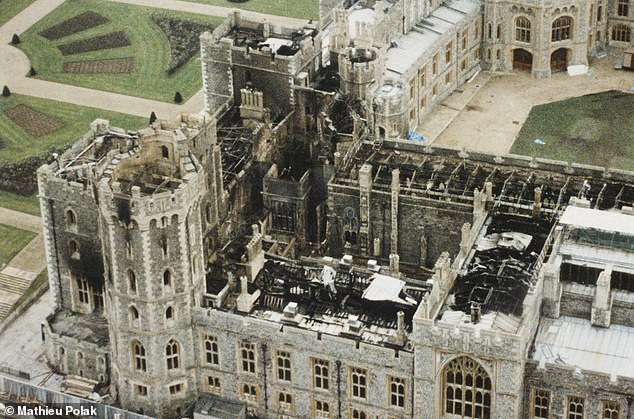
The extent of the devastation was so great that shortly after, the secretary of state for national heritage, Peter Brooke, announced that public money would be used to fund the restoration, estimated to be at a cost of around £40million. But, this sparked great public outrage
However, this sparked great public outrage, resulting in the repair costs being met by charging the public for entry to Windsor Castle and by opening Buckingham Palace for admission.
It marked a historic moment for the Royal Family, with the late Queen also agreeing to pay capital gains tax on her private investments and income tax on her Duchy of Lancaster money.
Yet the fire was, as Mr Low described, the ‘climax to a bad year’ and had followed an ‘unstinting chorus of criticism’ towards the Royal Family that had rocked the Monarchy to its very core.
In March, the former Duke and Duchess of York publicly announced their separation. Then, shortly after their high-profile split, intimate images of Sarah Ferguson and American businessman John Bryan were leaked – resulting in further criticism of the Royal Family.
During that year, Prince Charles and Princess Diana’s marriage was also publicly crumbling.
The so-called ‘War of the Waleses’ was in full swing. When the pair embarked on a four-day trip to South Korea in November, dubbed the ‘Togetherness Tour’, they could not have seemed more apart.
The facade of a happily married couple was near impossible for either Charles or Diana to maintain, with striking video footage capturing their looks of angst and sorrow, which later led to the press nicknaming the couple ‘The Glums’.
On December 9, former Prime Minister John Major announced in the House of Commons that the Prince and Princess of Wales were to separate.
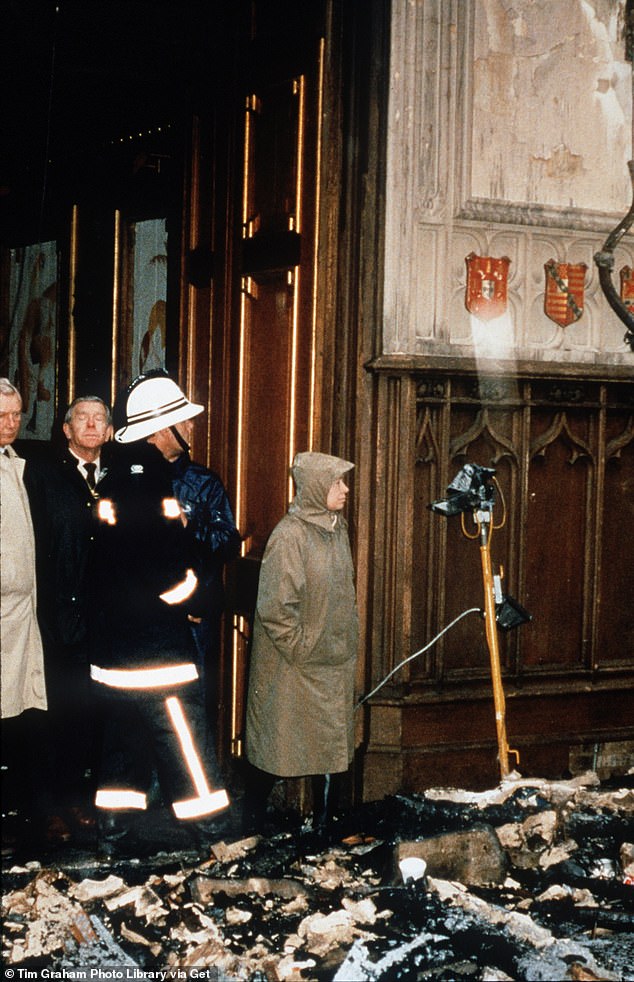
The repair costs were met by charging the public for entry to Windsor Castle and by opening Buckingham Palace for admission. The late Queen also agreed to pay capital gains tax on her private investments and income tax on her Duchy of Lancaster money
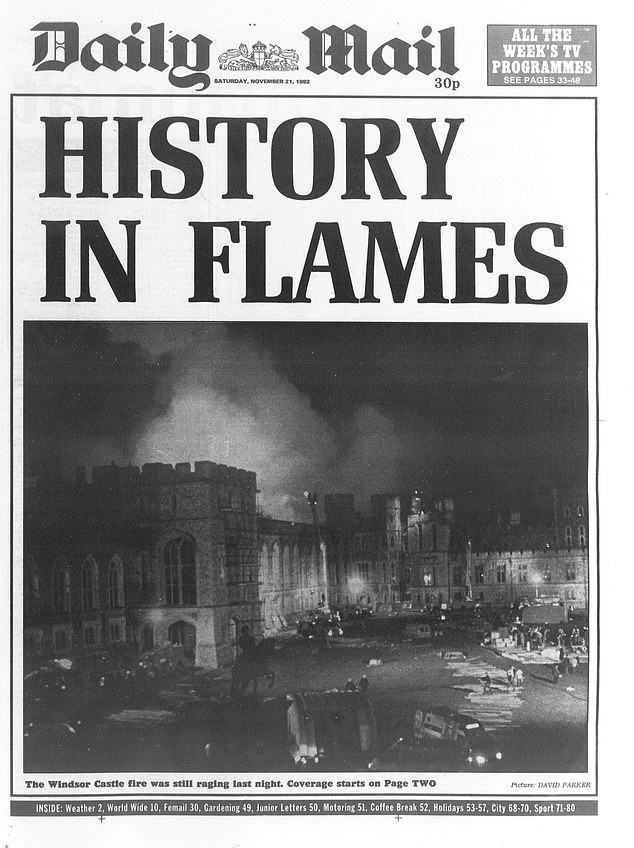
According to the Palace’s report on the fire, approximately 370 people helped to carry save items, including 125 castle employees and community members. The cause of the blaze was believed to have been a faulty spotlight. Pictured: the Daily Mail’s report on the fire at the time
‘It is announced from Buckingham Palace that, with regret, the Prince and Princess of Wales have decided to separate.
‘Their Royal Highnesses have no plans to divorce and their constitutional positions are unaffected. This decision has been reached amicably, and they will both continue to participate fully in the upbringing of their children,’ Mr Major said.
Diana’s personal fairytale that had captured the nation’s hearts had shattered before the world’s very eyes.
Yet it was not just Diana’s heart that had been broken. As her biographer Andrew Morton wrote in Diana: Her True Story, the entire Firm had suffered a ‘mortal blow’ following the events of 1992.
‘The symbolism of the fire at Windsor Castle was not lost on anyone inside the family,’ Diana was said to have told her friends.
Four days after the Windsor Castle fire, Queen Elizabeth II addressed a gathering in the City of London to mark 40 years of her reign.
Speaking with ‘her voice hoarse from a heavy cold as well as the smoke she had inhaled’, Her Majesty made abundantly clear her rather unfavourable view of the year.
Quoting the words of her former assistant private secretary, Sir Edward Ford, she said: ‘1992 is not a year on which I shall look back with undiluted pleasure.
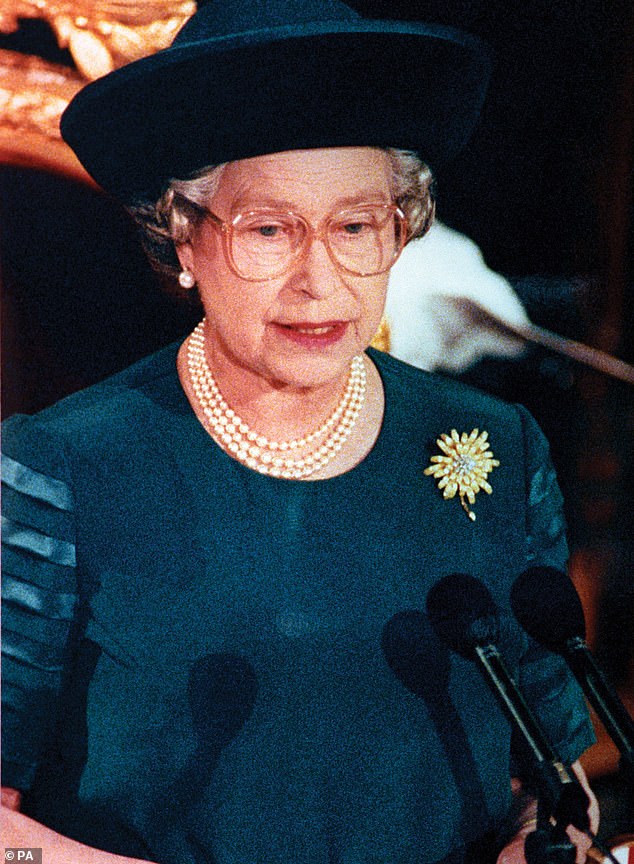
Four days after the Windsor Castle fire, the late Queen gave a speech held at a lunch in the City of London to mark her 40 years on the throne. Quoting the words of her former assistant private secretary Sir Edward Ford, she described 1992 as her ‘annus horribilis’
‘In the words of one of my more sympathetic correspondents, it has turned out to be an “annus horribilis”.’
She added: ‘I sometimes wonder how future generations will judge the events of this tumultuous year.
‘I dare say that history will take a slightly more moderate view than that of some contemporary commentators.
‘Distance is well-known to lend enchantment, even to the less attractive views. After all, it has the inestimable advantage of hindsight.’
The restoration of Windsor Castle was officially completed on November 20, 1997. Five years to the day since the blaze, it marked a particularly touching tribute for the late Queen and Prince Philip on their golden wedding anniversary.
The bravery displayed by first responders was commemorated by a new stained-glass window for the chapel, which shows a workman in a hard hat carrying out a painting and a firefighter surrounded by smoke dousing the flames.
In a ‘thank you’ reception hosted in the restored rooms on November 14, 1997 for over 1,500 contractors, the late Queen made clear her undeniable gratitude for all those involved.
Issuing an emotional speech, the monarch expressed her thanks to all those who had worked tirelessly to restore her beloved home.
‘It was the best anniversary present we could have wished for. I can’t begin to describe what it means to us to have Windsor back.’