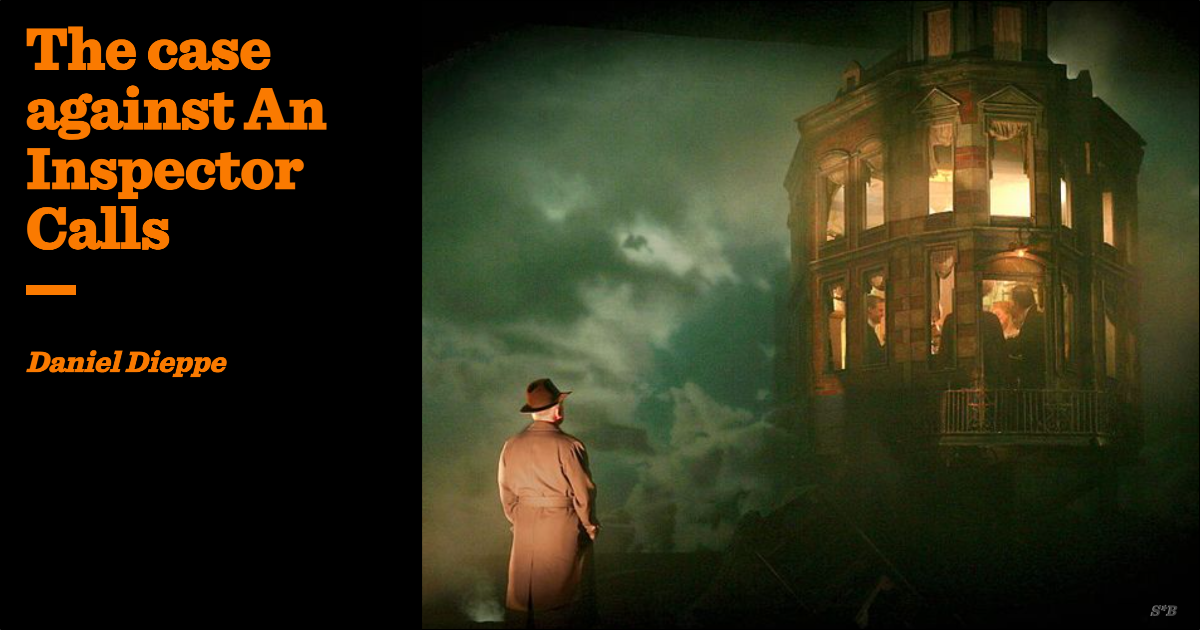
They say the soul of a nation is formed in the classroom — if so, we may well be in poor health. As a new Civitas report reveals today, by far the most popular text studied for English GCSE is An Inspector Calls, a 72-page play. In 2024, over 80 per cent of GCSE English literature students studied J.B Priestley’s short play, likely making it the most read book amongst teenagers. In uptake for GCSE, An Inspector Calls easily surpasses Great Expectations (studied by just 0.4 per cent), War of the Worlds (0.2 per cent), Frankenstein (2 per cent) and any Shakespeare play.
It is not hard to guess why Heads of English choose An Inspector Calls. At just 72 pages, it’s not much longer than a pamphlet, and took BBC radio just 87 minutes to read. My own GCSE English class dropped Lord of the Flies in favour of An Inspector Calls for this very reason, despite us being top set boys.
And the problem with An Inspector Calls is more than just its brevity. Contextually, linguistically and conceptually, it is a very simple play. First performed in the Soviet Union in 1945 with the aim of promoting socialism, it depicts a bourgeois, capitalist British family disrupted by an Inspector over the suicide of a young woman who, the play reveals, had a connection to each family member. In a simple and predictable plot, each character represents a contemporary political issue — gender, age, class. The Inspector, meanwhile, represents the socialist ideal and moral judgment. Each character fits his mold perfectly.
By contrast, alternative 20th Century British texts develop nuanced and enduring ideas. For example, through his depiction of what might happen when a few dozen preadolescent boys become stranded on an island, William Golding’s Lord of the Flies explores good and evil, civilisation and chaos, human nature and authority, leadership and fear. What could be more compelling — or terrifying — for teenagers to read? Yet, at most, 5 per cent of students study Golding’s bestseller.
One has to ask, therefore, whether An Inspector Calls is really the most enriching book for 80 per cent of teenagers? Or, is it just the one most likely to get them an exam grade? George Orwell, Aldous Huxley, Tolkien, C.S. Lewis, Virginia Woolf, John Buchan, Rudyard Kipling, and Richard Adams are all competing 20th Century British authors with timeless and teachable books. But they are all largely ignored.
In the short term, choosing simple texts may boost exam grades, but it has spectacularly poor returns over time. In the past ten years the number of A-level English students plummeted, partly because the curriculum is “boring”. Extraordinarily, universities complain they have to teach English literature undergraduates how to read long novels.
Today, just 12 per cent of young teenage boys read for fun and nearly half of 18-24-year-olds have not read a single book in the past year. An Inspector Calls is hardly the book to inspire many phone-addicted teenagers to see the value in reading.
What is perhaps most regrettable about the dominance of An Inspector Calls is the questions children answer about it. Over the past few years, GCSE students have been asked:
-
How does Priestley present what life is like for women in An Inspector Calls?
-
In what ways is mystery significant in the play?
-
Explore the importance of the younger generation in An Inspector Calls.
None of these topics are particularly inspiring, memorable, or testament to Priestley’s work. Instead, they divulge a hollow truth about the popularity of An Inspector Calls, that it well exemplifies the technical skills-driven GCSE English Literature course.
Young people should be reading Great Books and wrestling with life’s perennial questions, like who are we? Where have we come from? And what are we for? They should be joining what the philosopher, Michael Oakeshott, called the “conversation of mankind”. Instead they spend their time analysing literary techniques in the shortest possible books.
Anything less than the greatest texts diminish children and the soul of the nation they’re joining
This thin gruel could not be further from the classical liberal ideal. As described in Civitas’ latest report, Renewing Classical Liberal Education not only emphasises the great books, but the asking of humane questions about them. Rather than technical questions that disproportionately rely on ‘PEE’ (Point, Evidence, Explanation) responses, children should engage with questions like these:
Which heroes — Orestes, Oedipus, or Aeneas — show the most fortitude? Articulate the most beautiful passage we’ve read this year and what effect it has had on you. Compare/contrast the theme of truth and honesty in two of the novels read this year.
A renewal of classical liberal education is the best route to ensuring children encounter and contend with the most meaningful texts and ideas. Exam reform will be needed. However, parents and teachers must also expect more than just grades at GCSE. Anything less than the greatest texts diminish children and the soul of the nation they’re joining. English Literature has so much more to offer than the literary techniques in An Inspector Calls.