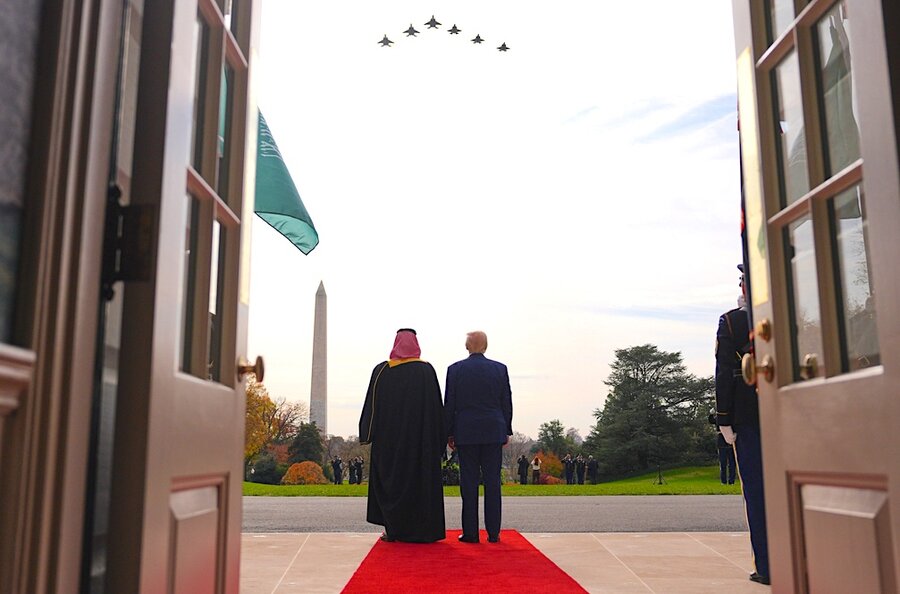
During a visit to the United States this week, Saudi Arabia’s Crown Prince Mohammed bin Salman achieved much of what he sought, mainly access to advanced American fighter jets and microchips and “major ally” status with the U.S. He also received a reputational redemption of sorts, when President Donald Trump dismissed questions about the prince’s suspected involvement in the murder of a Saudi journalist.
And thanks to diplomacy by Saudi Arabia, along with Qatar and the United Arab Emirates, Mr. Trump also got something he wanted (and needed): approval from the U.N. Security Council for his Gaza peace plan.
Soft-power persuasion by these Arab states helped avert potential vetoes by China and Russia. It underscored the value of keeping doors open to even potential foes – and to the institutions that maintain multilateral relationships.
The Gulf States are playing a growing role in many global standoffs and bring unique perspectives to international mediation. According to former U.N. Mideast peace envoy Nickolay Mladenov, they approach conflict resolution as “not a singular event but a process that requires nurturing understanding, cooperation, and interdependence among former adversaries.”
Both culturally ingrained and politically strategic, this standpoint fosters “enduring relationships … and careful building of trust and rapport,” he wrote last year.
Such interactions are based on pillars of respect and consensus, and on not publicly maligning any party. Perhaps more than public pressure or quick deals, values such as these might prove better adapted to the complex military and trade wars of today. In recent years, Qatar mediated a 2020 deal between the U.S. and Afghanistan; Oman played bridge-builder between the U.S. and Iran; and the UAE facilitated a prisoner exchange between Russia and Ukraine.
Even with its avowed “America First” stance, the Trump administration recognizes the value that a multilateral approach provides. Mike Waltz, the U.S. ambassador to the United Nations, acknowledged Arab allies’ “absolutely indispensable” support. These countries supported the U.S. seeking a mandate from the U.N. to implement key steps for Gaza – especially setting up a governing Board of Peace and a stabilization force, with troops expected from some Arab and Muslim-majority countries.
“The Gulf states are uniquely positioned to support these efforts due to their foreign policies of balancing relations between hostile regional and global powers [and] their close ties with Washington,” the International Centre for Dialogue Initiatives observed. The fact that they have the money to pay for peacetime reconstruction in Gaza helps, too.
In addition to underscoring the importance of patience and persistence, the Gulf States take an approach that also offers a less obvious lesson – the “quiet” in “quiet diplomacy.” According to Mr. Mladenov, an emphasis on “dignified discussion” and confidentiality has proved “particularly effective in resolving disputes that might otherwise escalate under the harsh spotlight of social media polarization and global attention.”