You are what you eat – and how you eat it is a reflection of yourself.
‘Tis officially the season to eat and drink until your heart’s content, and to brush up on your manners while you’re at it, according to an etiquette expert.
While research has found that most of Gen Z think that many common rules of conduct have fallen by the wayside, an etiquette expert says that good old fashioned manners are going nowhere and urges everyone to learn them.
Renowned etiquette coach Myka Meier told the Daily Mail there are a myriad of rules that come with socializing, sharing the little known – and commonly forgotten – ones with the Daily Mail.
‘Dining manners say a lot about you, especially as a guest, and they are very easy to learn,’ she said.
Meier, who runs one of the leading etiquette and protocol schools in the world, Beaumont Etiquette, said it’s important to remember that table manners exist not just for ourselves, but everyone at the table.
‘The way we act, speak, and treat others during a meal creates a dining atmosphere of respect that helps everyone relax and enjoy the experience,’ she said.
‘Good dining manners are not just for formal occasions or dinner parties but should be used every day and will set you apart.’

Renowned etiquette expert Myka Meier shared the little known – and commonly forgotten – rules of dining with the Daily Mail (stock image)
Passing the salt and pepper together
Meier said to always pass the seasonings together – even if someone only asks for one of them.
‘Passing them as a pair prevents the table from becoming lopsided with condiments scattered everywhere,’ she advised.
She added it’s also a good way to keep the meal flowing at the table.
‘If someone asks for salt or pepper they are easy to locate without stopping the table’s conversation to find one or the other,’ Meier pointed out.
Pause your eating when someone is speaking
The etiquette expert said to always pause what you’re doing at the table to show attentiveness to whomever is talking.
‘Putting your fork down signals that the person has your full attention, which makes conversations feel more thoughtful and respectful,’ she advised.
Meier said this is especially key if someone is making a toast or saying something important.
‘It also helps create a calmer, slower and a bit more connected dining atmosphere which is something I think people really appreciate during the holidays,’ the expert added.

Meier said to pause what you’re doing at the table when someone is speaking, adding especially important if someone is making a toast (stock image)
Tear bread into small bites
Enjoying some bread at the table is one of life’s simpler pleasures – and Meier said to tear the smaller pieces of bread up before eating, rather than biting directly into it.
‘Smaller pieces are simply easier and neater to eat,’ she explained.
The expert added that eating it this way also prevents other social mishaps.
‘It prevents crumbs, messy moments and taking large bites that prevent you from easily speaking due to the amount of chewing large pieces of bread take,’ she said.
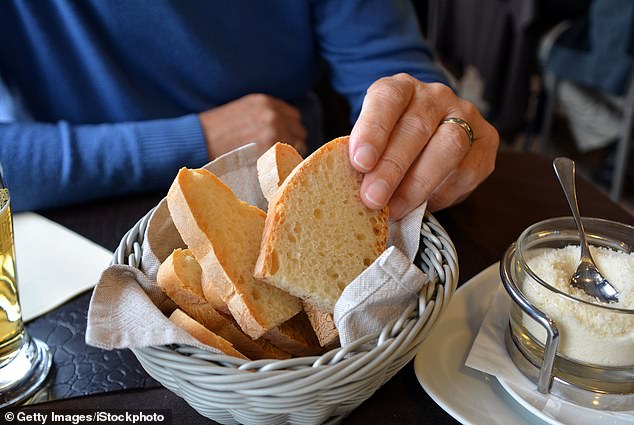
Meier said it’s polite to tear bread into smaller pieces before eating, rather than biting directly into it (stock image)
Always offer food and slow your speed
If there is only one of something left, always offer it to those around you before taking it.
‘If they decline, you’re welcome to enjoy it,’ Meier said. ‘But the simple common courtesy of offering to others first shows selflessness and awareness of others.’
She said that little gestures like that help create a table that feels considerate.
Meier also pointed out that many people also tend to eat much faster than is considered healthy or gracious, urging everyone to slow down.
‘When we rush, things tend to get messy, and it can make others feel pressured to hurry through their meal,’ she pointed out.
‘Pacing yourself so you finish around the same time as the table creates a more relaxed, welcoming experience for everyone.’

If there is only one of something left, always offer it to those to your left and right before taking it, Meier said (stock image)
Holding silverware correctly
One of the common mistakes Meier she often people incorrectly holding cutlery.
However, the expert noted it’s one of the easiest problems to fix.
‘It can be one of the most jarring things to watch at a table and you can learn how to fix it in moments,’ she said.
There are two way to hold silverware, American and Continental.
The American method entails holding the fork in your left hand and the knife in your right, but switching to your dominant hand after cutting the food.
For Continental style, hold the knife in your dominant hand and the fork in your non-dominant hand, keeping them in these hands throughout the meal.