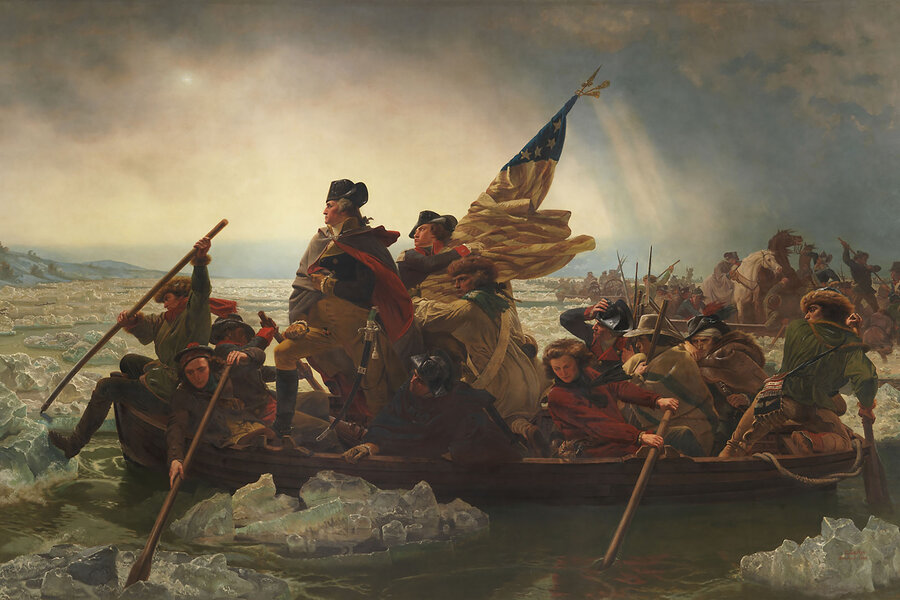
If nothing else, it is ironic to watch Ken Burns’ new documentary, “The American Revolution,” in light of recent political upheaval and historical narratives. There have been tireless declarations that “violence is not the answer” and questions about the moral fiber of protests stemming from tariffs and laws that some believe to be unjust.
It is a reminder, as Burns noted on a recent episode of the MeidasTouch podcast with host and lawyer Ben Meiselas, that the events of July 4, 1776, were world-changing.
“Everybody up to that point had been under authoritarian rule, had been a subject. It was in the interests of their rulers that they be uneducated, that they be superstitious, that they be distracted by conspiracies. And then suddenly you had something new,” Burns said. “And they were creating a new thing: citizens. And the pursuit of happiness for them, uniformly, was not the pursuit of objects in a marketplace of things, but lifelong learning in a marketplace of ideas.
Why We Wrote This
Ahead of the country’s 250th anniversary, iconic documentarian Ken Burns centers the “world-changing” events of July 4, 1776, in his latest project, “The American Revolution.”
“And that virtue would allow you to enjoy and be able to have the active idea of citizenship,” he continued. “This is brand new in the world.”
Burns, along with co-producers and co-directors Sarah Botstein and David Schmidt, believe viewers are ready to engage in this intellectual pursuit. The first few minutes of a two-hour episode aptly named “In Order to Be Free” open with a figurative spark – Thomas Paine’s quote about America’s revolutionary flame, having “arisen not to be extinguished.” The episode quickly follows with the inspiration for America’s interpretation of democracy – the Haudenosaunee (Iroquois) Confederacy, a blueprint for governmental representation – and a plot twist: diversity, equity, and inclusion.
It’s a theme that persists not just because of the subject matter, but because of Burns’ reputation and commitment to telling the story through an unbiased lens – the gaze of history. Viewers might be amazed at the demographics of the 13 colonies, which included free and enslaved Africans, along with Native American nations and European immigrants. Their freedoms, if they had any at all, varied as much as their nationalities.
Wherever you land on the political spectrum, the Burns standard seemingly resonates in this moment. What some may describe as slow and painstakingly meticulous also presents as attention to detail that doesn’t want to leave anyone out. Some 35 years after he made a name for himself with “The Civil War,” a man also known for his baseball documentaries has a profound pitch – providing lesser-known stories and narratives to allow viewers to make decisions for themselves.

Massachusetts Historical Society/PBS
What results is the type of stuff that not only lands with history buffs. A historian and friend of mine was geeked to watch the first episode at 8 p.m. on Sunday evening, as was I. Sitting down to watch it meant that my oldest boy’s Ninja Turtles viewing session came to an end. I was pleasantly surprised 15 or 20 minutes later with his dose of remarkable honesty: “I didn’t like the words as much, but I really liked all of the action.”
The action is certainly part of the tale. Where Burns has previously relied on photography to tell stories, the lack of pictures led to a need for reenactments, voices by actors including Meryl Streep, Tom Hanks, Laura Linney, Damian Lewis, and Edward Norton. The six-part series, airing every night this week on PBS, is sprawling at times, but it is also definitive, from the gunfire to the maps to the stone-faced historians.
Historians always figure prominently in Burns’ work. Those lending their scholarship to “The American Revolution” include Rick Atkinson, Maya Jasanoff, Annette Gordon-Reed, Nathaniel Philbrick, and Christopher Brown.
While their time on screen may be modest, their words are soul-stirring. Narrator Peter Coyote, a frequent Burns collaborator, provides a contrast of freedoms describing Charleston under siege: “In Charleston, South Carolina, white anti-Stamp Act protesters marched through the streets, chanting ‘Liberty!’ But when enslaved South Carolinians echoed their cries, frightened enslavers called out the militia to patrol the streets.”
“Part of our revolution, I think we have largely sanitized,” adds writer and Pulitzer Prize-winner Stacy Schiff. “We’ve forgotten much of the street warfare, of the anarchy, of the provocations that took place.”
While the documentary reminds us of America’s past violence, it also lays out the sobering cost of war. Beyond oppressive policy, it’s the bloodshed that drives the American Revolution. A preview of the documentary in its entirety links the 18th-century conflict and its human costs to the national and international revolts that would follow.
“To believe in America is to believe in possibility,” declares the trailer. But it is worth noting, as Burns and his cohorts do in this documentary, that such lofty ideals carry the heavy weight of history and humanity.