This week I’m in the public gallery at an employment tribunal in Belfast — that of Sara Morrison who used to work at Belfast Film Festival. Morrison is yet another gender heretic — in trouble for claiming people can’t change sex, and that in the real world, sometimes it matters what sex you are.
It is frustrating that legal action like Morrison’s is still needed, three years after Maya Forstater ensured gender critical views are legally protected and nearly eight months after the Supreme Court confirmed what we all already knew, that sex means, and has always meant, biological sex in the Equality Act.
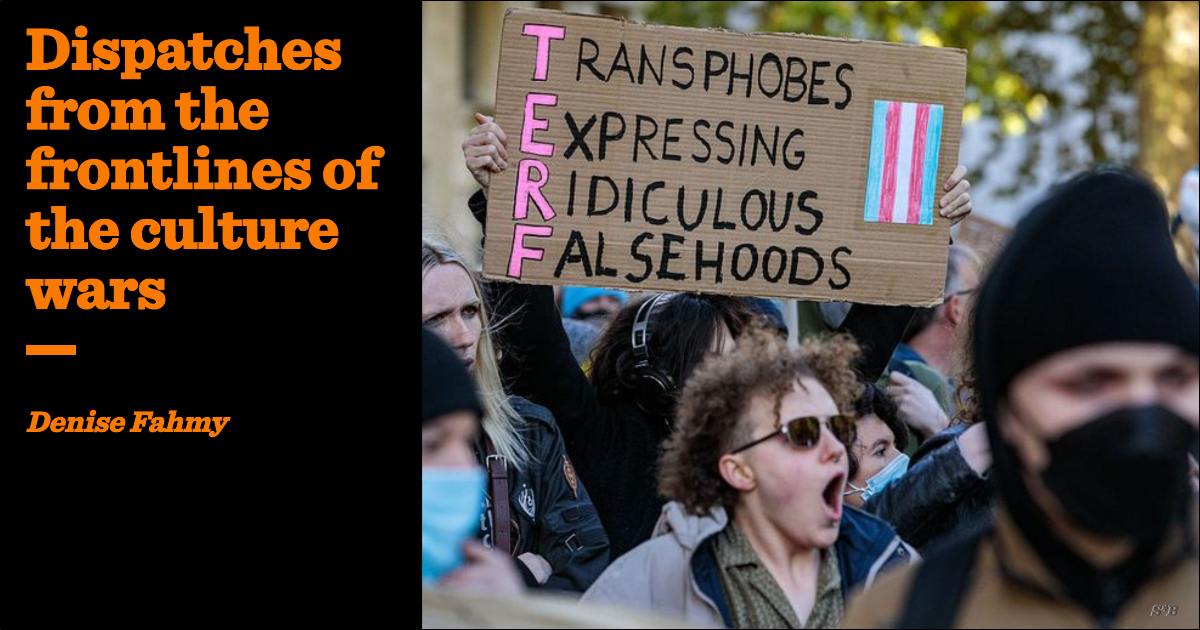
Morrison’s case is interesting, in part because it will test, for the first time, how Northern Ireland’s equality legislation treats gender critical beliefs. But it is also because Morrison is unusual in having been reported to have received financial backing in her legal fight from JK Rowling. It occurred to me, with some satisfaction, that we are seeing the economic fruits of cultural practice, directly deployed in culture wars combat — a fact not missed by protesters outside Bristol Waterstones this weekend, begging shoppers not to buy Rowling’s books.
The term “culture wars” is routinely used to downplay the ethical disputes of our day to day lives, as if citizens’ material reality is somehow irrelevant to the parliamentary playground. But for me, deeply embedded in the arts, a place where contentious ideas are hard currency, it comes as no surprise the creative industries are the Culture Wars’ ground zero.
Cultural power is not benign; it shapes hearts and minds. It is frequently funded by taxpayers, but lacks democratic accountability. Whilst flirtation with political philosophy in the cultural sector can be insightful, even groundbreaking, who’s to stop its influence when it’s just plain bonkers or drifts into discrimination?
In August my organisation, Freedom in the Arts (FITA), instructed our solicitors to request the withdrawal of guidance by Leicester University that had been published in September 2023.
Before getting into the weeds of our legal action, let me first explain Leicester University is the leading academy in the UK museums world. As the first university teaching Museums Studies back in 1966, many museums’ curators were trained at Leicester. The thriving Research Centre for Museums and Galleries is close to the heart of many museum professionals and closer still to the Museums Association, which represents over 11,000 individual members and 1,800 museums. In other words, Leicester is respected, grounded in museum practice and highly influential, in this country and internationally.
That said, FITA objected to “Trans Inclusive Culture: Guidance for Museum, Galleries and Archives” because we maintained that it promotes unlawful conduct. In our view, the Leicester Guidance misstates UK equality law and encourages discrimination against gender critical staff, volunteers and visitors. For example, the Guidance encourages museums to implement policies of allowing anyone to use the toilets of their choice. This, in our opinion, contravenes the Health and Safety at Work Act, and may lead to behaviour which in reality, constitutes criminal offences and discriminates against women and girls.
When the Guidance was originally published back in 2023, I raised concerns about its lawfulness. Only a couple of weeks later, I was shocked by the treatment of Sex Matters staff, Maya Forstater and Helen Joyce at the People’s History Museum in Manchester. In June 2023, they had to publicly threaten legal action against the museum to honour their room booking hosting their AGM. Then in September, following the publication of Leicester’s Guidance, Joyce and Forstater were terrifyingly jostled and heckled by activists when they left the museum, after their second event booking.
This ugly episode is unsurprising, given Leicester’s Guidance to museums portrays those with gender critical views as potentially dangerous and harmful people.
This year, there is good reason to demand that Leicester remove its Guidance. In May, despite the Supreme Court ruling, Leicester announced an expansion of Trans Inclusive Culture, establishing a network with eight museums across the UK including Museum Wales, National Museums Liverpool and National Museums NI, and somewhat bizarrely the Royal Air Force Museum.
Following this expansion, FITA wrote to Leicester requesting our inclusion in the partnership, so that a gender critical perspective and advocacy for freedom of expression were represented. Our request was politely declined. We then issued a formal legal letter, listing our concerns about the lawfulness of the Guidance, and in September Leicester explicitly rejected each of our points.
You can read the legal back and forward on our website. It’s instructive, if you like that kind of thing.
With Leicester’s refusal to accept the Guidance was unlawful, we decided to apply to the High Court for permission to go to Judicial Review, to see the Guidance withdrawn. We checked the Guidance, one last time before, making our submission, and lo! It had been surreptitiously changed in 30 places! Each change introduced caveats, directly advising any organisation using the Guidance to take their own legal advice. Despite the University disagreeing with FITA’s initial challenge, all the changes made related to specific issues we had raised back in August. Has Leicester now accepted that its original Guidance was unlawful?
You would think that this apparent climbdown would be embarrassing enough for a highly respected academic department. Not so Leicester’s Museums Department who presented their newly revised Guidance, whilst failing to mention it had been revised following legal threats, to enthusiastic museums apparatchiks at the Museums Association conference in early October.
Despite Leicester’s hasty and humiliating fudge, the “October” Guidance continues to contain what we see as a litany of legal errors. So, FITA’s solicitors have once again sent the university a legal letter continuing to demand the Guidance’s withdrawal.
Why are we so exercised about some dodgy academic Guidance? Because culture is soft power. It changes society, insidiously influences debate and reaches into our lives, uninvited. What’s more this Guidance is having an impact on the sector. Consider some of this year’s exhibitions and events — Bristol Museum’s summer show saw the foyer adorned with giant murals of women with mastectomy scars and a central exhibition the museum advised was not appropriate for under 14 year olds. As summer shows are museums’ economic equivalent of theatres’ panto, programming a show inaccessible to families during the school hols is public sector activism in action. This spring, Manchester Art Gallery was dishing out free chest binders to young girls who’d have been better off pondering the casual misogyny of the gallery’s excellent Pre- Raphaelite collection that afternoon, than indulging dangerous “health” practices pushed by activist museum professionals.
FITA’s challenge to Leicester is about more than one piece of guidance. It’s about ensuring that cultural institutions act within the law and uphold genuine equality and freedom of thought. We may be winning the “Gender Wars”, case by case, but whilst the arts are beholden to unaccountable influential players, promoting legally illiterate social “policies” that lack public support, FITA will continue to pursue legal redress until the principle of freedom of expression is restored across the arts.